The Chronicle of Epic Words
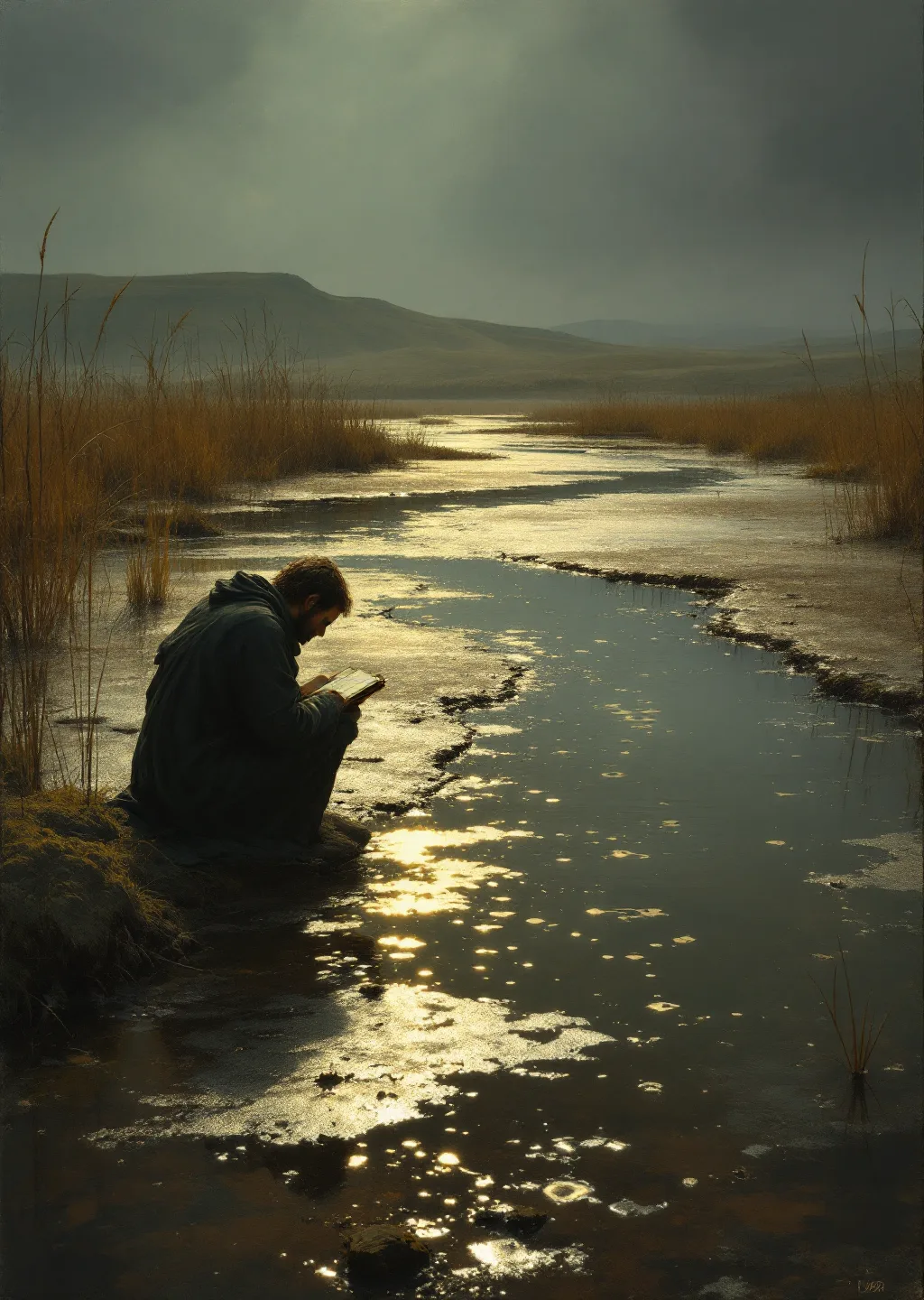
The Glossary Mire
Where the river writes a word into the bank and the bank never quite agrees to keep it.
At a glance
- Kingdom X (The Lexicon Forge)
There is a country where the river meets the land and neither is quite sure which is which, and in the Lexicon Forge they call it the Glossary Mire. It is not a place anyone chose to build near. It is a place that accumulated — silt over silt, season over season — until it became worth walking down to, because things wash up in a mire that would sink anywhere else, and some of the things that wash up here are words.
That is the mire's whole strange trade. Where a river slows and spreads, it drops what it carries; and this river, somewhere upstream of anything the Glossary-Keeper has managed to catalogue, carries writing. Not paper — paper doesn't last a mile of current. It carries marks: letter-forms pressed into stone and clay, boundary-inscriptions, surveyors' notes, the pressed word left when someone once stood on a firmer bank than the one that's there now. The silt takes an impression the way soft wax takes a seal, and holds it just long enough for the next flood to argue with it. Read the mire on a dry week and you can find a whole word laid out in the bank; come back after rain and the second letter has gone to water, and you're left guessing at a gap the way you'd guess at a name half-remembered.
It is exactly the sort of ground that rewards a certain kind of patient reader and punishes everyone else. The Glossary-Keeper knows this, which is why she catalogues the barrow and lets the mire keep its own hours. Someone else did not know it, or knew it and came anyway — because when you arrive, the mire already has a visitor.
You'll find the visiting scholar crouched at the silt-line, cataloguing an inscription with the easy patience of a man who has decided in advance what it means. He is warm about it. He is specific. He is already using your name before you've offered it, and he explains the marks pressed into the bank the way you'd explain something long settled — a surveyor's boundary, a decorative habit, a curiosity from a time before any of it meant much. It is a persuasive account. It is also, in three quiet places, wrong, and the mire is the sort of witness that won't correct him. You'd have to already know what to look for.
The inscription he's bent over is a case in point. A word pressed into the silt where a river meets the land: five letters, the second one long since dissolved. What survives reads as an instruction to take what lies adjacent and add it to what already exists — the plain sense of a boundary marker, except that surveyors mark property with numbers, not words. Whoever pressed this was marking a boundary of a different kind. What was annexed, and to what, the mire does not say. It rarely does. It holds the word for a season and then, with the next flood, lets the river reconsider.
That is the temper of the place, and it's worth carrying back up the ridge with you. The Worn Index keeps its records in careful hands across three generations; the mire keeps its records in mud and moving water, and forgets them on schedule. Between the two — the archive that holds too tightly and the mire that won't hold at all — sits most of what the Lexicon Forge is trying to teach you. Some words were separated on purpose, not lost by accident. The mire is where you first feel the difference, standing over a gap in a five-letter word, wondering who took the missing letter and where the river carried it.
Where you'll find it
The Glossary Mire lies a short walk downslope from the Worn Index, at the foot of Lexicon Ridge in Kingdom X (The Lexicon Forge). You'll be sent here if you ask Geva the Glossary-Keeper about the visiting scholar she's been trading letters with — she'll point you down to the silt-flats where he's been cataloguing inscriptions. Follow the water and watch the ground: this is the kind of place where the path is one bad step from becoming the river, and half the words underfoot are pressed into mud that will swallow them again by spring.