
Deep under the mountain, where the water goes black and the light gives up, a hobbit sat across from a pale creature with very large eyes.
"We plays a game," the creature said. "A guessing game. If it wins, it goes free. If it loses..." and here it smiled, which was worse than if it hadn't, "we eats it."
The hobbit had been in the dark a long time and had grown careful.
"A word game," he said. "We each think of a secret word. We each try to guess the other's. Green for a letter in the right place, yellow for a letter in the wrong place. Six guesses."
"Yesss," said the creature. "And equal, both equal, or it isn't fair."
"Not equal," said the hobbit. "I'll give you the advantage. You take a four-letter word: short, easy, half the letters to worry about. I'll take a five. And whoever finds their word in fewer guesses walks out of here."
The creature turned this over. Four letters. Four little letters against five. It had counted on the hobbit trying to cheat it, and here he was handing it the shorter word, the easier word, the word with fewer places to hide.
"It is generous," the creature said suspiciously.
"I am," the hobbit agreed.
He walked out an hour later.
The trick
The hobbit didn't lie. He just knew something the creature didn't: a four-letter Wordle is harder than a five-letter one. Not marginally. He gave away the shorter word precisely because the shorter word is the trap.
I wanted to know how far that goes, so I built the other four games (4, 6, 7 and 8 letters) and played every one of them to completion. Every possible answer, every length, all the way down. That's 13,074 games. Here's what the dark under the mountain actually looks like.
First, the part everybody gets wrong
You cannot do this with a dictionary. This is where most "what if Wordle had N letters" arguments fall apart before they start.
Wordle does not pick its answer from every legal five-letter word. There are about 9,500 of those, and if TSADE or AALII could be the answer, nobody would play twice. Wordle picks from a hand-curated list of roughly 2,300 words a normal person actually knows. The big list is only there so your guesses are accepted. (If you've ever wondered which words those are, I went through the most common 5-letter words separately.)
That curation does more than set the difficulty. It rewrites the letter frequencies of English. I counted every letter in all 2,343 Wordle answers for Why Does Wordle Hate the Letter N?, and the answer list turns out to snub N and I badly while running Z about five times hot. Same cause as everything in this piece: the moment you hand-pick the answers, you stop playing against English and start playing against somebody's list.
So the real question isn't "how many 4-letter words are there." It's "how many 4-letter words would a game designer let be the answer." That number is the whole ballgame, and getting it wrong invalidates everything downstream.
I started from a public list of every English word (a little over 200,000 of them, the compilation usually attributed to Oxford and Webster) and cross-referenced it against word-frequency usage tables to pull out the words people actually use. Those became the answer pool; the full 200,000 stayed on as the list of guesses the game would accept.
Then, before trusting any of it, I checked that pool against the two lengths where somebody has already done this curation by hand:
- At five letters it produces 2,308 words. Wordle's real answer list has 2,343.
- At six letters it produces 3,059 words. Our own game Pairdle uses a hand-built pool of 3,038 six-letter solutions.
And it isn't just the totals. 3,037 of Pairdle's 3,038 solution words, 99.97%, are on that common list. Two answer pools, built by different people years apart, land in the same place. That's what makes it safe to extend the same rule out to 4, 7 and 8 letters.
Do that, and the first surprise arrives before a single game is played.
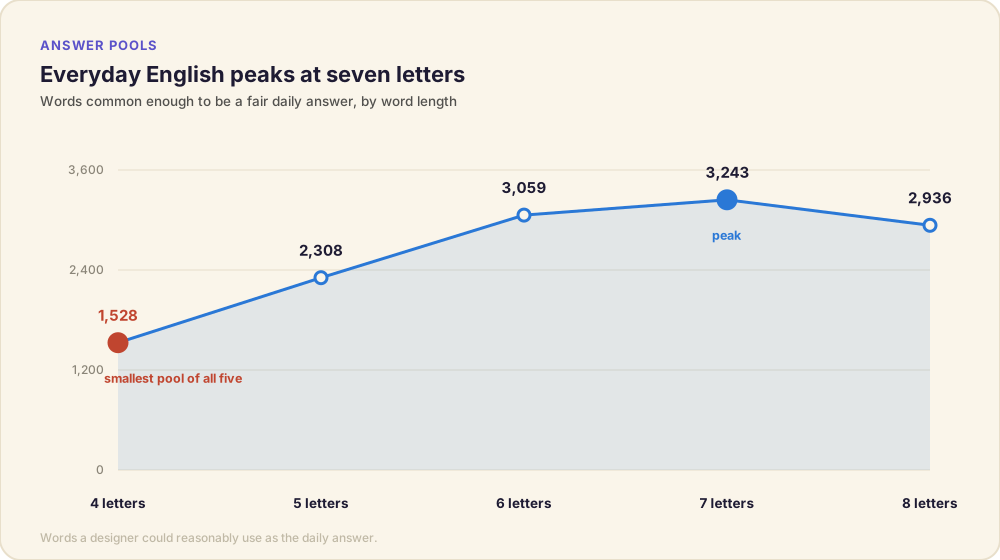
Everyday English peaks at seven letters. And the four-letter game has the smallest answer pool of all five, fewer than half the seven-letter game.
Fewer possible answers. That should make it easier. Hold that thought.
How I played the games
I wrote a solver meant to imitate a good human, not a supercomputer. It opens with a fixed word, and after that it plays any word still consistent with every clue on the board, breaking ties toward common letters in common positions. No entropy math, no lookup tables, just the thing you do, which is stare at the board and play a word that fits.
Then I checked it. Turned loose on the real Wordle answer list, it averages 3.65 guesses and wins 99.49% of the time. Real Wordle players average about 4.0. Landing a little under that is exactly right for a model with perfect vocabulary recall and no careless Tuesday-morning guesses. Close enough to trust, and honest about which direction it's off.
Openers are the hobbit's, all five of them: NEAT, PLATE, PLANET, PLANTER, NOTARIES.
One assumption worth stating plainly, because it does real work: the player is assumed to know every word on the common list. They never waste a guess on something that isn't a word, and they never fail to think of a word that is one. That's generous, and it cuts in a specific direction: it flatters the long games most, since eight-letter words are far easier to recognise than to produce. Read the 7- and 8-letter numbers as a ceiling on how easy those games are.
The results: fewer letters, more losses
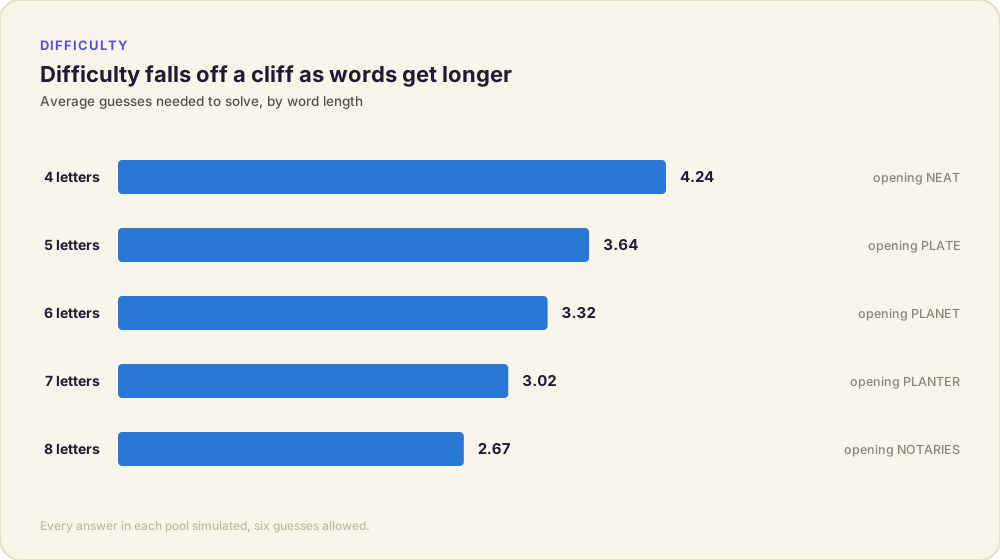
Difficulty falls off a cliff as words get longer, and it runs exactly opposite to intuition at every step.
But the average undersells it. Look at the losses.
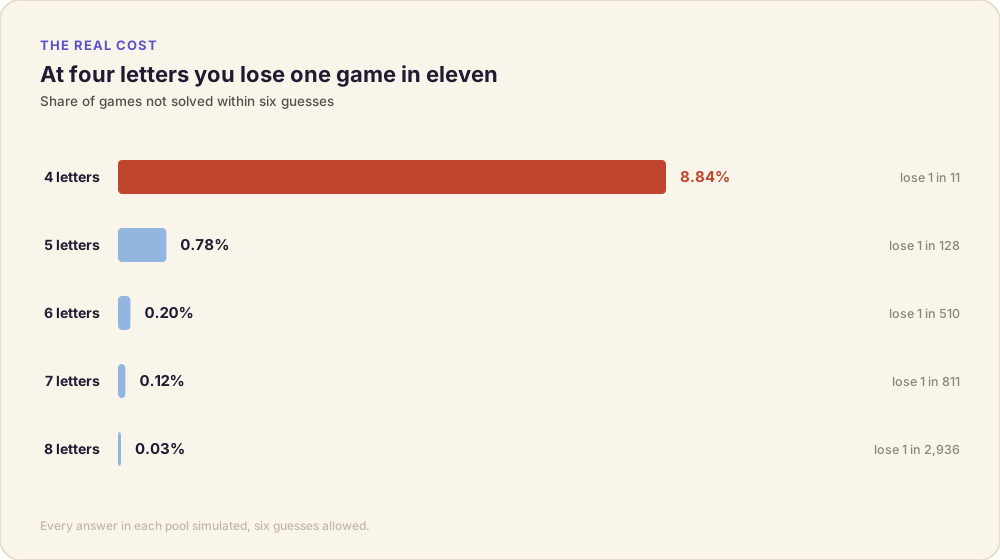
At four letters you lose one game in eleven. At five, one in 128.
That's not a slightly harder game. That's a different product. A daily puzzle you fail 8.8% of the time isn't a gentle morning ritual you share with your group chat. It's a game that breaks your streak once a fortnight, forever.
The hobbit wasn't being clever about the average. He was being clever about the odds of walking out.
Why is 4-letter Wordle harder? Short words hide in packs
Think about CATCH. Now think about BATCH, LATCH, MATCH, PATCH, HATCH, WATCH. Get four letters green and you haven't solved anything. You've been handed a menu. Each remaining guess crosses off exactly one item, and the board barely changes colour while your guesses run out.
I counted, for every word, how many other words in its pool sit exactly one letter away.
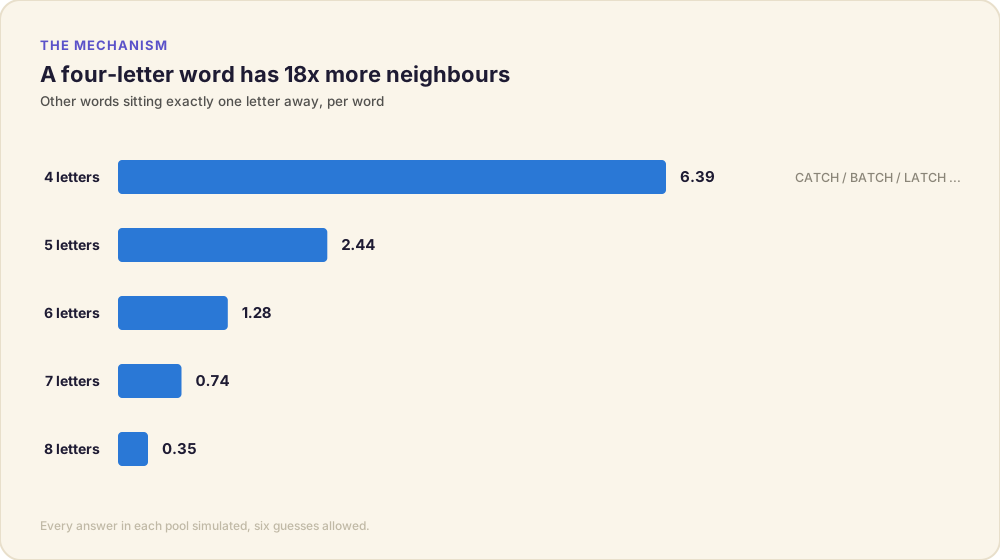
The average four-letter word has eighteen times more one-letter neighbours than the average eight-letter word. Four out of five four-letter words live in an ambush. At eight letters it's one in twenty-five.
BEAR DEAR FEAR GEAR HEAR LEAR NEAR PEAR REAR TEAR WEAR YEAR. Twelve words, one blank, six guesses. Good luck.
This is also why the small pool doesn't save you. Yes, there are only 1,528 four-letter answers, but they're packed so tightly that narrowing the field barely narrows your choices. After one guess at four letters you're still looking at 136 candidates on average. After one eight-letter guess: 5.5.
Length isn't just more letters to guess. It's more room for words to be unlike each other.
Watching it happen
A statistic can tell you four-letter Wordle is hard. Watching a game die tells you why.
Below are three games the solver lost, played exactly as it played them. G is a green tile, y is yellow, . is a grey one. The number on the right is how many words were still possible at that moment. That column is the whole story.
4 letters, answer CAPE                 words still possible
  NEAT    . y y .                              80
  CARE    G G . G                               7
  CAFE    G G . G                               6
  CAGE    G G . G                               5
  CAKE    G G . G                               4
  CAME    G G . G                               3
  out of guesses: CAPE, CASE, CAVE all still standing
By its second guess the solver has C A _ E locked in green and seven words that fit. It has four guesses left and needs one of seven. Then watch the count: 7, 6, 5, 4, 3. Every single guess eliminates exactly one word, because that is all a guess can do once the only unknown is a single letter.
That's the trap family in motion. The solver didn't play badly. There is no good play. The board stopped teaching it anything after guess two, and the rest was a nine-sided coin.
HATCH is crueller still. It ran out of guesses on the exact turn it finally knew the answer:
5 letters, answer HATCH                words still possible
  PLATE   . . y y .                             41
  TACIT   y G y . .                              5
  BATCH   . G G G G                              4
  MATCH   . G G G G                              3
  WATCH   . G G G G                              2
  CATCH   . G G G G                              1
  out of guesses: only HATCH left
And the one to end on. Out of 2,936 eight-letter games the solver lost exactly one, and it still lost it to a trap family, because STA??ING has eleven members:
8 letters, answer STAINING             words still possible
  NOTARIES  y . y y . G . y                      9
  STACKING  G G G . . G G G                      5
  STABBING  G G G . . G G G                      4
  STAFFING  G G G . . G G G                      3
  STALLING  G G G . . G G G                      2
  STANDING  G G G y . G G G                      1
  out of guesses: only STAINING left
The mechanism never goes away with length. It just gets rare enough to stop mattering.
Now put that next to eight letters
Here is the simplest way to see the whole thing.
A four-letter guess can only ever tell you about four letters. An eight-letter guess tells you about eight: twice as much information, out of a pool that isn't twice as big. So the field doesn't shrink. It collapses.
Open an eight-letter game with a reasonable word like NOTARIES and you go from 2,936 possible answers to about five. Not five hundred. Five. And roughly one time in five you're left with exactly one word: you have already won, and you haven't typed your second guess yet.
The unluckiest thing that can happen to you is still only 25 words out of nearly three thousand.
That is why the solver finished 38.5% of eight-letter games in two guesses, and 94.7% in two or three. It is not quite "always in two", because five words is still five words, and you have to pick the right one. But the game is effectively over the moment you press enter the first time. Compare that with CAPE, where pressing enter four more times eliminated four words and still didn't get there.
"But you picked a bad starting word"
Fair challenge, and worth checking properly, because if NEAT were simply a weak opener, the whole conclusion would collapse.
For every length I searched the entire answer pool for the opening word that cuts the field down fastest, then replayed all 13,074 games with it. Four letters produced SALE.
It came out at 4.247 guesses, very slightly worse than NEAT's 4.235.
Among sensible opening words, then, the choice is worth a few hundredths of a guess. Going from four letters to eight is worth 1.56 guesses. You cannot start your way out of this. The difficulty is built into the shape of short words, and no reasonable opening word touches it. (For five letters, where opener choice really is worth arguing about, I've written up the best Wordle starting words separately.)
Note how differently that lands at the two ends. At eight letters your opener matters enormously: NOTARIES leaves you five words, COOKBOOK leaves you 455. At four letters it barely matters what you pick, because there is no four-letter word good enough to escape the packs. Being clever helps you most in the game that least needs it.
The whole distribution
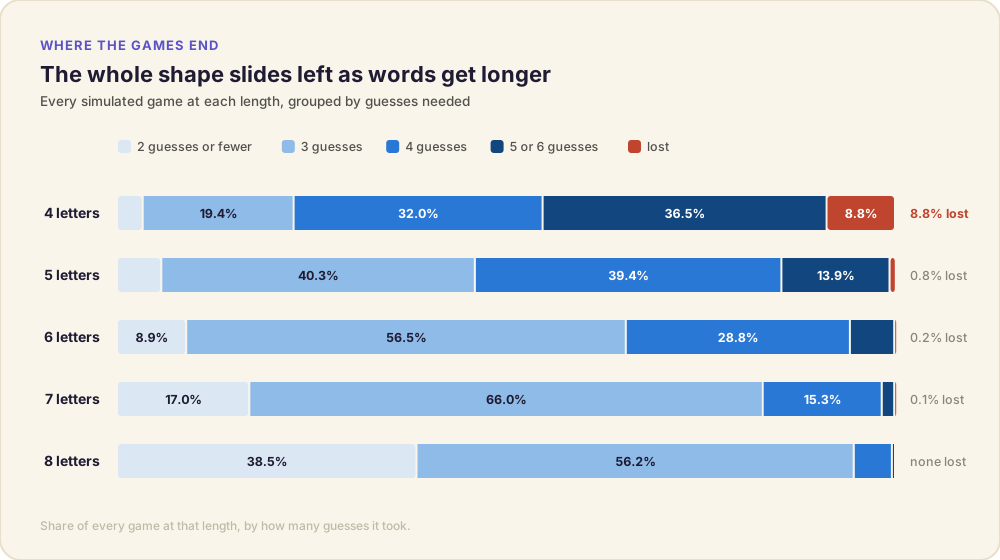
Read the rows top to bottom and the whole argument is in the shape. At four letters the mass sits on the right: four, five, six guesses, and a red bar of outright losses. By eight letters it has all slid left and the red is gone entirely.
Which means eight-letter Wordle fails as a game for the opposite reason to four-letter. Four letters is too cruel. Eight letters has no tension. The outcome is decided on your first guess and the rest is administration. There's a reason the genre settled where it did.
Five was the right answer all along
If you want to feel that 0.78% loss rate in person rather than read it off a table, we put five of Wordle's toughest answers in a row and built a test out of them.
| Letters | Answer pool | Avg guesses | Lose rate | Verdict |
|---|---|---|---|---|
| 4 | 1,528 | 4.24 | 8.84% | Punishing. Streak-breaking. |
| 5 | 2,308 | 3.64 | 0.78% | Real tension, rare losses. |
| 6 | 3,059 | 3.32 | 0.20% | Comfortable. Room for more. |
| 7 | 3,243 | 3.02 | 0.12% | Easy. |
| 8 | 2,936 | 2.67 | 0.03% | Decided on guess one. |
Five letters sits exactly where a daily puzzle wants to sit: hard enough that a win means something, forgiving enough that you don't lose your streak to a _ATCH family twice a month. Six is the other defensible choice. It's where we landed with Pairdle, and the extra breathing room is what lets a six-letter game afford mechanics a five-letter game couldn't carry, including the shape of its own guess distribution.
Four is a trap dressed as a favour.
Which the hobbit, sitting in the dark doing arithmetic while something with big eyes counted its letters, had worked out already.
Method: answer pools are the commonly-used words of each length, drawn from a public ~200,000-word English word list cross-referenced against word-frequency usage tables, then validated against Wordle's and Pairdle's real answer lists. The solver plays hard-mode: any word consistent with every clue so far, ties broken by positional letter frequency. Calibration against the real Wordle answer list: 3.648 average, 99.49% solved. Every answer at every length was played to completion; no sampling.
Where to play: Website · App Store · Google Play
Related articles
The Hardest Wordle Words on Record: Can You Solve Them?
We ranked 502 Wordle answers by the guesses they actually took, found the five worst, and built a five-round test so you can play them against the average.
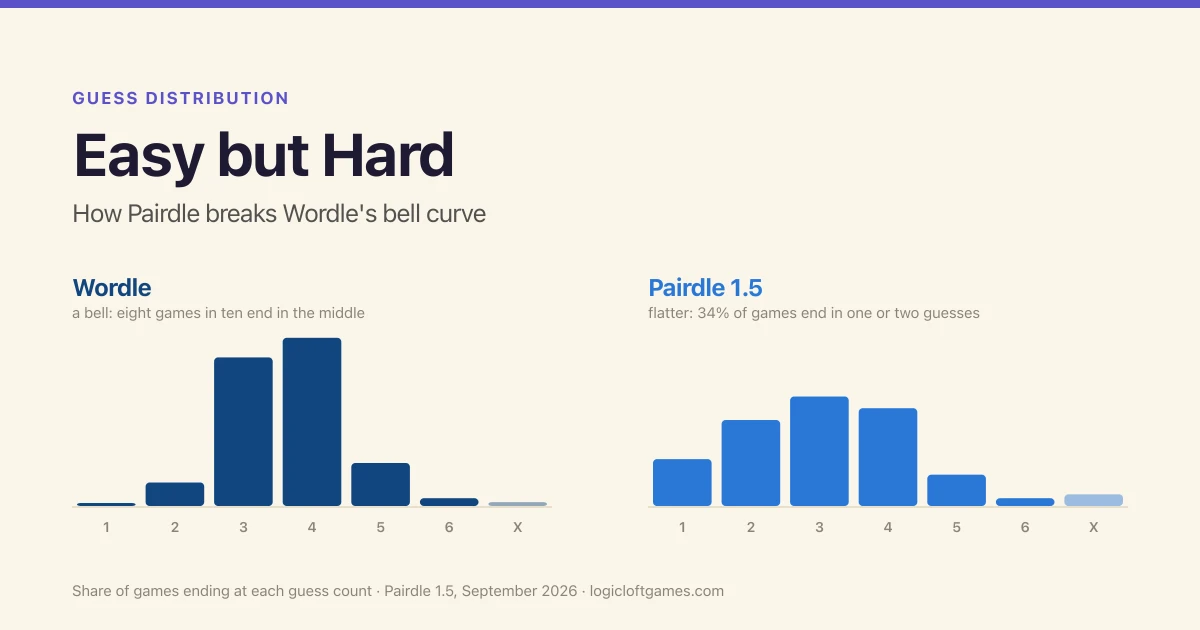
Easy but Hard: How Pairdle Breaks Wordle's Bell Curve
Wordle's guess distribution is a tight bell. Pairdle's isn't. Players win faster and lose more often. We pulled real data to find out why.
Capon? Where Wordle's Rarest Answers Really Come From
CAPON was never on Wordle's original list. We scored all 1,895 answers to date for rarity and found the 50 words the editor has added since 2022.