
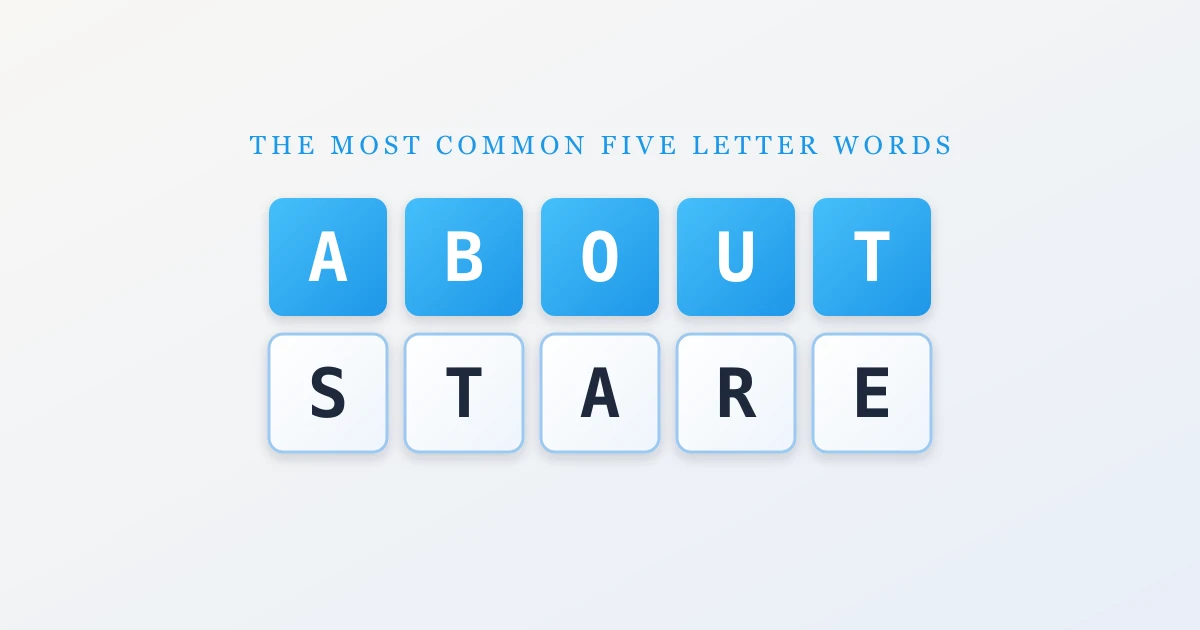
Five-letter words sit at the center of most modern word puzzles. Wordle made them famous, but they show up everywhere: anagram games, crosswords, Scrabble racks. (Our own Pairdle hides a six-letter word, but the same letter instincts carry straight over.) If you play any of these regularly, having a feel for the common five-letter words is one of the most useful skills you can build.
This is a reference you can come back to. Instead of a giant alphabetical list, we've sorted common five-letter words by the patterns that matter when you're stuck on a puzzle.
Why "common" beats "complete"
There are thousands of valid five-letter words, but puzzle answers skew heavily toward familiar ones. Designers (us included) generally avoid obscure words because a puzzle isn't fun if the answer is a word nobody knows. So when you're down to your last guess, betting on a common word is almost always the right move. This list leans into that.
High-frequency everyday words
These are the words you'll see most often in writing and speech. They're prime candidates whenever a puzzle's letters allow:
about · there · their · would · which · other · these · first · after · where · those · world · still · every · great · place · right · think · three · house · water · under · while · might · never · found · again · thing · point · state
These skew toward function words and everyday nouns and verbs: the words that turn up across every kind of writing, from news to text messages. That is why puzzle designers reach for them. When we pick the answer for a daily puzzle, we want solving it to feel fair, and a word almost everyone knows on sight clears that bar. If the clues point you toward an everyday word, go with it.
Words built from the best Wordle letters
If you've read our guide to the best Wordle starting words, you know the letters E, A, R, O, T, L, S, N, I carry the most information, and our starting word calculator will score any opener you like against the full answer list. Here are common words rich in those letters, useful both as openers and as last-guess bets:
stare · rates · tales · notes · tones · least · learn · early · alone · irate · arose · train · slate · crane · stone · range · react · trace · aisle · snore
Words with double letters
Double letters are easy to forget when you're guessing, which makes them a common blind spot. When your feedback suggests a letter appears but you can't place it twice, scan this group:
apple · happy · sorry · funny · error · offer · dizzy · silly · bully · daddy · puppy · berry · jelly · penny · llama · daffy · mommy · kitty · buggy · eerie
Double letters are a classic blind spot because of how the brain reads feedback. When a puzzle tells you a letter is present but you can't seem to place it, the missing piece is often that the letter appears twice. English loves doubled consonants in the back half of a word: the -pp-, -ll-, -ss-, -tt-, -nn- clusters above are everywhere, so when you're stuck, deliberately ask yourself "could this be a double?" before you assume a letter is wrong. It is a common reason a solvable puzzle feels impossible.
Vowel-heavy words
When a puzzle leaves you with a lot of vowels, try these:
audio · adieu · oaten · eerie · ouija · queue · azure · ideas · oasis · media · radio · union · equal · usual · alien
Consonant-heavy words
The opposite problem (lots of consonants, few vowels) is just as common. Try these:
crypt · lymph · nymph · glyph · myths · crwth · pygmy · synth · flyby · psych
How to actually use this
Memorizing a list cold doesn't work and isn't the point. Instead:
- Read it once or twice so the shapes feel familiar. You're building pattern recognition, not rote recall. The goal is that when a half-finished grid appears, the right candidates surface in your mind without you having to grind through the alphabet slot by slot.
- When you're stuck, scan the group that matches your situation: too many vowels, a stubborn double letter, a last-guess gamble. Each group above is built around one kind of dead end, so go straight to the one that fits instead of running through every word you know.
- Bet common. If two words fit your clues and one is everyday while the other is obscure, the everyday one is the safer guess in almost any well-designed puzzle. We say this as people who build the puzzles: a fair designer leans toward words players know, so betting common is also playing the odds. That choice shapes the game more than most players think: we counted the everyday words at every length and found they peak at seven letters, and that a four-letter Wordle would be the hardest version of all. See why Wordle is five letters long.
The same idea works in any word game: train your eye to spot the likely answers fast. We wrote more about that mindset in how to play Wordle, and the same instincts transfer straight to Pairdle and the other titles in our best daily word games roundup.
Bookmark this page for the next time you're on guess six with a half-filled grid.
Related articles
The Hardest Wordle Words on Record: Can You Solve Them?
We ranked 502 Wordle answers by the guesses they actually took, found the five worst, and built a five-round test so you can play them against the average.
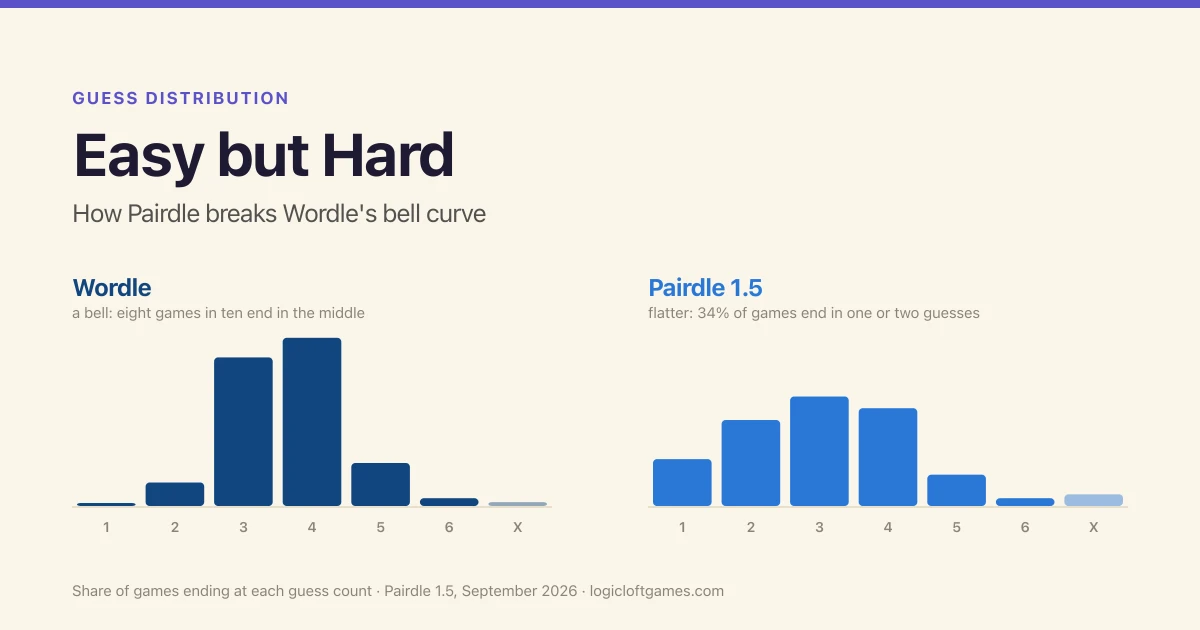
Easy but Hard: How Pairdle Breaks Wordle's Bell Curve
Wordle's guess distribution is a tight bell. Pairdle's isn't. Players win faster and lose more often. We pulled real data to find out why.
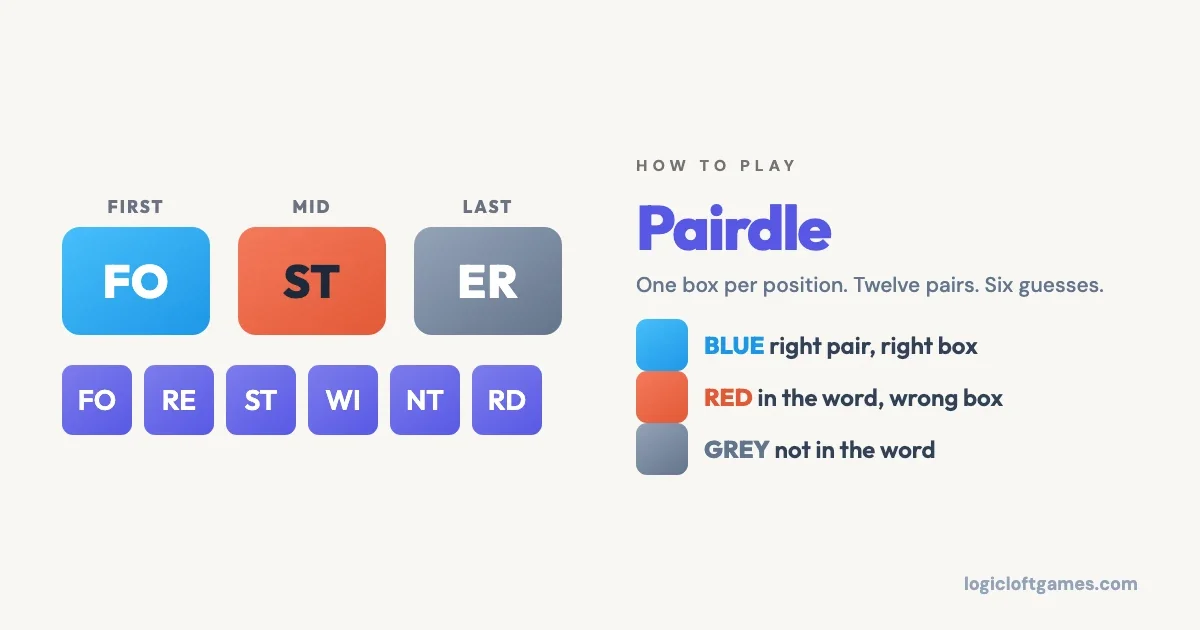
Pairdle 1.5: What's New, What's the Same, and an Exciting New Level
Pairdle 1.5 puts every level on one row, unlocks Pro, adds Expert and endless Practice, and introduces Olly the owl. Plus what a 12-tile board really holds.