
Ask ten Wordle players for their opening word and you'll get ten answers, half of them defended like religious beliefs. The good news: there's actual reasoning behind the popular choices, and once you understand it, you can stop arguing and start solving faster.
We design daily word games, so we spend an unreasonable amount of time thinking about exactly this question. Here's what makes a starting word strong, the openers worth using, and why "the best word" depends on what you're optimizing for.
Where to play: Website · App Store · Google Play
What a starting word is actually for
Your first guess earns you zero green tiles' worth of certainty, because you have no information yet. So the job of guess one isn't to win. It's to eliminate as many possibilities as possible. A great opener is one that, on average, splits the remaining words into the smallest leftover groups no matter what the answer is.
In plain terms, a strong starter does three things:
- Uses common letters. The letters
E, A, R, O, T, L, S, N, Iappear in a huge share of five-letter words. Testing them tells you the most. - Has no repeated letters. A repeat wastes a slot:
LLAMAonly tests four distinct letters, and you'd rather test five. - Spreads letters across positions that those letters commonly occupy, so yellows and greens are maximally informative.
The openers worth using
Here are the words that consistently rank near the top, and why each one earns its reputation.
| Opener | Why it's strong |
|---|---|
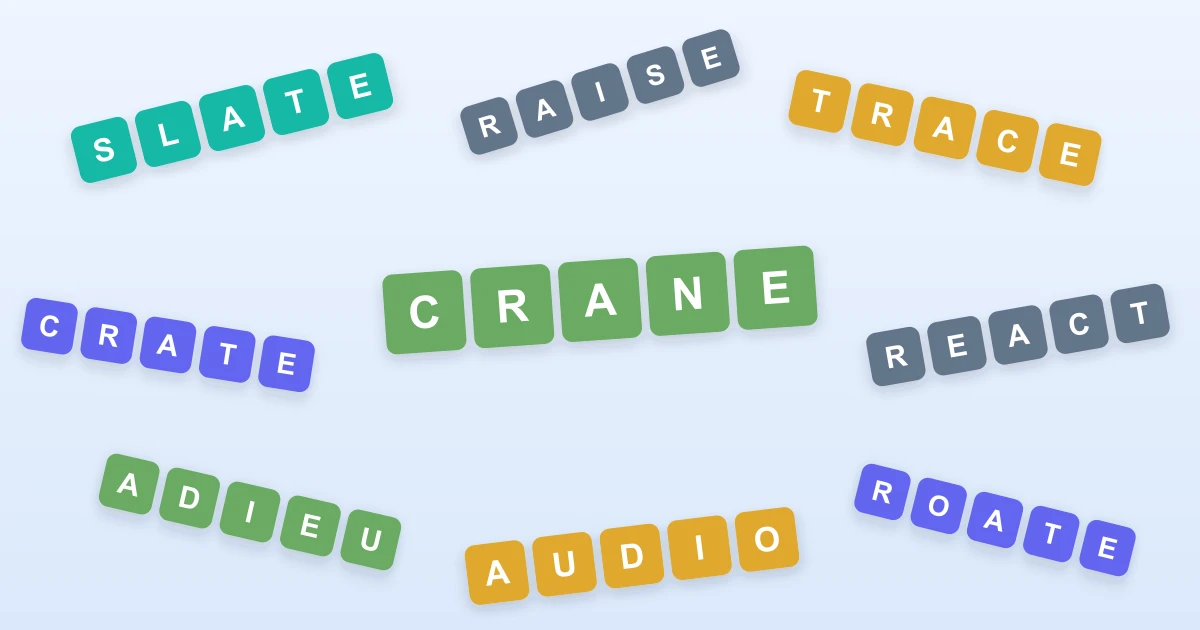
| CRANE | Five very common letters, all distinct, in plausible positions. A genuine all-rounder. |
| SLATE | Same idea. S, L, A, T, E are all high-frequency, and E and T cover common endings. |
| TRACE / CRATE / REACT | Anagrams of the same five great letters; pick whichever you remember. |
| ADIEU | Front-loads four vowels (A, I, E, U). Great at pinning down vowels fast, weaker on consonants. |
| AUDIO | Tests four vowels too; a favorite if you like to nail vowels on turn one. |
| ROATE / RAISE | Frequently cited by solvers who've run the numbers as top information-gainers. |
Notice the pattern: almost all of them are built from the same pool of common letters. There is no single magic word, and several are essentially tied.
Vowel-first or letter-coverage-first?
This is the real strategic fork:
- Letter-coverage openers (CRANE, SLATE) balance vowels and consonants. They tend to give the most reliable overall progress.
- Vowel-hunting openers (ADIEU, AUDIO) sacrifice consonant info to lock down vowels immediately. This can be powerful because once you know the vowels, the consonant skeleton of an English word is often easy to fill in.
Our take: if you play one game a day and just want to solve reliably, use a coverage word like CRANE or SLATE. If you enjoy a two-step plan, open with a vowel word, then play a consonant-heavy second word like CLUMP or THORN to sweep the common consonants. Both are valid. They just optimize for different things.
The second guess matters as much as the first
A great opener that you follow with a sloppy second guess wastes its advantage. The key rule: your second word should test five brand-new letters (assuming your first guess came back mostly gray) rather than re-testing letters you already know about. Players who open with ADIEU and then guess another vowel-heavy word are leaving information on the table.
If your opener lit up some yellows and greens, then yes, build on them. But if it came back nearly blank, treat guess two as a second opener and sweep more common letters. This two-opener approach is why vowel-first players can be so fast: ADIEU then STONK (or similar) tests nine or ten distinct common letters before they've spent half their guesses.
How to pick your own starter
You don't need a computer. Use this checklist:
- Five different letters (no repeats).
- At least two vowels.
- Built mostly from
E, A, R, O, T, L, S, N, I, C. - A real, common word you'll actually remember.
Run a word through that and you'll land on something in the CRANE/SLATE neighborhood, which is the whole point. If you'd rather let a computer check your work, our Wordle starting word calculator scores any five-letter word against all 2,343 answers, and ranks the twenty openers real players use most. If you want to understand why certain letter combinations carry so much information, our piece on the most common 5-letter words, our breakdown of common letter pairs in English, and our list of common prefixes and suffixes all feed directly into better openers.
A word on "best" being overrated
Here's the honest truth from people who build these puzzles: the gap between the very best opener and a merely good opener is small. We later put a number on exactly how small: simulating every possible game at five different word lengths, the mathematically optimal four-letter opener came out slightly worse over a full game than an ordinary one, while changing the word length was worth a guess and a half. The full breakdown is in why Wordle is five letters long. What actually decides your average score is how well you read feedback on guesses two through four: the deduction, not the opening ceremony. If you haven't yet, start with our how to play Wordle walkthrough, where we show that deduction step by step.
Pick a solid opener, stick with it so you get a feel for how it behaves, and put your real energy into reading the colors. That's where games are won. If you want to see what happens when a good opener meets a bad day, we lined up the five hardest Wordle words we could measure into a test.
Want a different flavor of daily deduction? Pairdle takes the Wordle format and has you place letters two at a time, and the opening-move logic is a fun twist on everything above, with a very different guess distribution than Wordle's.
Related articles
The Hardest Wordle Words on Record: Can You Solve Them?
We ranked 502 Wordle answers by the guesses they actually took, found the five worst, and built a five-round test so you can play them against the average.
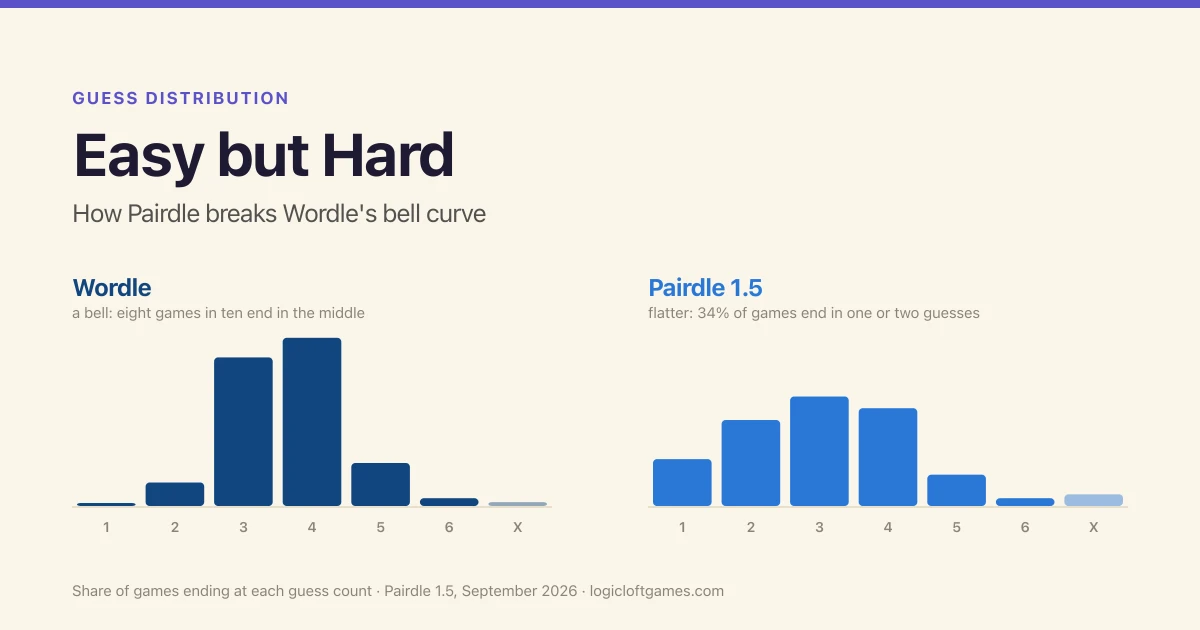
Easy but Hard: How Pairdle Breaks Wordle's Bell Curve
Wordle's guess distribution is a tight bell. Pairdle's isn't. Players win faster and lose more often. We pulled real data to find out why.
Boggle Got Easier in 1987. It Also Lost 735 Words.
Parker Brothers replaced every Boggle die in 1987 and never said why. We simulated 100,000 boards on both sets: more words per board, 735 words lost.