
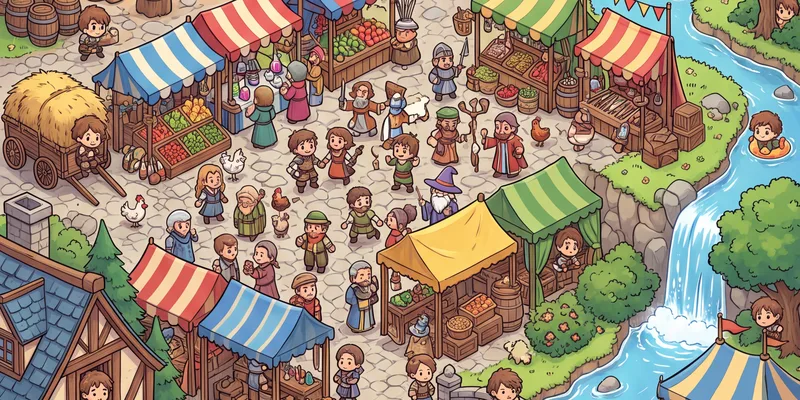
Hidden object games are the quietest corner of the puzzle world and one of its largest, and until today we had never written a word about them. That always felt like a gap rather than a judgment: the genre runs on the same search-and-find instinct our own word games do, just pointed at pictures instead of letters. So rather than open with a list of other people's games, we drew one.
Below is a single medieval village, top to bottom: a windmill and a sheep pasture, a castle wall with a bored guard on it, a tavern courtyard three drinks in, a market of striped stalls, two stone bridges over a river, a jousting ground, and a working dock. Somewhere in all of that, the hero from Epic Words is standing around twenty-three times.
The rules, such as they are
He is a boy with tousled brown hair, a brown leather jerkin, and a pale cream shoulder plate on one or both arms.
That last detail is the whole puzzle. The village is full of brown-haired people (it is a medieval village) and at a glance a good third of the crowd could be him. The shoulder plate is the tell. Nobody else in the scene wears one.
There is no timer and no limit on wrong taps. Tap him when you spot him and the ring stays put; your progress survives a page reload. When you have had enough, one button rings all twenty-three and lists where they were.
How to actually find twenty-three of anything
The instinct is to sweep the picture left to right like you are reading it. That is the slowest possible method, and it is why hidden object games feel harder than they are. Three things work better:
Search by band, not by sweep. Pick a horizontal strip about as tall as your screen, finish it completely, then move down. The genre's difficulty is almost entirely a memory problem: you lose because you cannot remember which patch of picture you have already cleared, not because the thing is well hidden. Bands give you a clean edge to track.
Let size do the filtering. He is drawn at the same scale as everyone else, which sounds unhelpful and is actually the strongest filter you have. Anything much bigger than a market stallholder is scenery. It kills most of the picture instantly.
Check the places a person would not stand. Illustrators hide figures where the eye expects an object instead of a person: windows, tree canopies, the inside of a wagon, water. Ten of the twenty-three are in one of those four categories (four in trees, two in upstairs windows, two riding in hay wagons and two floating down the river in inner tubes) and they are consistently the last ones people find.
The one thing that does not help is zooming all the way in and grinding. Detail-hunting at high magnification is how you lose your place in the picture, and losing your place is the actual failure mode.
Two who are not him
Two figures in the village will cost you a tap, and they are supposed to.
There is a boy in a red tunic and blue trousers near the market, and he has the hero's exact face and hair (same illustrator, same character sheet, different clothes). He has tan bracers on his forearms, not shoulder plates. He does not count.
There is also a stallholder under the green canopy with a grey apron and an irritated expression. He has a pale cloth over one shoulder that reads as a shoulder plate at thumbnail size. He is not the hero either; he is a man having a bad afternoon at work.
We could have counted both and claimed twenty-five. We did not, because a puzzle whose answer you cannot check is not a puzzle. It is an assertion. "Brown jerkin, cream shoulder plate" is a rule you can hold the picture up against, and all twenty-three pass it.
Why this genre is worth your time
What makes hidden object work is that the difficulty is purely visual. There is no vocabulary to learn and no arithmetic, and no clock at all unless the game chooses to impose one. The obstacle is your own attention: the way a familiar shape vanishes when it is the wrong colour, or how an object stops registering the moment it overlaps something else. Good scene artists exploit this on purpose, drawing a key as part of a wrought-iron fence so that your eye files it under "fence" and moves on.
That is also why the genre ages so well. A hidden object scene from 2006 is exactly as hard today as it was then, because the thing it is testing has not changed. Not much else in games can say the same.
The modern genre has grown well past find-the-item: most of the big titles wrap their scenes in a mystery, and you are a detective or an heir to a strange estate, with each cleared scene advancing a story. If you want the guided tour, we keep a list of the ten worth starting with on our hidden object page, from June's Journey and Hidden Folks through to the book that started all of it.
And if you would rather hunt words than villagers, that is the day job: Epic Words is an endless word adventure, and the boy you have just found twenty-three times is the one on its logo. Prefer letters laid out in a grid to pictures in a village? Our roundup of word search games worth trying is the closest cousin to this kind of hunt.
By Tim Nye, Logic Loft Games
Related articles
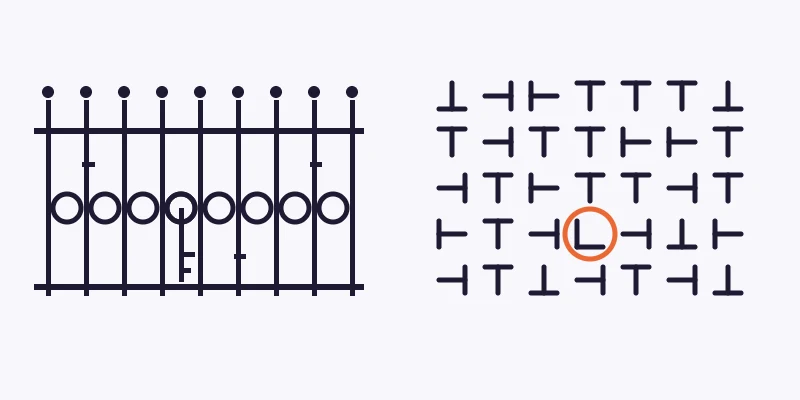
The Four Ways a Hidden Object Game Hides Things
Almost nothing in a hidden object scene is actually hidden. Four techniques do the work, and each exploits a different documented failure in how looking works.
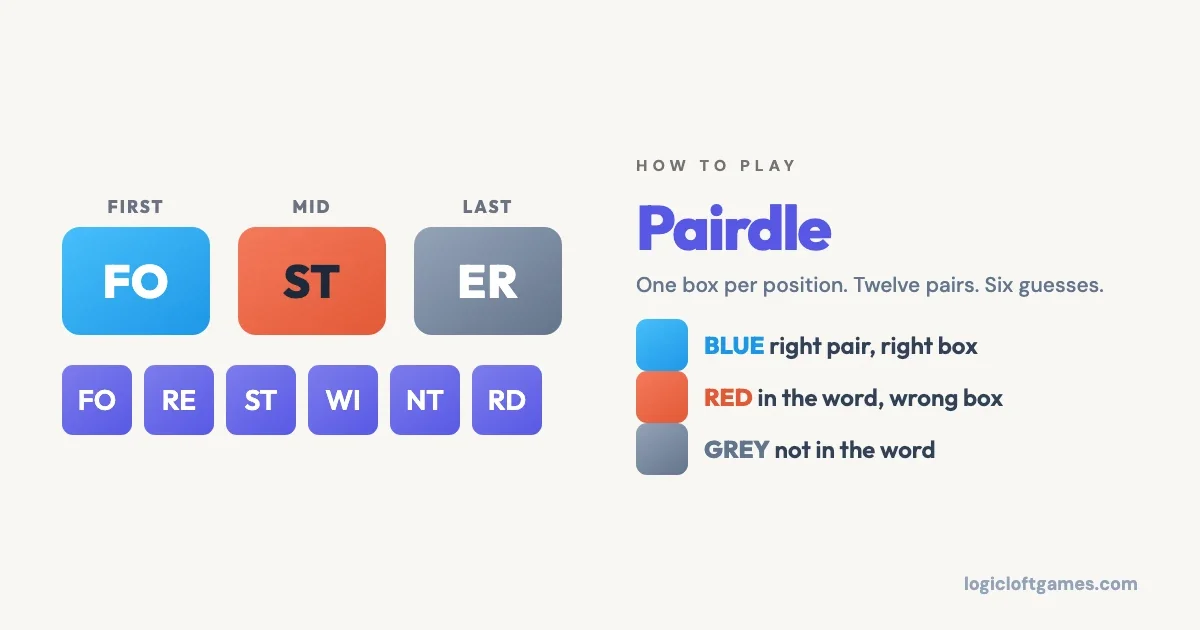
Pairdle 1.5: What's New, What's the Same, and an Exciting New Level
Pairdle 1.5 puts every level on one row, unlocks Pro, adds Expert and endless Practice, and introduces Olly the owl. Plus what a 12-tile board really holds.
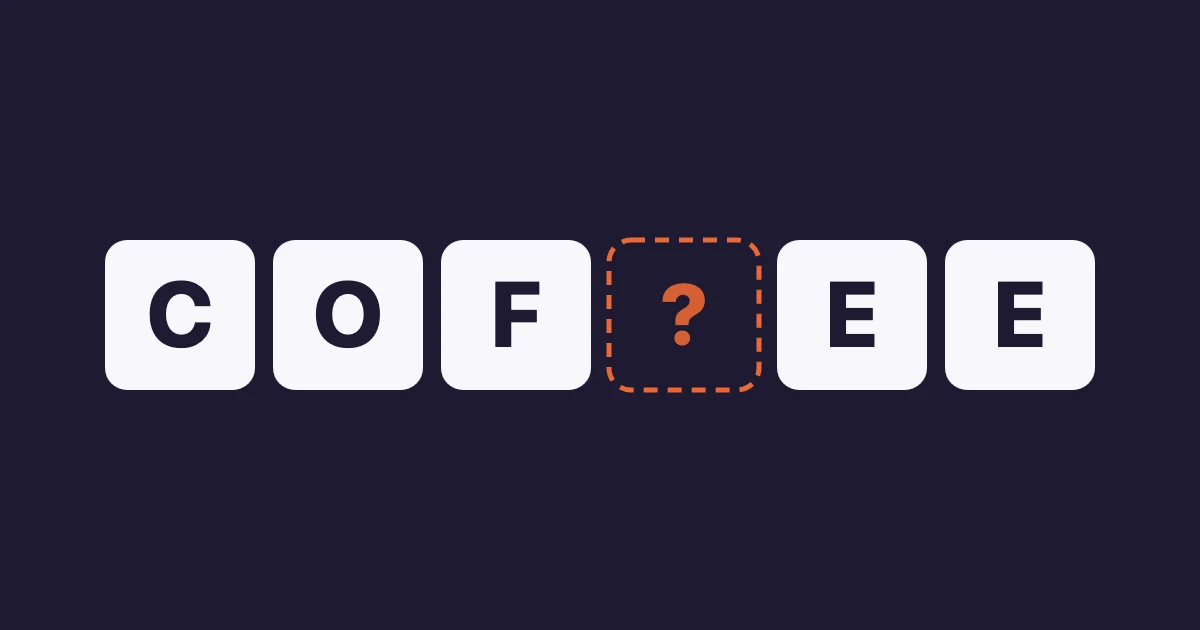
Why Boggle Hates Coffee, Pizza and the Bible
COFFEE, PIZZA, BIBLE, OFF, JOB, KICK and about 10,000 other words can never appear on a Boggle board. Three rules built into the dice explain every one.