
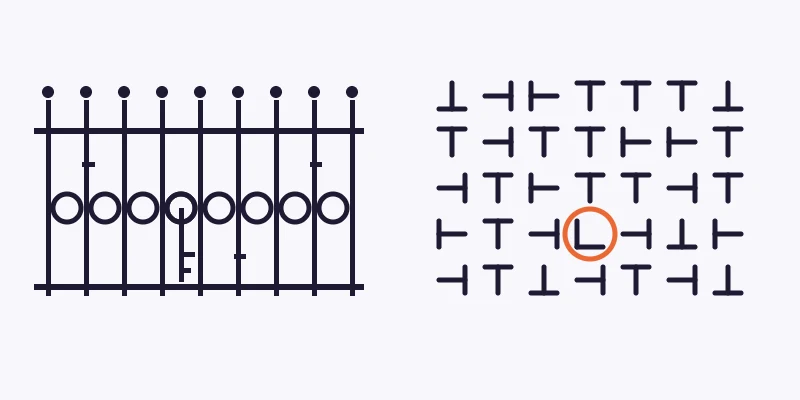
Here is the strange thing about hidden object games: almost nothing in them is hidden.
Open any scene from June's Journey or Hidden City and the pocket watch you are looking for is right there, fully drawn, unobscured, often near the middle of the picture. Nobody buried it. The artist did not paint it behind the sofa. It is in plain view and you cannot see it, and you will keep not seeing it for another forty seconds, and then it will appear as though someone has just switched it on.
That gap (between an object being visible and an object being seen) is the entire genre. It is also one of the better-documented subjects in perceptual psychology, which means the tricks a scene artist uses have names, and once you know the names you get faster.
There are four of them.
1. Camouflage: the object shares its edges with something else
The oldest trick, and the only one most people can describe. The object is drawn so that its outline coincides with the outline of something already in the scene. A key becomes part of a wrought-iron fence. A crescent moon becomes the highlight on a saucepan.
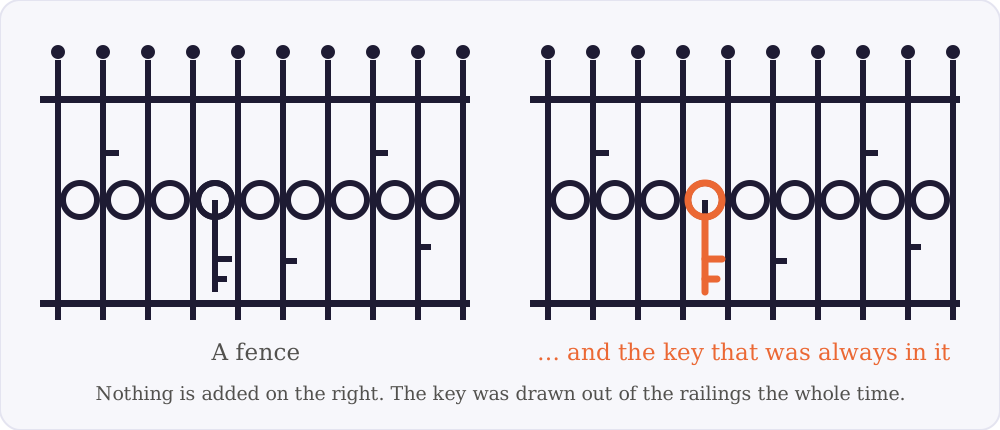
Nothing was added to the right-hand panel. The key was in the railings the whole time, but the ring reads as "fence ornament", the bar reads as "fence post", and once your visual system has assigned those parts to the fence it does not offer them to you again as parts of anything else.
That last point is the actual mechanism, and it has a name: figure–ground assignment. Every edge in a picture belongs to the thing on one side of it. The shape on the other side of that edge does not get an outline at all. It becomes background. Edgar Rubin demonstrated this in 1915 with the most famous drawing in the whole field:
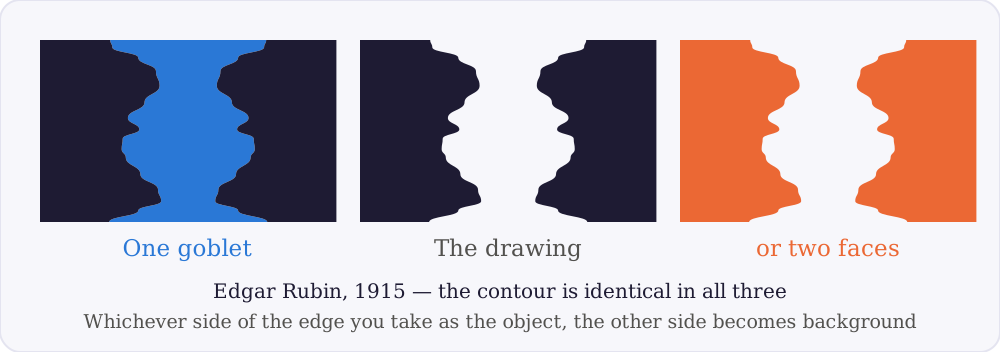
You can see the goblet or you can see the faces. You cannot see both at once, and no amount of effort will let you, because the contour down the middle can only belong to one of them at a time. A camouflaged object in a hidden object scene is doing exactly this to you: it has lost the argument over who owns the edge.
How to beat it: stop looking for the object and start looking at the edges of large objects. Camouflaged items nearly always sit along a boundary (a railing, a roofline, the rim of a bowl) because that is where a stolen outline is available.
2. Incongruity: the object is not hidden, it is just wrong
The opposite technique, and the one people find hardest to believe once it is pointed out. The object is at full size, high contrast, dead centre, and concealed by absolutely nothing. It is simply in a place where that kind of object does not belong: a trumpet on a kitchen worktop, a starfish in a library.
Nothing is obscuring it. What defeats you is that your eye is not really scanning the picture. It is scanning your idea of the picture. You looked at a kitchen, your visual system produced "kitchen", and it then spent its effort on the objects that a kitchen predicts. The trumpet was never checked because trumpets are not on the list of things kitchens contain.
This is why an incongruous object often becomes glaringly obvious the instant someone tells you the room is wrong, without telling you what is wrong with it. You are still looking at the same pixels. You have only stopped trusting the summary.
How to beat it: name what you are looking at out loud, then deliberately distrust it. "This is a kitchen" is the assumption doing the damage.
3. Crowding: the object is distinct, and surrounded by forty near-copies
Sometimes the object is not disguised at all and is not out of place either. It is just standing in a crowd of things that look almost exactly like it.
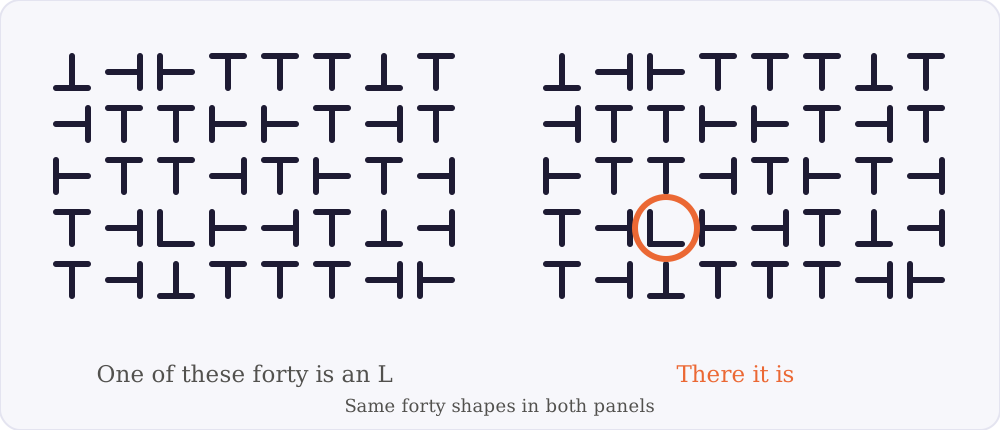
Find the L before you look at the right-hand panel. It takes most people several seconds, and the reason is precise: the L has no feature that the Ts lack. Same two strokes, same lengths, same weight, same colour. It differs only in where the strokes join.
Anne Treisman and Garry Gelade set this out in 1980 (Cognitive Psychology, 12, 97–136). A target that differs by a single feature (the one red dot among blue ones) is found in parallel, and it takes about as long in a crowd of fifty as in a crowd of five; it simply pops out. A target that differs only in how features are combined has to be checked item by item, and the time it takes grows with the number of distractors.
Hidden object scenes are built almost entirely out of the second kind. That is why a cluttered antique shop is so much harder than a bare beach, even when the object is the same size in both.
How to beat it: search a small patch completely before moving on, and pick patches with a hard edge you can track: a shelf, a table, a wall. You are not fighting the picture, you are fighting your own memory of which bits you have already done.
4. Ambiguity: you have already decided what those lines are
The rarest technique, and the cleverest one. The object is fully visible, in a sensible place, not crowded, but the same lines also form something else, and your brain committed to the other reading before you arrived.
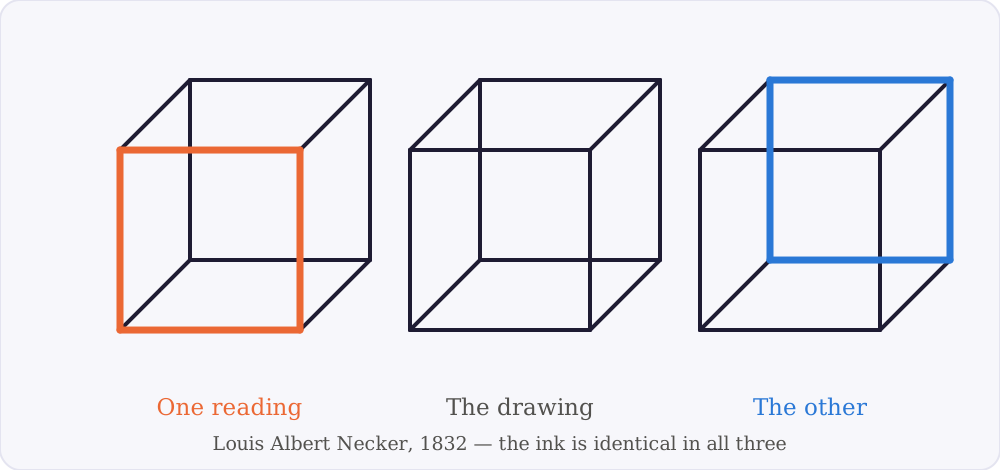
Louis Albert Necker, a Swiss crystallographer, noticed in 1832 that a wireframe cube flips. Look at the middle drawing for a few seconds and it will reverse on you, unbidden. There is no extra ink in the left and right panels: they only show you which reading you are having.
An artist who hides an object this way has made a shape that is two things at once, and you will not find it by looking harder. You find it by looking differently.
The gorilla, and why the list is the trap
None of the above explains the most common experience in the genre, which is finding an object instantly on your second pass through a scene you had already searched carefully.
For that, the relevant experiment is the famous one. In 1999 Daniel Simons and Christopher Chabris asked people to watch a short video of two teams passing basketballs and count the passes made by one team. Partway through, a person in a gorilla suit walks into the middle of the shot, turns to the camera, and leaves. 46% of viewers did not notice. They were looking directly at it. (Perception, 28, 1059–1074; Simons' own write-up and the video are at theinvisiblegorilla.com.)
The finding is called inattentional blindness, and the important part is what causes it: not the gorilla, the counting. People who watch the same video with no task see the gorilla every time. It is the act of holding a specific goal that closes down everything else.
Now look at what a hidden object game hands you at the start of every scene. A list.
The list is the pass-counting task. While you are holding pocket watch, blue umbrella, cat, the game has bought itself an enormous amount of licence: you will walk your eyes straight over the candlestick eleven times, and on the twelfth, when the candlestick joins the list, it will be sitting in the open like it just arrived. Nothing about the scene changed. The task changed.
This is the genre's actual design secret, and it is a slightly uncomfortable one: hidden object games are not really testing whether you can see things. They are metering out a supply of inattentional blindness that they created by giving you the list in the first place.
How to beat it: on a scene that has gone cold, stop reading the list. Look at the picture with no target at all for ten seconds. Things surface.
If you want the ten games worth starting with, they are on our hidden object page. And if you would rather test the four techniques than read about them, we drew a village and hid the same character in it twenty-three times: go and find him. If letters interest you more than pictures, word search puzzles run on a related kind of scanning.
By Tim Nye, Logic Loft Games
Related articles
Where's Epic Words? A Hidden Object Puzzle You Can Play Right Here
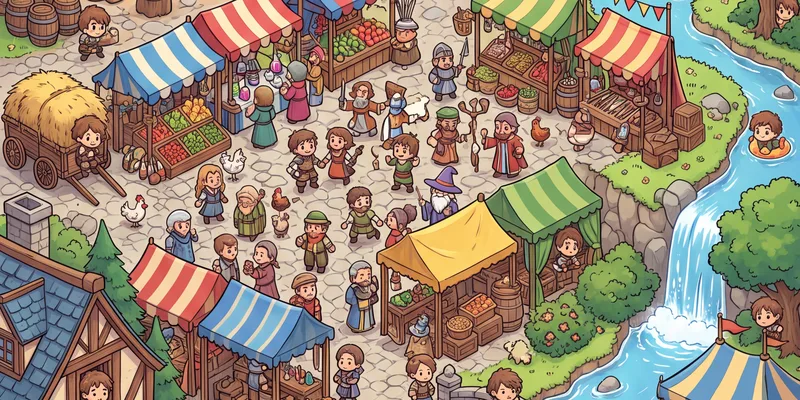
We hid the Epic Words hero twenty-three times in one crowded medieval village. Scroll the scene, tap him when you spot him, and the answers are one button away.
Pairdle 1.5: What's New, What's the Same, and an Exciting New Level
Pairdle 1.5 puts every level on one row, unlocks Pro, adds Expert and endless Practice, and introduces Olly the owl. Plus what a 12-tile board really holds.

How I Came to Build Pairdle and Accidentally Made It EPIC
I loved Wordle but refused to clone it, so I built a puzzle out of letter pairs instead. Then, fact-checking this very article, I found the generator had been throwing away seven of every eight words since December.