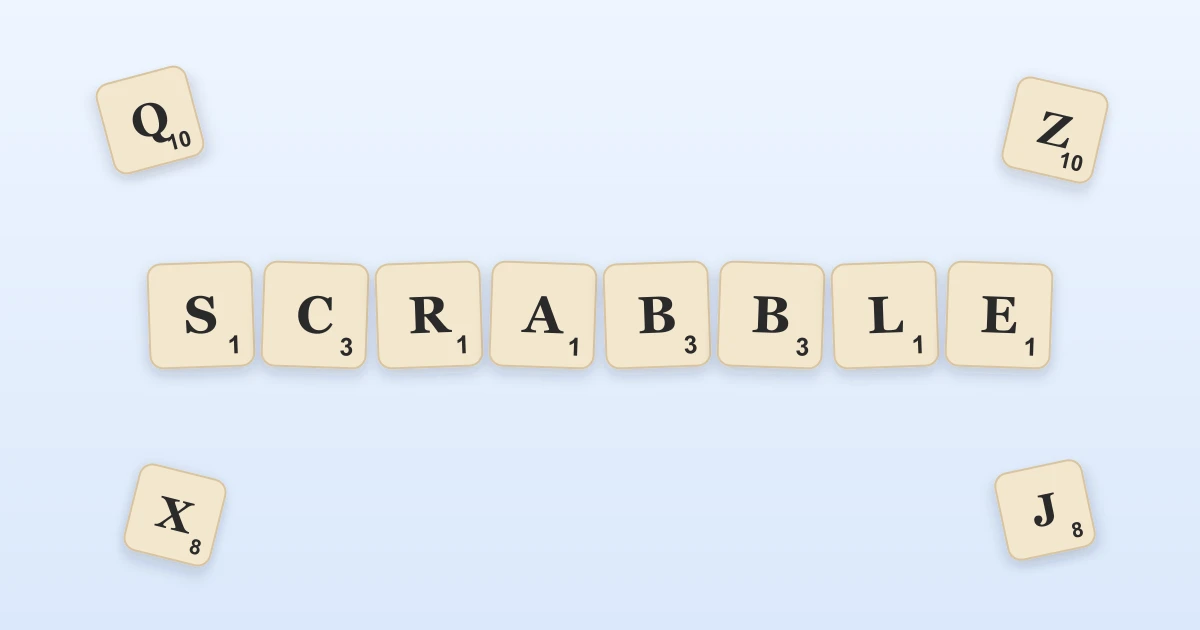
In Scrabble, four tiles are worth far more than the rest: J and X at 8 points, Q and Z at 10 (with K close behind at 5). Played well, a single one of these can score 30, 40, even 50+ points on the right squares. Played badly — or left stranded on your rack — they're a liability that can cost you the game. This guide is about getting the most out of each one.
We build word games, and the high-value tiles are the purest expression of Scrabble's risk-reward: big upside, real danger of getting stuck.
The golden rule: pair high tiles with premium squares
A Z on a plain square scores 10. The same Z on a Triple Letter square scores 30 — and if the word it's in also lands on a Double Word square, you're looking at a 60+ point turn from one tile. The single most important habit with J, Q, X, and Z is patience: it's usually worth waiting a turn (or making a small play elsewhere) to land a high tile on a premium square rather than dumping it for face value.
But patience has a limit — see the warning at the end about getting stuck.
The Z (10 points)
The Z is the most flexible 10-pointer because of a few short, common words:
- ZA (slang for pizza) and ZO (a hybrid yak, Collins) — two-letter words that let you place a Z anywhere on a crowded board, scoring it in two directions at once.
- ZIT, ZIP, ZAP, ZED, ZOO, BIZ, FEZ, WIZ, ADZ — short, easy outlets.
- On a Triple Letter, ZA played across two words can be one of the best points-per-tile plays in the game.
The Q (10 points)
The Q is the most dangerous tile because of its U-dependency — it can sit unplayable for a whole game. Your safety net is the Q-without-U words, which we cover in depth in words with Q but no U: QI and QAT are the essential two. With a U available, QUIZ (a potential monster on premiums), QUAD, QUAY, AQUA, QOPH open up. The rule with the Q: have an exit plan before you draw it, and never hoard it into the endgame.
The X (8 points)
The X is secretly the easiest high tile to use well, because it forms tons of two-letter words: AX, EX, OX, XI, XU. That means you can almost always play it parallel to an existing word, scoring two words at once. AXE, FOX, TAX, HEX, SIX, FIX, WAX are everywhere. The X on a Triple Letter, played so it forms two words, is a reliable 40-point play. Of all the high tiles, the X is the one you should rarely get stuck with.
The J (8 points)
The J is the trickiest of the four because it has the fewest two-letter outlets — only JO (a sweetheart). That makes the J more position-dependent. Lean on short words: JAB, JAM, JAR, JAW, JAY, JET, JIG, JOB, JOG, JOT, JOY, JUG, RAJ, TAJ. Because JO is your only two-letter escape, plan a slot for the J a bit earlier than you would for an X.
The K (5 points)
Not a true heavyweight, but worth a mention: the K is easy and underrated. KA, KI (two-letter; KO is Collins-only), plus ASK, INK, OAK, KEY, KIT and many more. Land it on a Double or Triple Letter inside a longer word and it quietly adds up. Because the K is so easy to place, don't hold it hostage waiting for a perfect square the way you might a Q — take a good score and move on.
Don't get stuck — the patience limit
Patience pays, but a high tile you "save" for a premium square that never opens is a disaster. Remember: at the end of the game, unplayed tiles are subtracted from your score, so a stranded Q costs you 10 twice over. The discipline:
- If a great square is likely to open in a turn or two, wait.
- If the board is closing up, tiles are running low, or your opponent might block the lane, take a solid score now and get the tile off your rack.
- The Q especially should never reach the endgame unplayed if you can help it.
Putting it together
The high tiles reward two skills: knowing the short words that deploy them (especially the two-letter ones — see our 2-letter Scrabble words list) and the judgment to balance patience against the risk of getting stuck. Master that and J, Q, X, Z stop being scary and become your biggest scoring weapons. For the fundamentals underneath all of this, start with how to play Scrabble and our guide to setting up bingos — and for a daily word workout that keeps your letter-eye sharp, there's always Pairdle.
Related articles
How to Play Scrabble: Rules, Scoring & Board Bonuses
A clear, complete guide to Scrabble — setup, turn order, how scoring and the premium squares work, and the beginner habits that quietly win games.
How to Get a Bingo in Scrabble (7-Tile Plays)
A bingo — using all seven tiles in one turn — is worth a 50-point bonus. Here's how to set them up, the endings that unlock them, and how to train your eye.
How Anagrams Work (and How to Unscramble Any Word)
An anagram rearranges the letters of a word into a new one. Here's how they work and a reliable method for unscrambling letters fast — no luck required.