If you learn one thing to get better at Scrabble, make it the two-letter words. They look trivial — AA, QI, ZA — but they're the single highest-leverage knowledge in the game. They let you play parallel to existing words, build off awkward racks, and unload expensive tiles like Q and Z for big points. Tournament players know all of them cold. You can too; there are only about a hundred.
This is a reference you can keep coming back to. We've grouped the words by their first letter and added notes on the ones that win games, because a flat alphabetical dump is hard to actually remember.
Why two-letter words matter so much
When you play a new tile alongside an existing word, you score every new word you form, not just the main one. Two-letter words are the glue that makes this possible. Drop an A next to a column of tiles and suddenly you've made AB, AD, AE, or AH and scored both your main word and the little one — often on a premium square.
They also rescue bad racks. Stuck with a Q and no U? QI and QA exist (see our guide to words with Q but no U). Drowning in vowels? AA, AE, AI, OE, OI clear them out. This is exactly the kind of position our how to play Scrabble guide warns you about — and two-letter words are the escape hatch.
The list, grouped by first letter
Note: valid words differ slightly between the North American (TWL) and international (SOWPODS/Collins) word lists. The set below reflects the commonly accepted entries; agree on your dictionary before the game.
- A: AA, AB, AD, AE, AG, AH, AI, AL, AM, AN, AR, AS, AT, AW, AX, AY
- B: BA, BE, BI, BO, BY
- C: (none in TWL; CH exists in Collins)
- D: DA, DE, DO
- E: ED, EF, EH, EL, EM, EN, ER, ES, ET, EW, EX
- F: FA, FE
- G: GI, GO, GU (Collins)
- H: HA, HE, HI, HM, HO
- I: ID, IF, IN, IS, IT
- J: JO
- K: KA, KI, KO (Collins)
- L: LA, LI (Collins), LO
- M: MA, ME, MI, MM, MO, MU, MY
- N: NA, NE, NO, NU, NY (Collins)
- O: OD, OE, OF, OH, OI (Collins), OK, OM, ON, OP, OR, OS, OW, OX, OY
- P: PA, PE, PI, PO (Collins)
- Q: QI
- R: RE
- S: SH, SI, SO, ST (Collins)
- T: TA, TE, TI, TO
- U: UH, UM, UN, UP, UR, US, UT
- W: WE, WO
- X: XI, XU
- Y: YA, YE, YO, YU (Collins)
- Z: ZA, ZO (Collins)
The high-value ones to memorize first
You don't need all hundred on day one. Start with the ones that solve the most painful racks:
- QI and ZA — the two most famous "I can't believe that's a word" plays.
QIlets you score that 10-pointQwithout aU;ZA(short for pizza) does the same forZ. Both are worth their weight in gold — our high-value Scrabble tiles guide covers where to play them for maximum points. - JO, XU, XI — outlets for your other expensive tiles (
J,X). - AA, AE, AI, OE, OI — the vowel-dumpers. When your rack is all vowels, these clear the logjam.
- HM, MM — yes, the "thinking" sounds are valid, and they're a lifeline when you're stuck with awkward consonants.
How to actually learn these
Memorizing a wall of letter pairs cold doesn't stick. Try this instead:
- Learn them in the groups above, not alphabetically end-to-end. Your brain remembers "the vowel-dumpers" and "the expensive-tile outlets" better than position 47 in a flat list. Chunking is how memory actually works — a dozen small, themed sets are far easier to recall under pressure than one wall of a hundred entries.
- Drill the weird ones. You already know
TO,IT,OR. The ones that win games are the ones that surprise you —QI,ZA,XU,OE. Spend your effort there, because those are the plays your opponents won't see coming and won't be able to block. - Play them on purpose. Next game, deliberately look for a parallel play every turn — set a tile alongside an existing word and check whether the little cross-word it forms is valid. After a few sessions it becomes automatic, and you'll start seeing the board the way strong players do: not as isolated words, but as a grid of scoring opportunities.
- Check both word lists once. If you play casually with friends on the TWL (North American) list but online against the Collins list, spend five minutes noting which of the words above are Collins-only (we've marked them). Knowing which set you're playing prevents the most common Scrabble argument there is.
This is the same principle behind getting good at any word game: you're training pattern recognition, not memorizing a dictionary. If you like that idea, our breakdown of common letter pairs in English feeds the same instinct, and you can put your sharper word-eye to work in Pairdle, where reading letter pairs is the game.
Bookmark this one. The next time you're staring at a Q with no U, you'll be glad you did.
Related articles
High-Value Scrabble Tiles: Where to Use J, Q, X, Z
The J, Q, X, and Z are worth the most in Scrabble — and the most wasted. Here's how to place each for maximum points without getting stuck on your rack.
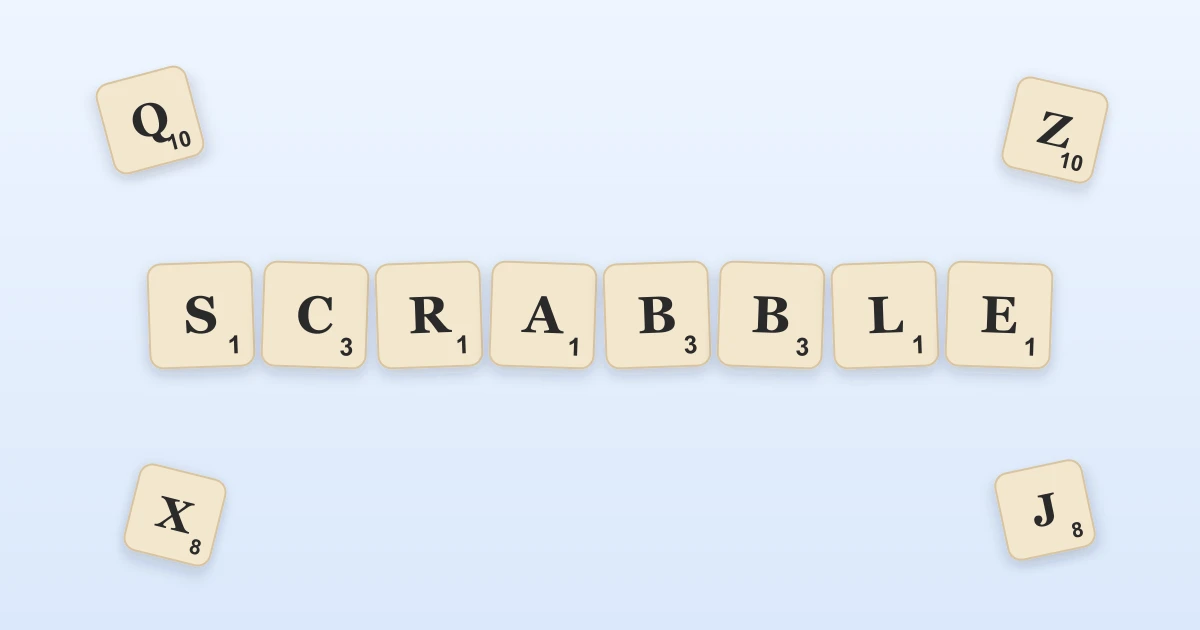
How to Play Scrabble: Rules, Scoring & Board Bonuses
A clear, complete guide to Scrabble — setup, turn order, how scoring and the premium squares work, and the beginner habits that quietly win games.
Vowel-Heavy Words That Save a Bad Rack
Stuck with a rack full of vowels in Scrabble? These vowel-heavy words clear the logjam and keep you scoring — from a studio that builds word games.