
Scattergories is a word game for 2 to 6 players where everyone gets the same letter and the same list of 12 categories, and races a timer to write one answer for each. An answer only scores if nobody else at the table wrote it. So the game is less about knowing a fruit that starts with B and more about knowing a fruit that starts with B that your friends will not think of.
This guide covers the rules, the scoring, the arguments that come up at every table, and how to play with two people or with no box at all. To test the usual tips, we built lists of 1,050 everyday words in 12 common categories and counted what each letter of the alphabet has to offer. The numbers below come from those lists. There is a free round against three computer players at the end of the page.
What is in the box
Hasbro's current edition lists 6 folders, 48 category cards, an answer pad, 6 pencils, a 20-sided letter die, a timer and a tray to roll the die in. Each category card has several numbered lists of 12 categories on it, and each player clips the same card into a folder so the lists line up with the answer sheet.
The answer sheet has three columns of 12 lines, one column for each round.
How to play Scattergories
- Pick a list. Everyone puts the same card in their folder and the group agrees which numbered list of 12 categories to use.
- Roll the die. One player rolls the 20-sided die. The letter on top is the letter for the round.
- Start the timer. The timer runs for about three minutes. Everyone writes, at the same time and in secret, one answer per category, and every answer has to start with the rolled letter.
- Pencils down. When the timer goes off, everyone stops writing, even mid-word.
- Read and score. Going down the list one category at a time, each player reads their answer out loud. An answer that nobody else wrote scores 1 point. If two or more players wrote the same answer, all of them cross it out and score nothing.
- Play three rounds. Roll a new letter and use the next list for round two and round three. The player with the most points after three rounds wins.
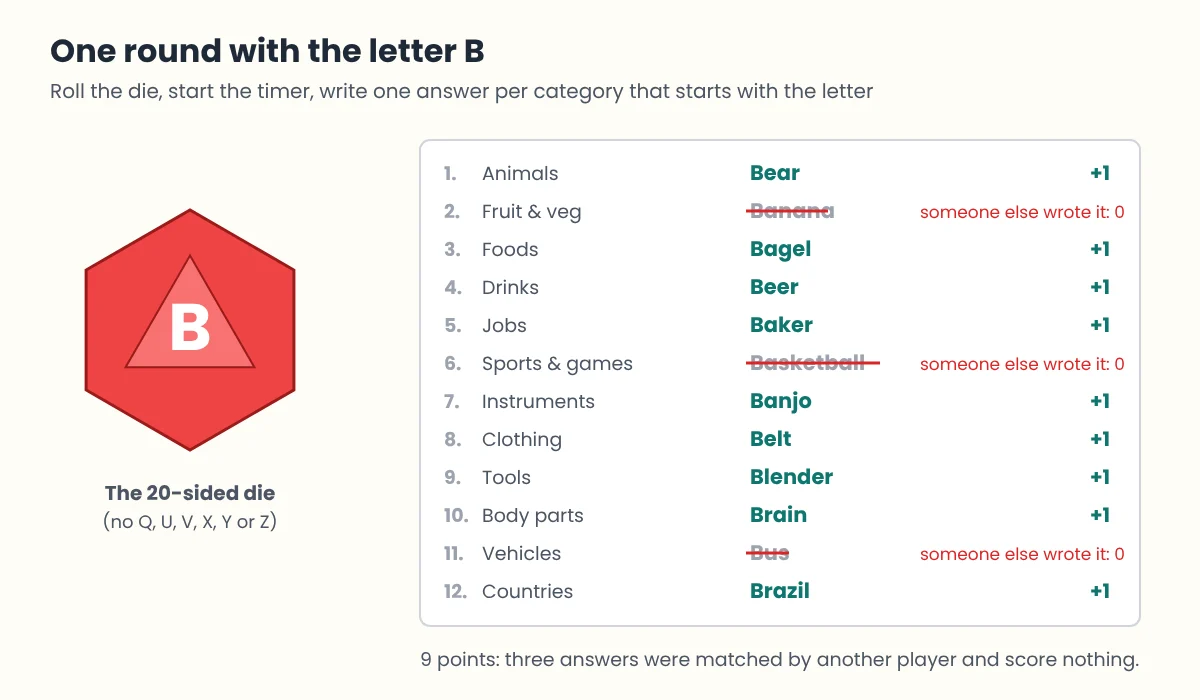
In the round above, the player wrote an answer for all 12 categories and still scored 9. Banana, basketball and bus are the first words most people reach for with a B, so somebody else had them too.
The letter rule
The first word of the answer has to start with the letter. "A", "An" and "The" at the front are ignored, so "The Bahamas" is fine for B and "A Taxi" is not fine for A. An answer of two or more words is allowed, and most rule books give an extra point for each word that starts with the letter, so "Big Brown Bear" for Animals scores 3 if nobody matches it.
Challenges
Any player can challenge an answer that does not fit the category, like "Bagel" for Drinks. The table votes. If the vote goes against the answer, or ties, it scores nothing. Most of the shouting in a game happens here, so agree before the first round how strict you want to be.
The rules people argue about
These come up in nearly every game. The rule book settles a few of them and leaves the rest to the table.
- You cannot use one answer for two categories in the same round. "Banana" for both Fruits and Yellow Things only counts once.
- Plurals are the same answer. If one player writes "Bear" and another writes "Bears", both are crossed out.
- "Blue Banana" is not a fruit. Adding a word that starts with the letter just to get the extra point is the classic trick, and the table can vote it down.
- Many groups let a person count by first or last name. Decide this before you roll, because it changes how easy the People categories are.
- An answer can be true but odd. If you can explain why "Boa" is a piece of clothing (a feather boa), the vote usually goes your way.
Why the die has no Q, U, V, X, Y or Z
The standard die has 20 faces: A to P, then R, S, T and W. The six missing letters are Q, U, V, X, Y and Z. We counted why.
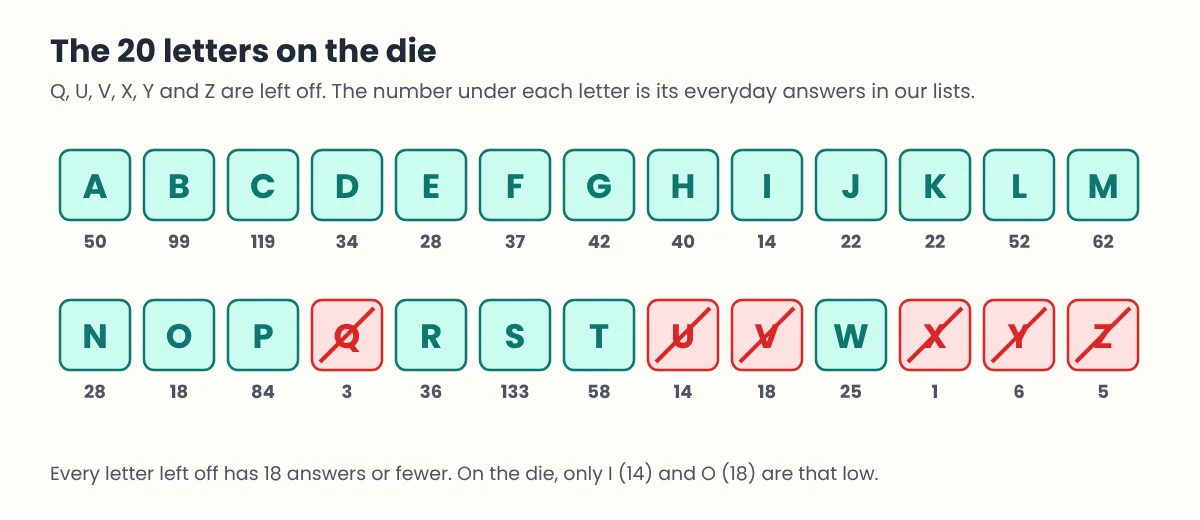
Across our 12 categories (animals, fruits and vegetables, foods, drinks, jobs, sports and games, musical instruments, clothing, tools, body parts, vehicles and countries), the 20 letters on the die average 50 everyday answers each. The six letters left off average 8. X has exactly one, xylophone. Q has three: quiche, quartermaster and Qatar.
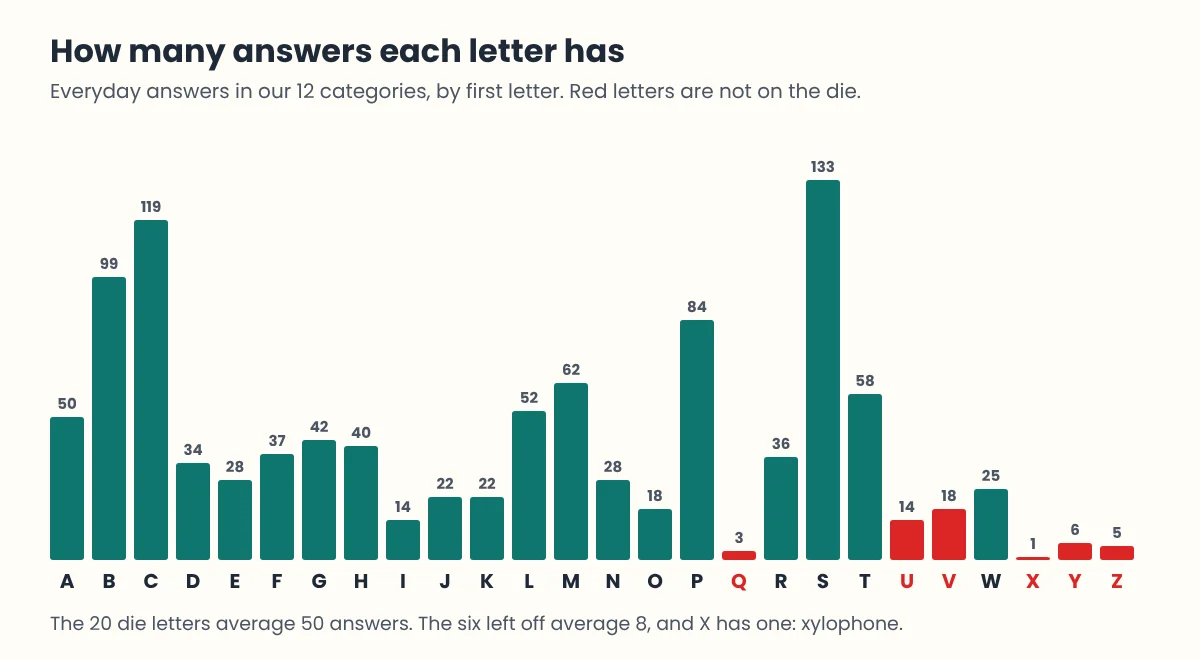
S is the easiest letter by a distance, with 133 answers in our lists, followed by C (119) and B (99). S has more than twice the answers of A and nine times the answers of I.
The cut is not perfect. V has more answers than I does, and U has the same number, yet I is on the die. But U has a bigger hole: in our lists it has nothing at all in 7 of the 12 categories, and V has no tool.
The hard letters that are still on the die
Being on the die does not make a letter easy. We counted, for each of the 20 die letters, how many everyday answers each category has.
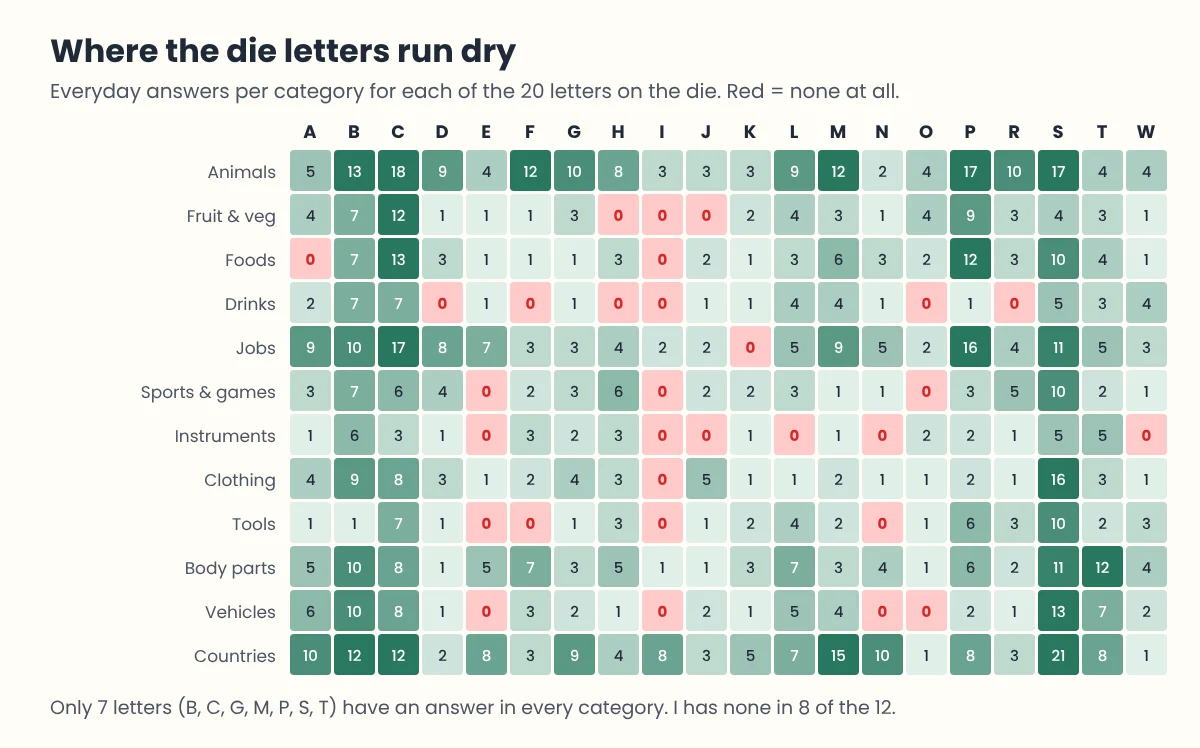
Only 7 of the 20 die letters (B, C, G, M, P, S and T) have at least one everyday answer in every one of the 12 categories. The rest have gaps:
- I is the hardest letter on the die. It has nothing in 8 of the 12 categories in our lists: no fruit, food, drink, sport, instrument, clothing, tool or vehicle among the everyday words. Its answers are insect, iguana, impala, India, Ireland, Israel, intern and a few more.
- E has no sport, instrument, tool or vehicle.
- O, N and H each miss two or three categories. O has no drink, sport or vehicle; N has no instrument, tool or vehicle.
- K has no job in our everyday list, and J has no fruit or instrument.
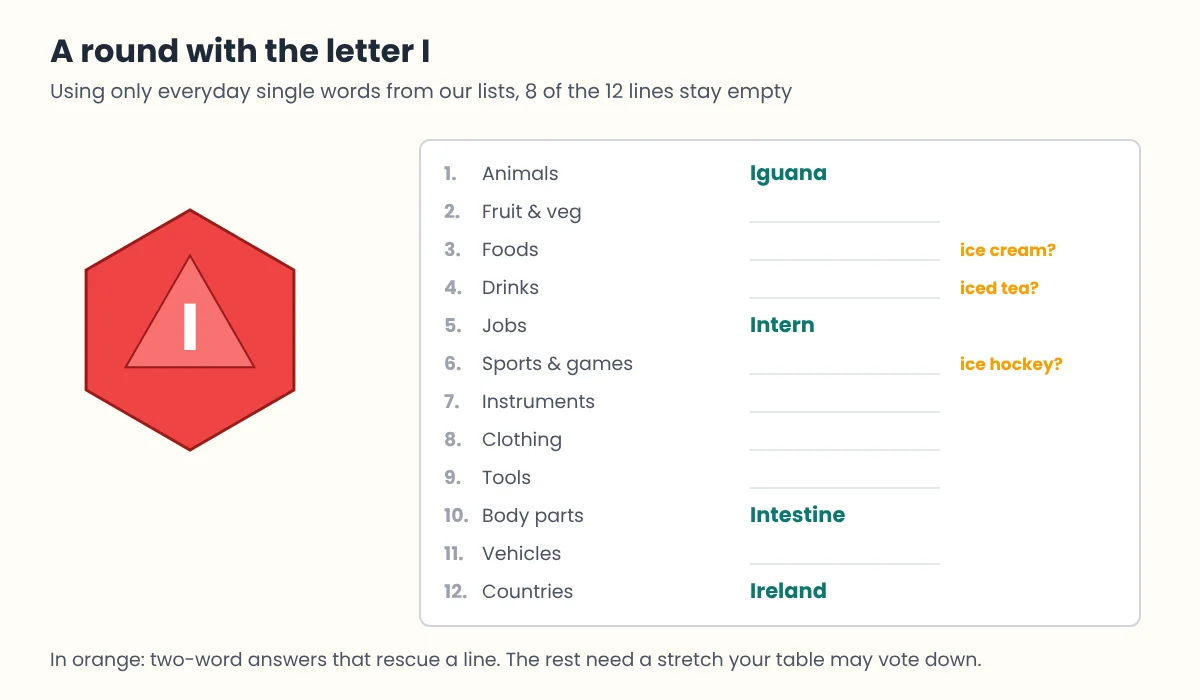
The gaps are why a roll of I or E feels like a lost round. When you get one, use two-word answers: "ice cream" (Foods), "iced tea" (Drinks), "ice hockey" (Sports) and "electric guitar" (Instruments) all start with the letter. Our lists only count single words, so they do not show up in the grid.
Do not write the first answer you think of
The scoring is the strange part of Scattergories. A good answer that someone else wrote is worth the same as a blank line. So we asked: how often does the most obvious answer get matched?
To find out, we let a group of computer players pick answers the way people tend to, with each word's chance in proportion to how often it is used in English. "Banana" is used far more than "blueberry", so it gets picked far more. We ran this for the 78 letter and category pairs that have five or more everyday answers, 400 times each.
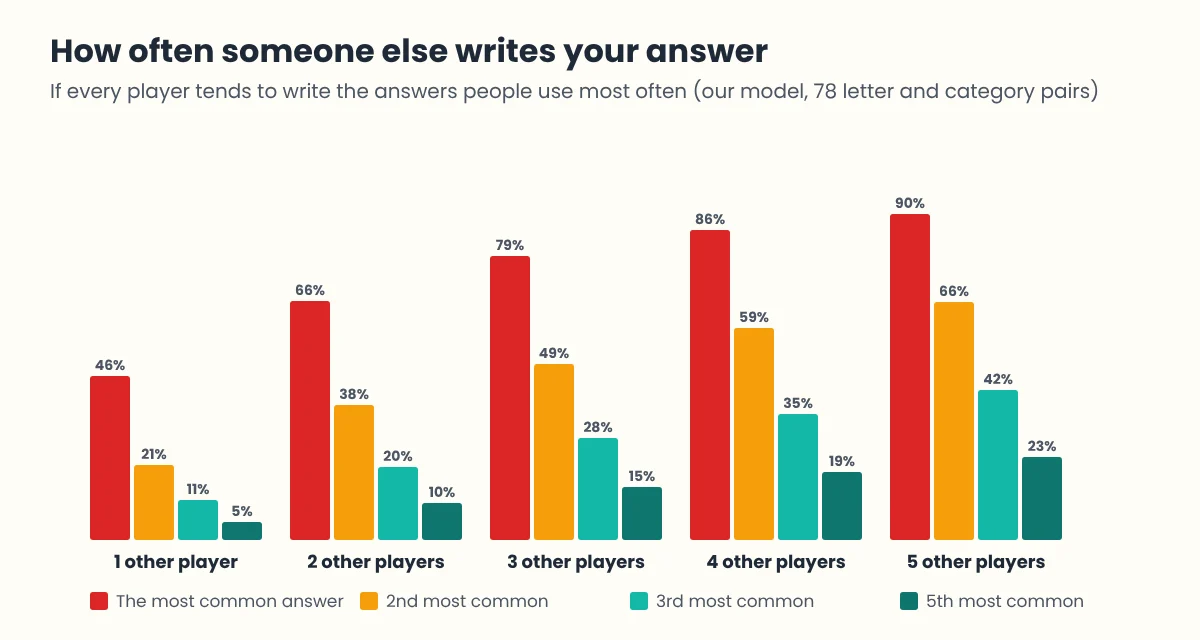
In a four-player game (you and 3 others), the most common answer is matched 79% of the time, so it scores about one time in five. The second most common answer is matched 49% of the time, the third 28% and the fifth 15%. With six players, the obvious answer scores less than one time in ten.
Under this model the most common word takes, on a typical line, 43% of all the picks by itself. That is why "banana", "basketball" and "bus" got crossed out in the round at the top of the page.
So skip the first word that comes to mind and write the second or third. It costs you a few seconds and roughly doubles or triples your chance of scoring that line. In a small game it matters less: with one other player, even the obvious answer is matched only 46% of the time.
Tips to score more
- Go for the third answer. As shown above, it scores far more often than the first one.
- Use two-word answers. They are rarer, they can earn the extra alliteration point, and they fill the holes in hard letters.
- Fill every line first. A blank scores zero for sure. Write something quickly on all 12 lines, then go back and swap obvious answers for better ones while the timer runs.
- Think of places and brands. Many lists include categories like Things in a Kitchen or Store Names, where a specific answer ("Blender", "Best Buy") is less likely to be matched than a general one.
- Watch your table. If your friends always write "Banana", write "Blackberry".
- Keep answers short. You only need enough words to fit the category, and a short answer is easier to defend in a vote.
Playing with two players, in teams or without the box
Two players. The game works with two, but matches are rarer (46% for the obvious answer in our model, against 79% with four players), so scores run high. Many pairs make it harder by allowing only answers of two or more words, or by cutting the timer to two minutes.
Teams. For a big group, split into teams of two or three. Each team shares one sheet and whispers. Scoring works the same, team against team.
No box. You only need a letter, a list and a timer. Pick a letter by opening a book to a random page and taking the first letter (skip Q, U, V, X, Y and Z, as the die does), write 12 categories on a sheet, and use a phone timer. Or play the round at the bottom of this page.
In a classroom. Teachers use Scattergories for spelling and vocabulary because every pupil plays at once. Put the categories on the board, roll a letter, and have pupils swap sheets to score each other.
For other word games that play well with a group, see our guides to Bananagrams and Connections. If you like word games that you can play alone, Word Ladder is a good next one.
How we checked
We built lists for 12 categories from WordNet, a free dictionary that groups words by meaning (every animal word sits under "animal", and so on), and kept only single words that are common in everyday English. For that we used wordfreq's Zipf score, a measure of how often a word is used, and kept words scoring 3 or more (about one use per million words or more). We dropped words whose main meaning is something else (a drill is a kind of monkey, but mostly a tool) and words that are not suitable for a family game, added a short list of common answers the dictionary missed (like saw, bus and juice), and built the country list from the ISO list of country names. That gave 1,050 answers in all.
The duplicate numbers come from a model, not from real games. Each computer player picks a word with odds in proportion to how often the word is used, so real players, who think of different things on different days, will match a little less often. The order (first answer matched most, then second, then third) is what to take away. The scripts are in our site's code at apps/web/scripts/startwriting/how-to-play-scattergories/.
Common questions
How many letters are on a Scattergories die? 20. The die has every letter from A to T except Q, plus W. The letters Q, U, V, X, Y and Z are left off because they have so few answers. In our lists the six missing letters average 8 everyday answers across 12 categories, against 50 for the letters on the die.
How long is the Scattergories timer? About three minutes for each round. Many groups shorten it to two minutes once everyone knows the game.
How many players do you need? The box is for 2 to 6 players. More can play in teams.
Can you use the same answer twice? Not in the same round. Each answer can only fill one category on your sheet.
What happens if two players write the same answer? Both cross it out and score nothing for that line. This is the rule that makes the game, and the reason the most obvious answer is a bad bet.
Do answers with more than one word count? Yes. The first word has to start with the letter, ignoring "A", "An" and "The". Most rule books also give an extra point for each word that starts with the letter.
What is the hardest letter in Scattergories? Of the letters on the die, I is the hardest in our count, with no everyday single-word answer in 8 of 12 common categories. E, O and N come next.
Play Scattergories now
Here is one round against three computer players, Ada, Ben and Cleo. Choose a timer of 2, 3 or 5 minutes and press Roll the die and start. You get a letter from the 20 on the real die and our 12 categories in a new order each time. Type one answer per line (Enter jumps to the next line) and press Pencils down when you are done, or wait for the timer.
The computer players write their answers from our lists of everyday words, picking common words more often, the way people do. Any answer that two players wrote is crossed out for both. If you write something that fits but is not on our list, you decide whether it counts, as your table would.
Where to buy: Scattergories (Hasbro). The page lists what is in the box and has the official rules to download.
Related articles
How to Play Wordscapes: Rules, Bonus Words and How Many Words a Wheel Holds
How Wordscapes works: the letter wheel, the crossword board, bonus words, hints and shuffle. Plus counts from 8,534 letter wheels, two tips tested, and a free letter wheel game to play.
How to Play Bananagrams: Rules, Dumps and What 4,000 Hands Show
Bananagrams rules for 2 to 8 players: Split, Peel, Dump and Bananas. Plus what 4,000 computer hands say about the Q and vowels, and a free solo game.
How to Play Scrabble: Rules, Scoring & Board Bonuses
A clear, complete guide to Scrabble: setup, the 100-tile bag, how scoring and premium squares work, and the rules most people get wrong.