
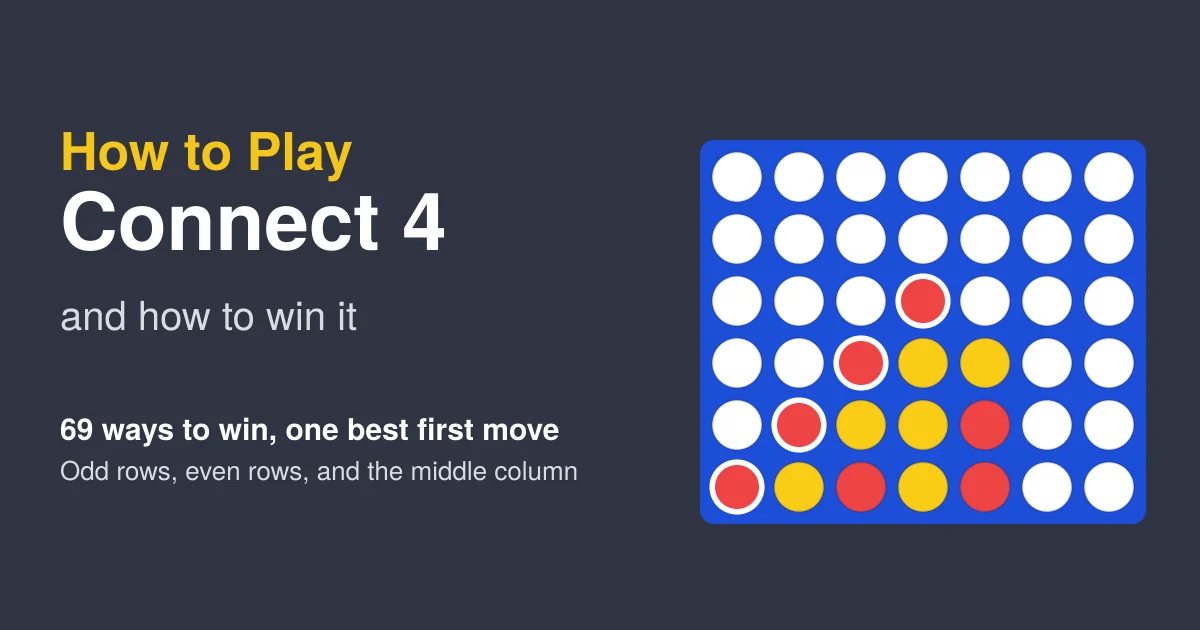
Connect 4 looks like a game of luck for children: drop discs, hope for four in a row. In fact it is a game of pure planning, and it has been solved. With perfect play, the player who goes first can always win, but only by starting in one particular column.
You will not play perfectly, and neither will your opponent. So this guide covers the rules, then the three ideas that matter most in real games: the middle column, double threats, and the rule about odd and even rows. We checked each one with numbers: every possible line on the board, 20,000 random games, thousands of games between computer players, and a perfect solver that checks every first move.
How to play Connect 4
Connect 4 needs a stand-up grid and two sets of colored discs, usually red and yellow.
- The grid has 7 columns and 6 rows, 42 holes in all. Each player has 21 discs.
- Players take turns dropping one disc into any column that is not full. The disc falls to the lowest empty hole.
- The first player to get four of their discs in a line wins. The line can go across, up and down, or on a slant.
- If the grid fills up with no four in a row, the game is a draw.
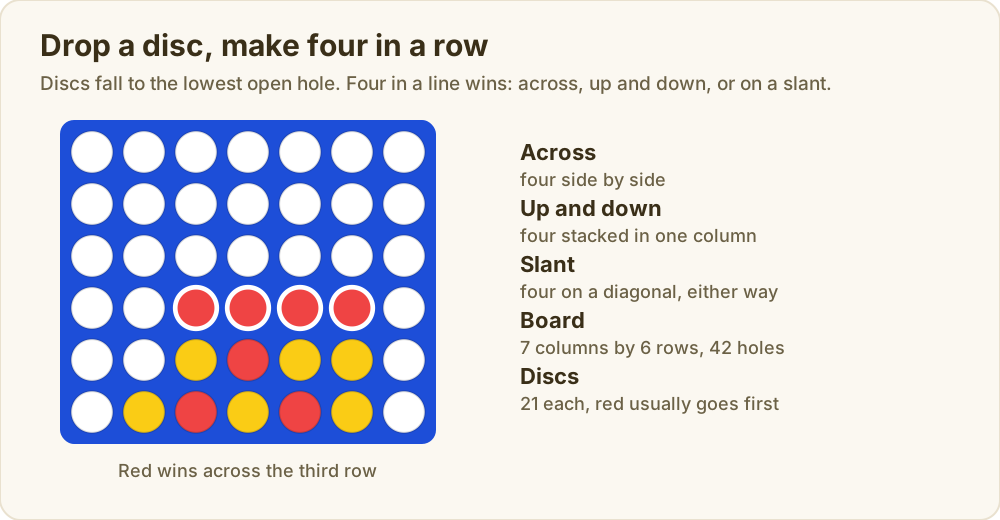
Because discs fall, you cannot play anywhere you like. You can only play on top of what is already in a column. That one rule is what makes Connect 4 so much deeper than tic-tac-toe.
Why the middle column matters
Everyone says to start in the middle. Here is why, in numbers. There are exactly 69 possible lines of four on the board: 24 across, 21 up and down, and 24 on the two slants. We counted how many of them pass through each hole.
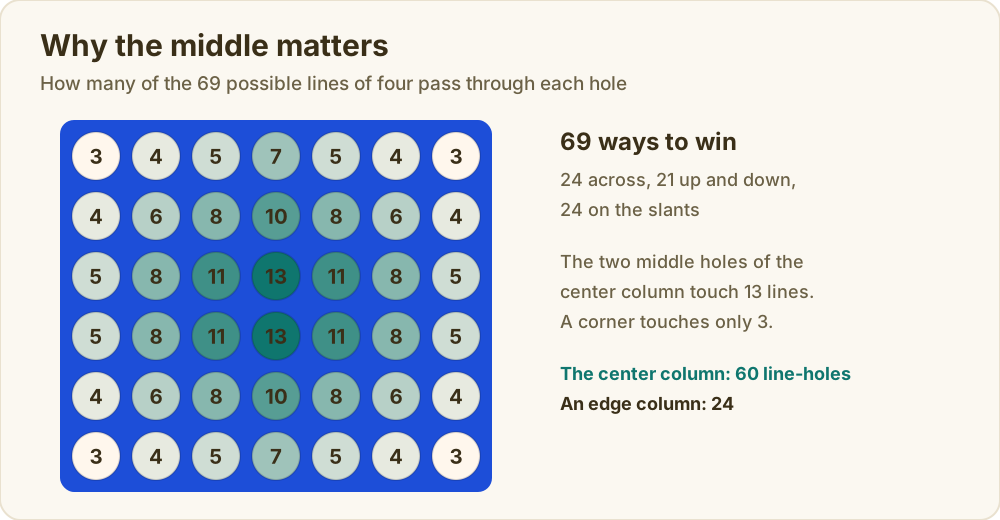
A corner hole is part of only 3 lines. The two middle holes of the center column are part of 13. Add up the whole column and the center is worth 60 line-holes, against 24 for an edge column. Every disc in the middle helps more of your possible fours and blocks more of your opponent's. A disc on the edge mostly sits there.
That is also why random play is so even. In 20,000 games where both players dropped discs at random, the first player won 55.4% and the second 44.3%, with almost no draws (0.3%). The games lasted 21 moves on average. Random players do not use the middle on purpose, so going first only helps a little.
Double threats
You win Connect 4 the same way you win tic-tac-toe: by making two threats at once. A threat is a hole where one more of your discs would make four. If you have two, and your opponent can block only one, you win.
The twist in Connect 4 is gravity. A threat only counts when the hole below it is filled. A threat high up on the board can sit there for many turns, and the player who is forced to fill the hole under it hands the win to the other side. Most of the skill in the game is in setting up those threats early, then making your opponent run out of safe moves.
That leads to the most useful rule in Connect 4.
Odd rows for the first player, even rows for the second
Number the rows from the bottom, 1 to 6. Good players will tell you that the first player wants threats on odd rows (1, 3, 5) and the second player wants them on even rows (2, 4, 6). The reason is counting. Near the end of a game, when the players are forced to fill the last columns, the first player keeps landing on odd-row holes and the second player on even-row holes. A threat on the right row cannot be dodged: sooner or later your opponent has to fill the hole under it.
We tested it. We had two computer players that look four moves ahead play thousands of games against each other, and for every win we noted the row of the disc that completed the four.
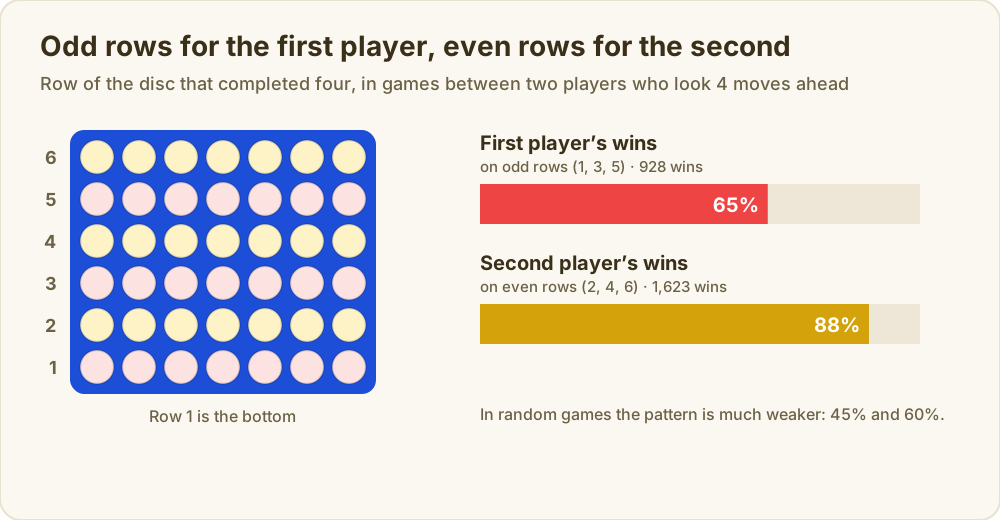
The rule holds, and strongly for the second player: 88% of the second player's wins came on an even row, and 65% of the first player's wins on an odd row. In random games, where nobody plans, the split was only 45% and 60%. So the rule is not an accident of the board. It is what happens when players start making threats on purpose.
In practice: if you went first, build toward fours that finish on rows 1, 3 or 5. If you went second, aim for rows 2, 4 and 6, and do not fill the hole under your opponent's odd-row threat.
The first move, solved
Connect 4 was solved in 1988, by James Dow Allen and, two weeks later and on his own, by Victor Allis. With perfect play from both sides, the first player wins, but only by dropping the first disc in the middle column.
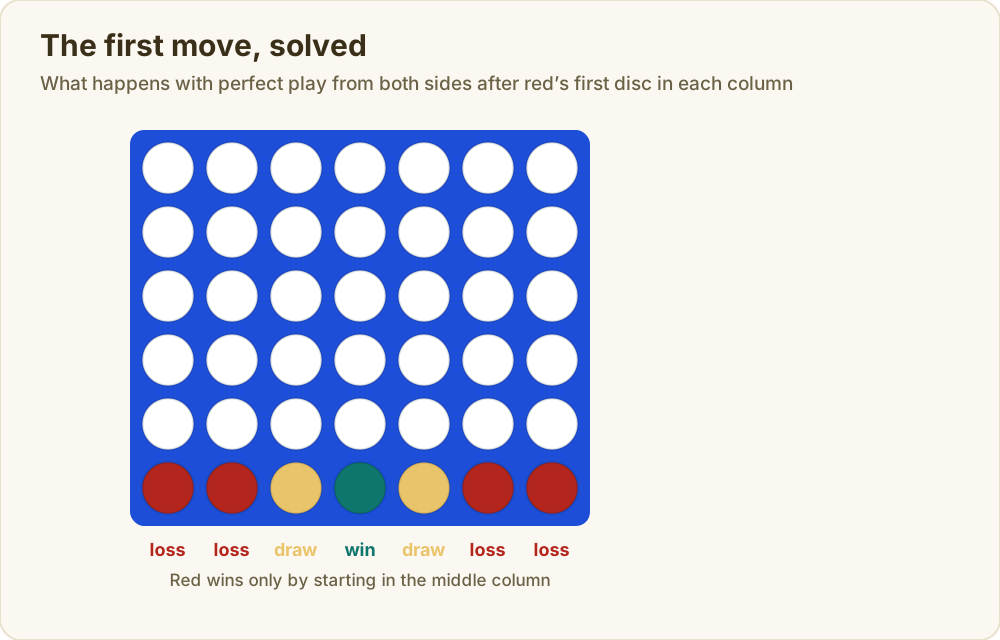
Start in the middle and a perfect player wins. Start one column off the middle and the game is a draw. Start in any of the four outer columns and the first player loses against perfect defense. We wrote our own perfect solver and checked every first move ourselves. It confirms all three results: the middle column wins for the first player, the column next to it is a draw, and the two outer columns on each side lose for the player who dropped the disc. (The board is the same from both sides, so we solved one side and the middle.) Even from the middle, the perfect win is slow: it comes on the first player's 21st and last disc, which shows how close to a draw the game really is.
Nobody plays perfectly, so a bad start is not the end. But it is a clear reason to take the middle when you go first, and to take it right back when you go second and your opponent did not.
Tips that come straight from the numbers
- Start in the middle column. Its holes touch up to 13 lines of four, an edge hole as few as 3, and it is the only first move that wins with perfect play.
- Look for double threats. Two holes that each complete four, and your opponent can block only one.
- Count rows from the bottom. First player: aim for threats on odd rows. Second player: even rows. In our computer games, 88% of the second player's wins landed on even rows.
- Watch what you fill. Before you drop a disc, check whether it gives your opponent the hole above it.
- Block early. Three in a row with open space on both ends is already two threats.
How we checked
The line counts are exact: a program listed all 69 lines of four and counted them through each hole. The random games are 20,000 games where each player picked any open column at random. The computer players look four moves ahead, take any win they see, and score positions by their open lines; each first move was played 400 times, with ties between equally good moves broken at random, and every won game was logged with the row of its last disc. The solver is a perfect player that searches the whole game, the same kind of program used to solve Connect 4. The code is in our site's repository, and the playable game below uses the same engine.
Where Connect 4 came from
Milton Bradley sold Connect Four in 1974, and it is now made by Hasbro. The idea of dropping pieces into a vertical frame was the new part; games of four in a row on a flat board are much older. The game's small size made it a favorite test for early computer researchers, which is why it was solved so early, in 1988.
Frequently asked questions
Is Connect 4 solved? Yes. It was solved in 1988 by James Dow Allen and by Victor Allis. With perfect play the first player wins by starting in the middle column.
What is the best first move in Connect 4? The middle column. It is the only first move that wins with perfect play, and its holes are part of the most lines of four.
Can the second player win Connect 4? Not against perfect play. Against real opponents, yes: aim for threats on even rows, counting from the bottom.
How many ways are there to win in Connect 4? 69 lines of four: 24 across, 21 up and down, and 24 on the slants.
What is the odd and even rule? The first player usually wins with threats on odd rows (1, 3, 5) and the second player on even rows (2, 4, 6). In our computer games, 88% of the second player's wins and 65% of the first player's followed it.
Play Connect 4 now
Play against the same engine we used for the numbers above. You are red. Choose to go first or second, and pick a level: Easy takes an obvious win when it sees one but otherwise plays loosely, Medium looks four moves ahead, and Hard looks seven. Tap a column to drop a disc, or press the keys 1 to 7 on a computer. Undo takes back your last move and the computer's reply. Tick "Show line counts" to see, in every empty hole, how many lines of four pass through it, the same counts as the map above.
If you like this kind of game
Connect 4 is a bigger cousin of tic-tac-toe, which is small enough to work out completely. For more games where planning beats luck, try our guides to Minesweeper and 2048, or see our list of the best brain training and logic games.
Related articles
How to Play Tic-Tac-Toe, and How to Win (or Never Lose)
The rules of tic-tac-toe, the best first move, the only safe replies, and how to win more often, from all 255,168 possible games worked out by computer.
How to Play Minesweeper, and When You Have to Guess
The rules of Minesweeper, what the numbers mean, two patterns that get you unstuck, and how often a perfect player still has to guess, from 360,000 boards played by computer.
How to Play Hangman, and the Best Letters to Guess
The rules of Hangman, the best first letter for every word length, and why MOM, not JAZZ, is the hardest everyday word, from 6,298 words played by computer.