
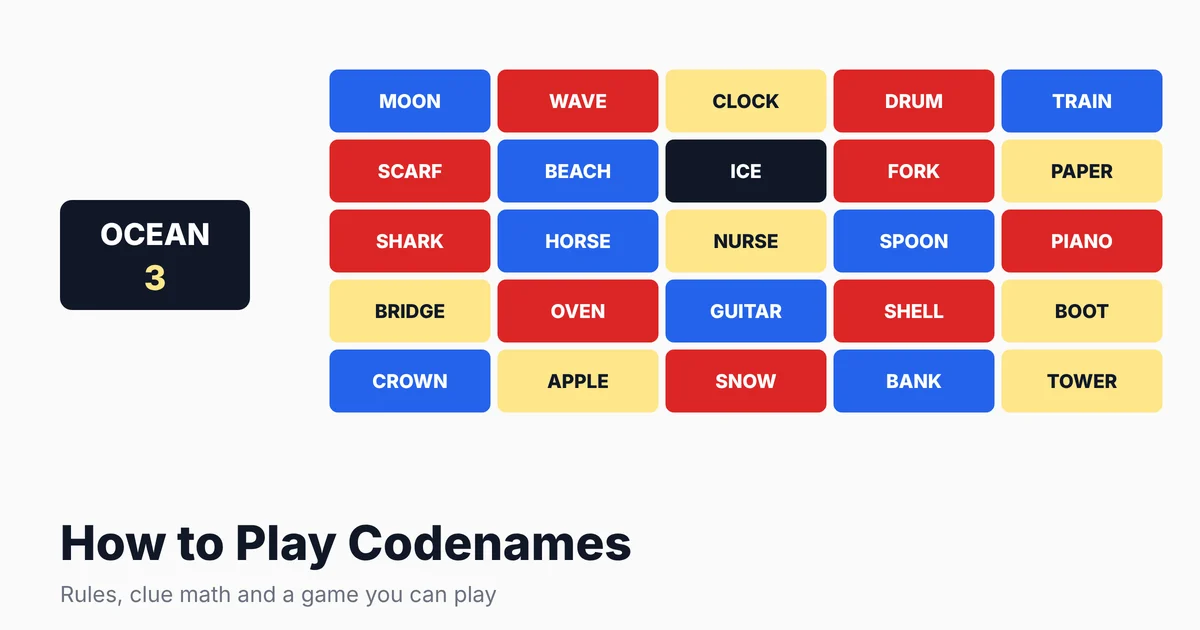
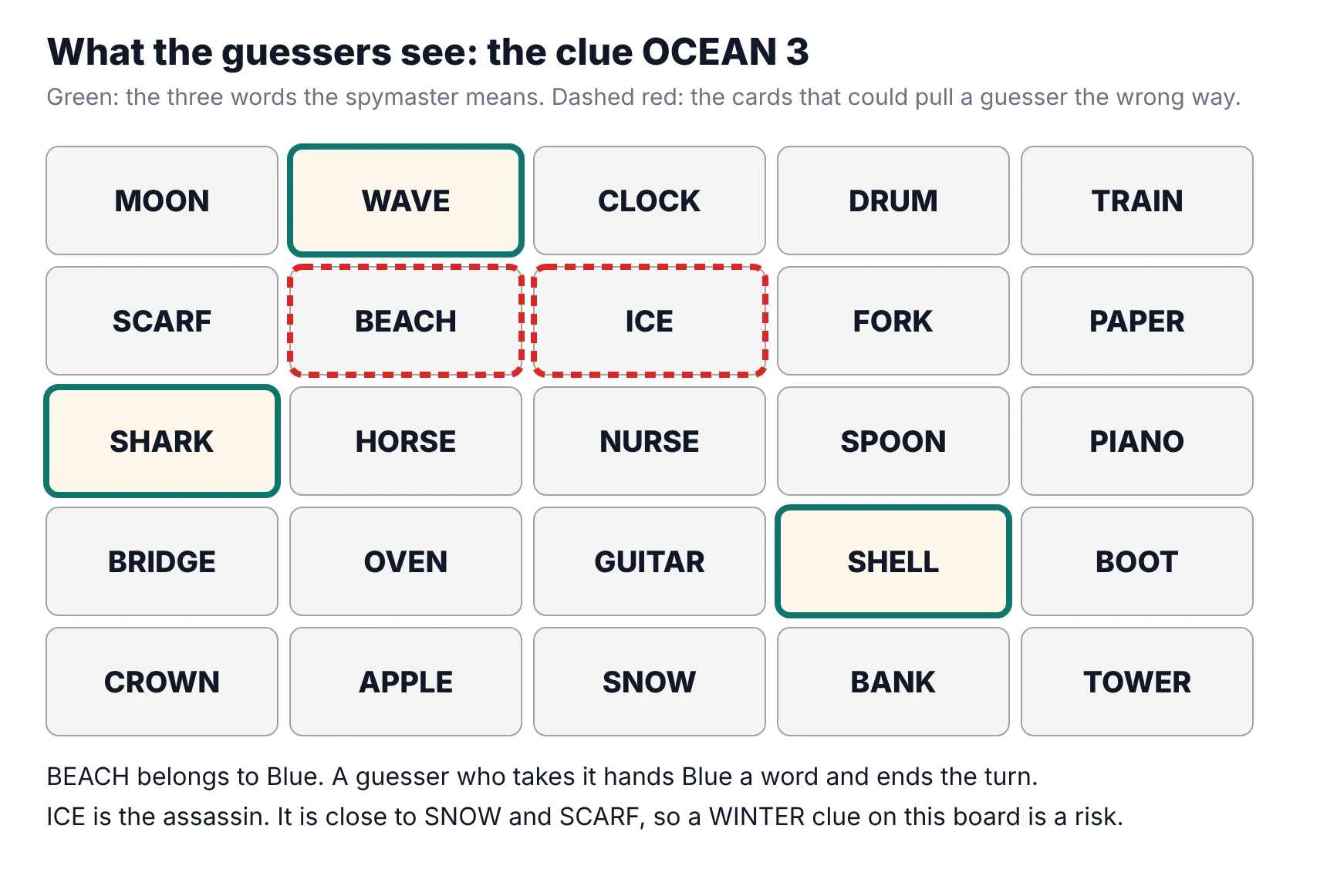
Codenames is a party word game for two teams. Each team has one spymaster who knows which words on the table belong to them, and the rest of the team has to work it out from one-word clues. The spymaster says something like "ocean, 3" and hopes the team touches WAVE, SHARK and SHELL, and not BEACH, which belongs to the other side.
It was designed by Vlaada Chvátil and came out from Czech Games Edition in 2015. It won the Spiel des Jahres, the big German game of the year award, in 2016. A game takes about 15 minutes and works best with four or more people.
Below are the rules, then what we found when we played the game out more than a million times in a simple model: how big your clues should be, whether going first helps, and how often the assassin ends a game. At the end there is a version you can play here, with our own boards and our own clues.
What is in the box
- Word cards. Each has a word on both sides. You lay 25 of them face up in a 5 by 5 grid.
- Key cards. Each key card is a small 5 by 5 map that shows which of the 25 spots are red, which are blue, which are plain bystanders and which one is the assassin. The coloured lights around its edge show which team goes first.
- Agent cards in red and blue, bystander cards and one assassin card, used to cover words as they are guessed.
- A sand timer, for groups that want one.
Setting up
Split into two teams, red and blue. Each team picks one spymaster. The two spymasters sit on the same side of the table, facing their teams.
Lay out 25 word cards in a 5 by 5 grid. One spymaster draws a key card at random and puts it in the stand, where only the two spymasters can see it. The key card says which team starts. That team has 9 words to find. The other team has 8. There are 7 bystanders and 1 assassin.
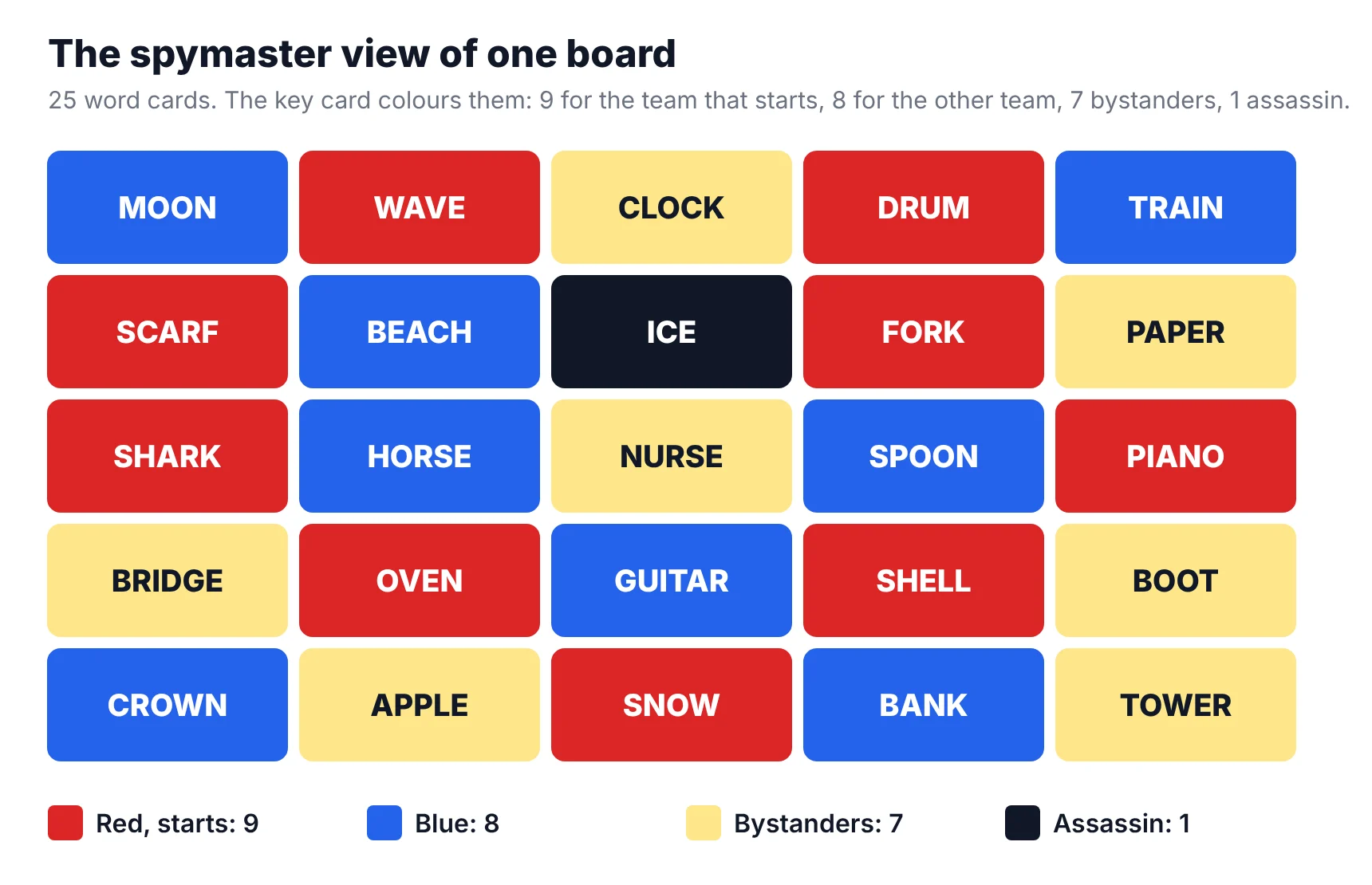
The guessers only see the plain words. The spymasters see the colours. That gap is the whole game.
How a turn works
The spymaster gives a clue: exactly one word and one number. The word is about the meaning of words on the table. The number says how many words it points to. "Ocean, 3" means "three of our words go with ocean".
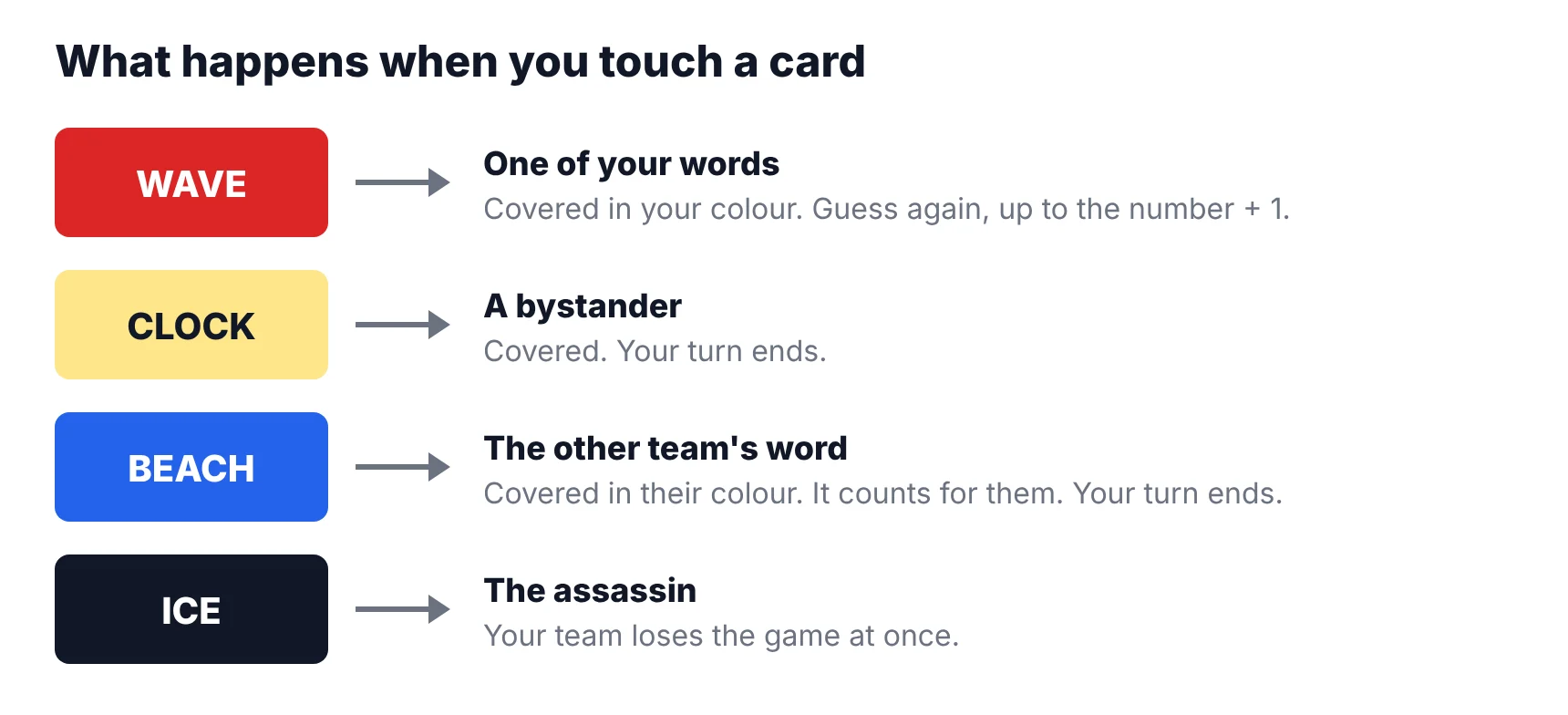
Then the team talks it over and touches one card at a time. The spymaster covers it with the right card:
- One of your words: it is covered with your colour and you may guess again.
- A bystander: covered with a bystander card. Your turn ends.
- One of the other team's words: covered with their colour, which helps them. Your turn ends.
- The assassin: your team loses at once.
You must make at least one guess each turn. You may stop whenever you like after that. You may make up to one guess more than the number, so after "ocean, 3" you can try a fourth word. That extra guess is for a word from an earlier clue that your team missed.
A team wins when all of its words are covered, even if the last one was turned over by the other team by mistake. A team loses at once if it touches the assassin.
What a spymaster may and may not say
The clue has to be about meaning. These are not allowed:
- A word that is on the table, or a form of one. If SHELL is face up, you cannot say "shells" or "seashell".
- Pointing, letters or positions. "S, 2" and "top row, 3" are out.
- Hints with your face, voice or hands. When your team touches a card, the spymaster stays still until it has been covered.
Two special numbers are allowed. Zero means "none of our words go with this", which is a warning: "ice, 0" tells your team to stay away from anything cold. Unlimited means "some of our words go with this, I am not saying how many", and lets the team guess as many as it likes.
The math of a blind guess
The board starts with 9 words for the team that goes first, 8 for the other team, 7 bystanders and 1 assassin. So a card touched for no reason at all on the first turn is yours 36% of the time and the assassin 4% of the time.
It gets worse as the game goes on, because your words get used up and the assassin never leaves.
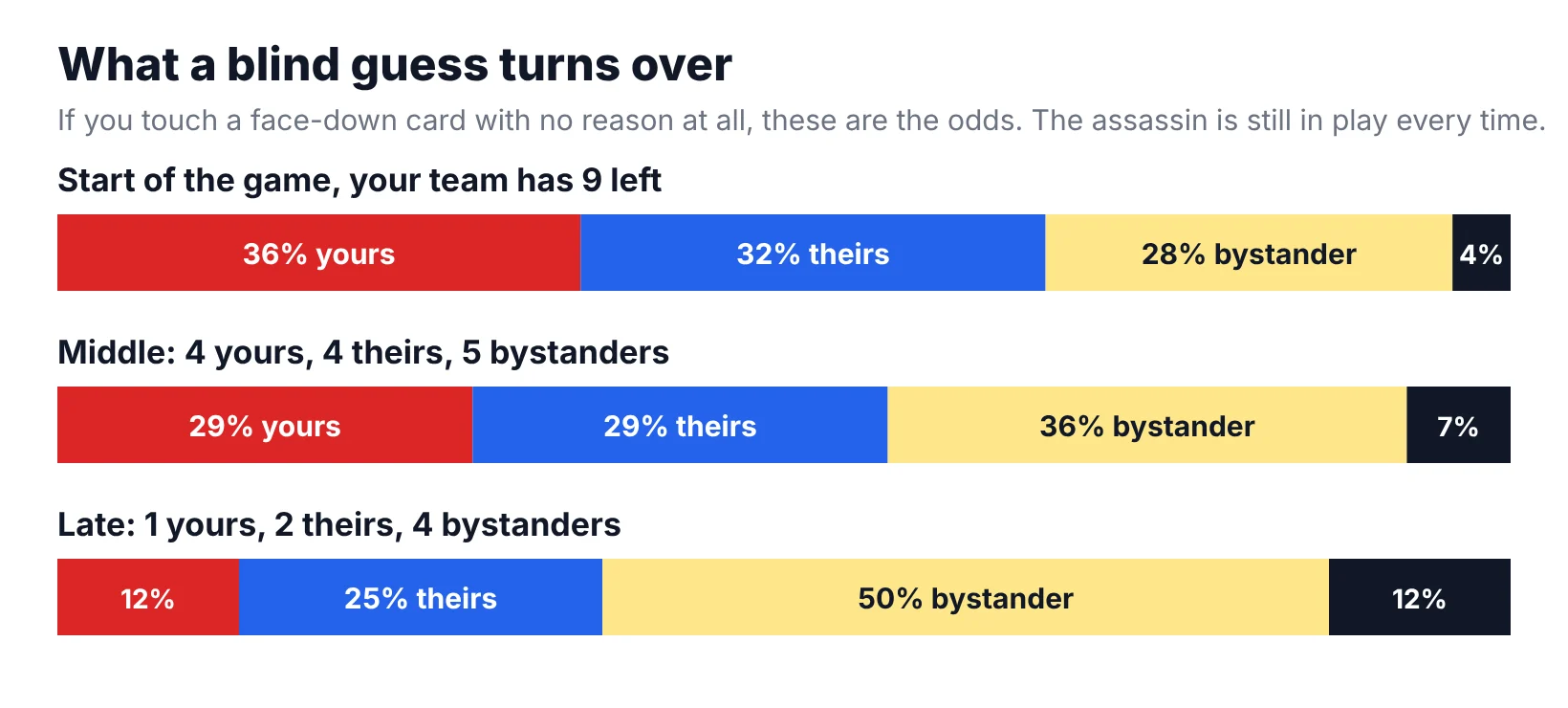
Late in a game, with one of your words, two of theirs and four bystanders still face down, a wild guess is as likely to hit the assassin as your own word: one chance in eight each. So the bonus guess is worth taking when you have a real candidate from an earlier clue, and almost never as a coin flip.
A side fact: for any 25 words on the table there are 210,344,706,000 ways a key card could colour them. Nobody is going to learn the key cards by heart.
How we tested clue size and going first
We wanted to know two things people argue about: is it better to give safe clues for 2 words or bolder clues for 3, and does the team that starts have an edge?
So we played the game out in a simple model. Each turn the spymaster gives a clue for the same number of words, or fewer when fewer are left. For each of those words the team is right with a set chance, say 90%. When it is wrong it touches some other face-down card at random. One of your own words means you keep going, a bystander or the other team's word ends the turn, and the assassin loses the game. Both teams play the same way unless we say so. We ran 30,000 to 40,000 games for each setting, about 1.2 million in all.
The model leaves things out. Real clues get harder as they get bigger, real teams talk, and a good spymaster steers away from the assassin. But it shows the shape of the game clearly.
Does going first help?
It depends on your clue size, and the reason is simple counting.
The starting team has 9 words. The other team has 8 but plays second. If both teams clue in threes, 9 words take three turns (3, 3, 3) and 8 words take three turns (3, 3, 2). Same number of turns, and the starting team gets there first. In our games it won 61% of the time at 90% accuracy.
If both teams clue in twos, 9 words take five turns (2, 2, 2, 2, 1) and 8 words take four. The ninth word costs a whole extra turn, and the starting team won only 37% of the time. Clue in fours and the same thing happens: 9 needs three turns, 8 needs two, and the starting team won 40%.
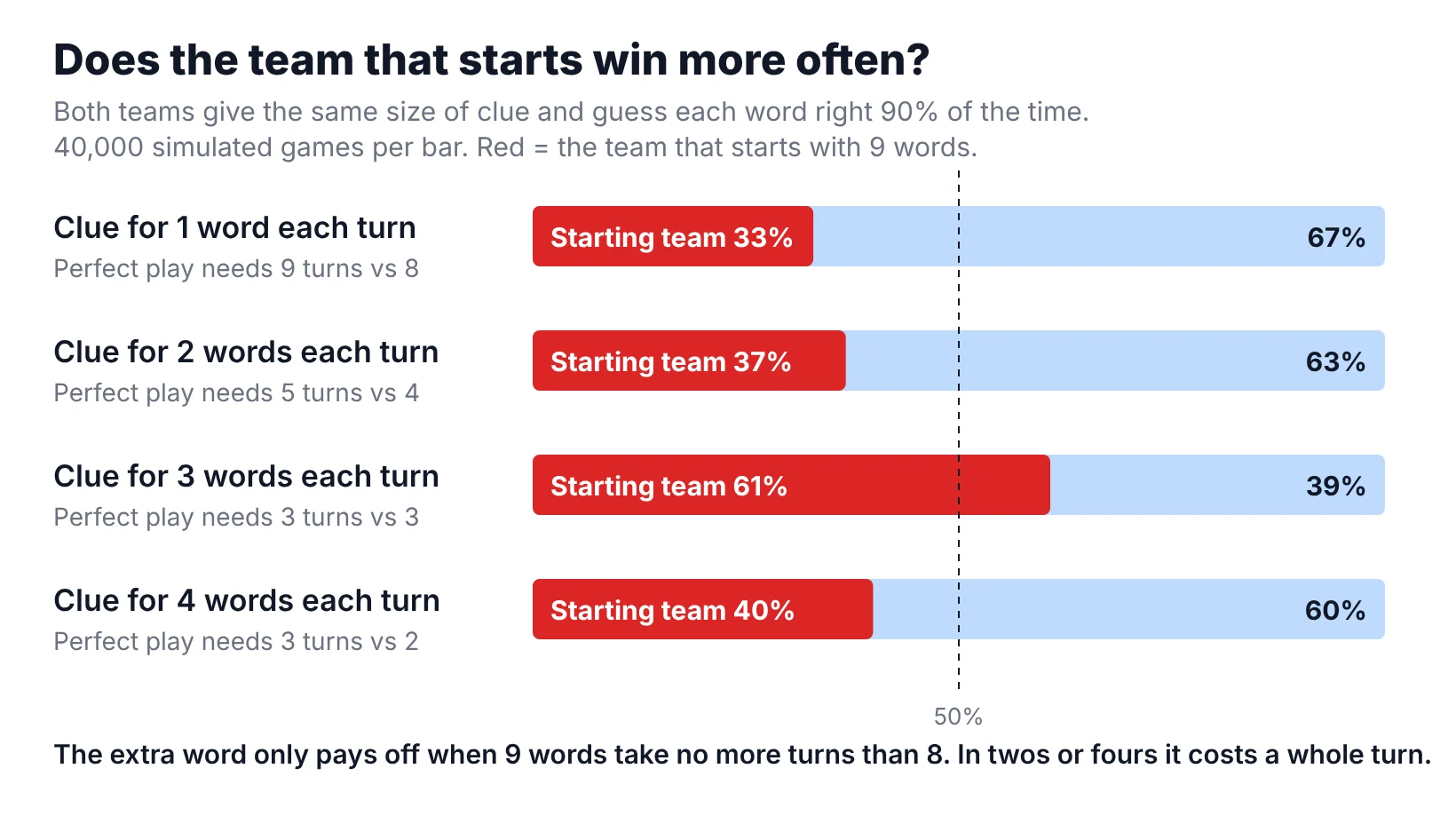
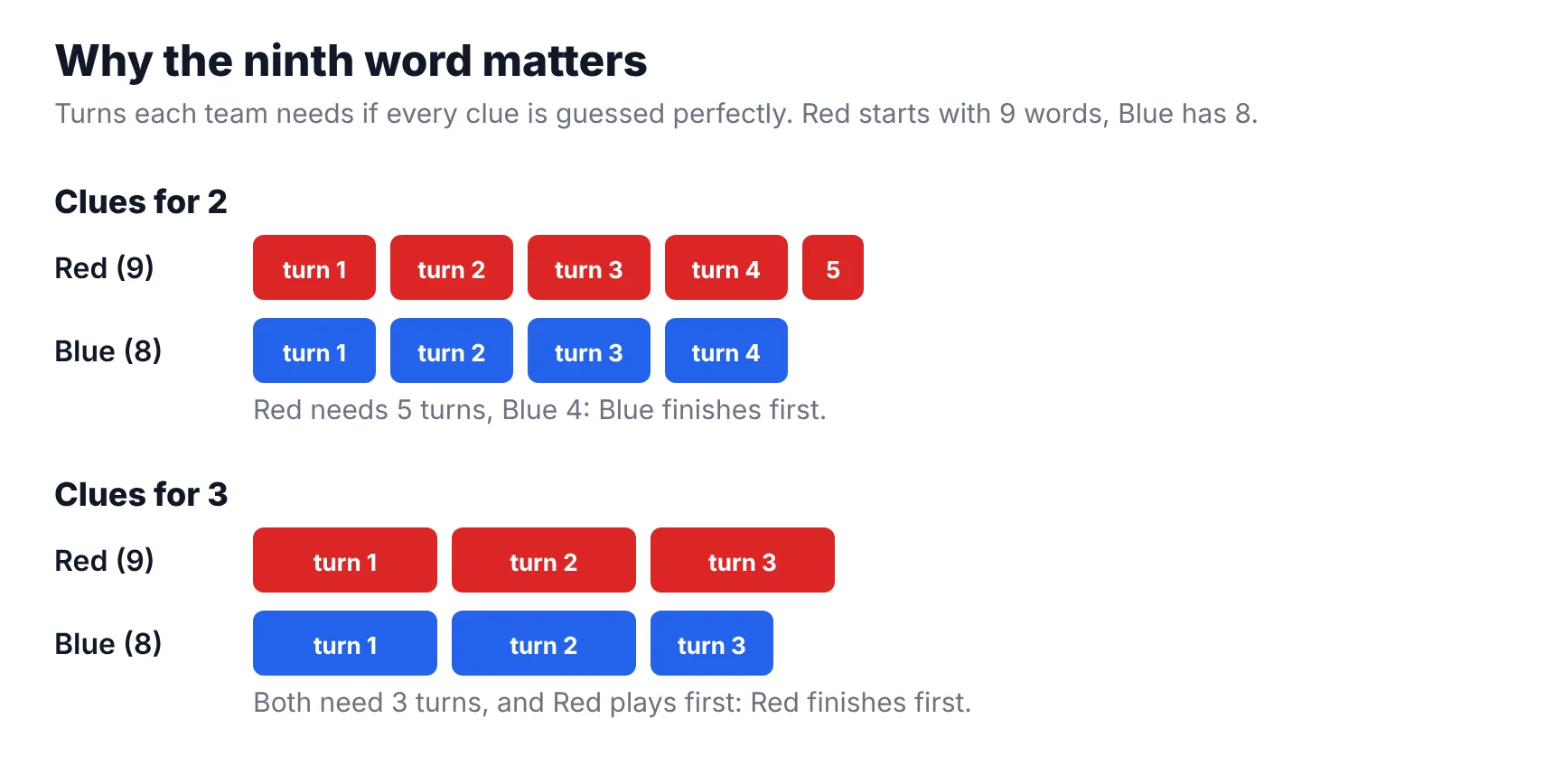
So the extra word is not a fixed handicap. It only stops mattering when 9 words fit into the same number of turns as 8. If your team starts, the leftover ninth word is the one to plan for: try to fold it into a clue for 3 rather than leave it alone at the end.
Bigger clues win, even when they go wrong more often
The bigger finding is about clue size. We put a team that clues for 3 against a team that clues for 2 and gets 95% of its words right. Each side started half the games.
When the clue-for-3 team was just as accurate, it won 91% of the time. Of course a clue for 3 is harder to read than a clue for 2, so we made the clue-for-3 team worse and worse. It still won 79% of games at 90% accuracy, 66% at 85% and 54% at 80%. It only fell behind at about 75%, when one word in four is a miss.
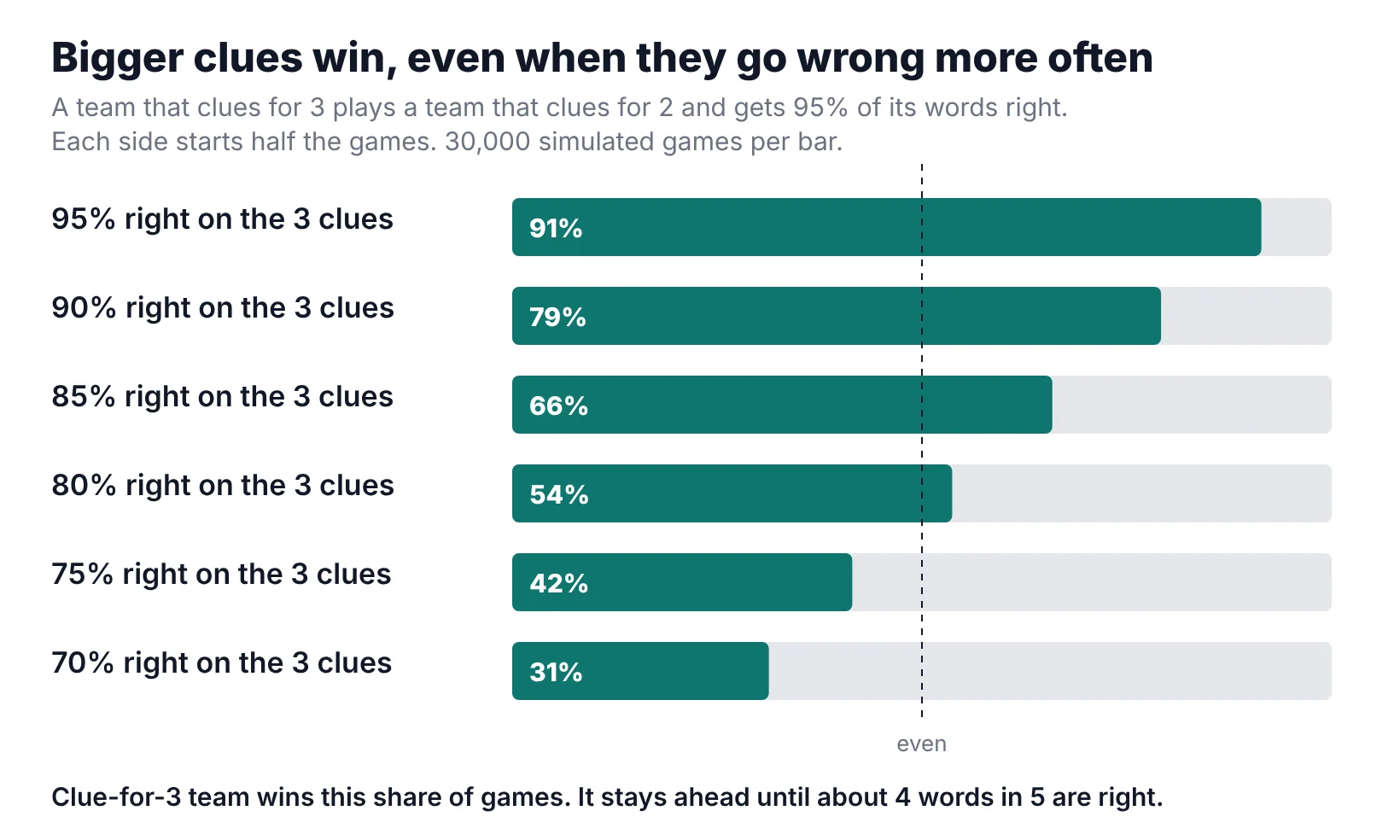
The reason is the clock. Codenames is a race, and a team that clues in twos needs four or five turns. A team that clues in threes needs three. One wrong guess costs the rest of a turn, but a slow team loses turns every time without any mistakes at all.
The assassin
In our games, how often a game ended on the assassin tracked how often teams missed. At 90% accuracy, about 10% of games ended that way. At 95% it was about 5%. Each wrong touch is a fresh roll, and with only one assassin on a board of 25 it is easy to forget that the roll comes up again and again.
The spymaster can cut that a lot in real play: before giving a clue, look at the assassin and ask whether the clue word could point at it. On the board above, ICE is the assassin and SNOW and SCARF are red. "Winter, 2" is a natural clue and a bad one. "Knit, 1" for SCARF and something else later for SNOW is slower but safe.
Tips for spymasters
- Look at the assassin first, then the other team's words, then yours. A clue is only as good as what it might accidentally point at.
- Aim for clues that cover 3 words when you can. A slightly shaky 3 beats a safe 2 in our numbers until your team gets about one word in four wrong.
- If your team starts, plan the ninth word early. Leaving it alone at the end costs a turn.
- Use the bonus guess for your team. If they missed a word from an earlier clue, a clue for the new words with the old one in mind lets them pick it up for free.
- Say "0" for a warning. If the assassin is FIRE and your team keeps eyeing it, "hot, 0" can save the game.
- Keep a straight face. A sigh after a wrong touch is a clue too, and it is against the rules.
Tips for guessers
- Start with the word that fits the clue best, then talk about the others. Each right guess gives you more information.
- Count what is left. If the other team has two words and you have five, a long careful turn is fine. If they have one, you may need to push.
- Remember old clues. "Ocean, 3" where you found only two means one ocean word is still out there. That is what the extra guess is for.
- Stop when you are guessing. A blind touch late in a game is as likely to be the assassin as your own word.
Codenames with two or three players
The main game needs four players to work well, two per team. The rules include a version for two or three players where only one team guesses, and the other side is a stand-in that covers one of its own words each turn. Codenames Duet is a separate box made for two players working together, with each player seeing half the key. There is also an official free online version that deals boards for you, so you do not need the box to try it.
Codenames FAQ
How many players do you need for Codenames? Four or more is best, split into two teams with a spymaster each. There is a small-group version in the rules, and Codenames Duet is built for two.
How many words does each team have? The team that goes first has 9, the other team has 8. There are 7 bystanders and 1 assassin, 25 cards in all.
How many guesses do you get? Up to one more than the number in the clue, as long as you keep touching your own words. You must make at least one guess.
What happens if you touch the other team's word? It is covered with their colour, it counts for them, and your turn ends.
What if you touch the assassin? Your team loses right away, no matter how many words either team has left.
Can a clue be two words? No, one word only. Most groups allow proper names like "Paris", and compound words that are one word in the dictionary.
Is going first an advantage? Not always. In our model the starting team won 61% of games when both teams clued in threes, but only 37% when both clued in twos, because the ninth word cost an extra turn.
Play Codenames now
Here you are the guesser for Red, and our computer is your spymaster. Red goes first and has 9 words. The clue is shown above the board, like OCEAN 3. Tap a word to guess it. You can keep going while you hit red words, up to one more guess than the number, and you can end your turn after your first guess. A blue word or a bystander ends your turn. The black assassin ends the game.
After your turn, Blue plays. On Easy it finds one word a turn, on Normal two and then one, on Hard two every turn, so on Hard there is no room for a miss. When the game ends the board shows every colour and the clues your spymaster had planned.
The 8 boards and all the clues are our own. They are not taken from the boxed game.
If you like word association games, our guide to NYT Connections is about sorting 16 words into four groups, and Strands hides themed words in a grid of letters. For more games to play with friends, we keep a list of the best classic word games.
By Tim Nye, Logic Loft Games
Related articles
The Mobile Gaming Landscape: Every Major Genre, Explained
From puzzle to shooter, slots to strategy, a founder's field guide to the 14 genres that make up mobile gaming today, with the games worth trying in each.
How to Play Tuba Scuba, the Daily Rhyme Puzzle
Tuba Scuba gives you six funny clues a day, and every answer is a rhyming pair. Learn how the hints, scoring and sister game Mission Ignition work.
How to Play Connect 4, and How to Win
The rules of Connect 4, why the middle column matters, the odd and even row rule tested over thousands of games, and the one first move that wins with perfect play.