The Chronicle of Epic Words
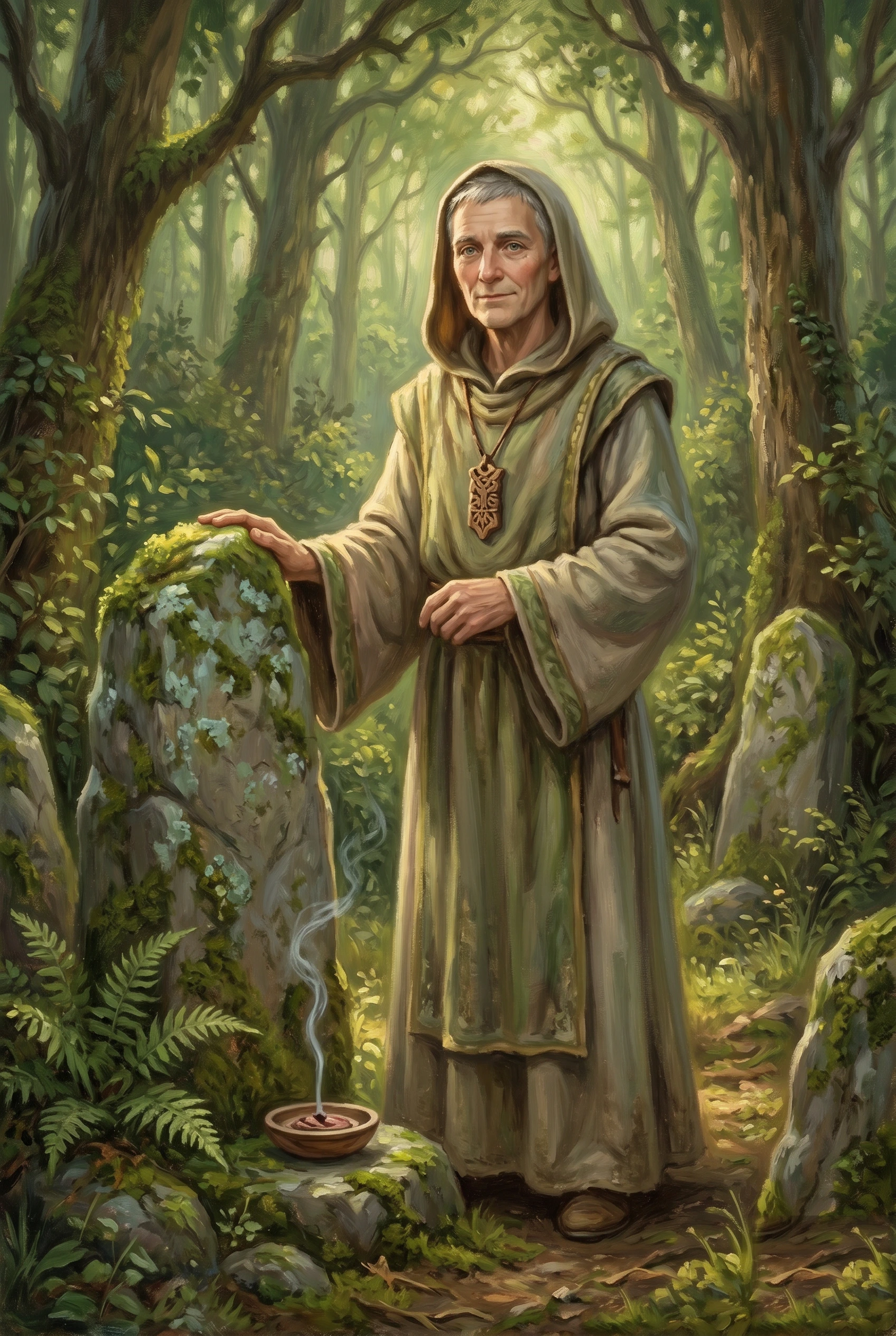
The Shrine Keeper
The caretaker of the old marks above the wood — who measures every traveler by one quiet thing: whether they can be trusted near something they don't understand.
At a glance
Old enough that most of the marks he tends are older than the kingdom, and young enough to still be alarmed when one of them goes quiet.
- Home Charcoal Barrow, above the wood
- Kingdom III (The Ink Well)
- Faction Lexicographers · Shrine-keeper
The Shrine Keeper tends the old places, and if you ask him what that means he will answer more plainly than you expect: he looks after things that are older than he is, that he did not make and does not fully understand, and he keeps them from being lost or handled or improved. It is not a grand calling. He would be the first to say so. It is mostly weather, and moss, and standing very still while strangers decide whether they can be trusted — and it is, in his own quiet estimation, one of the more important jobs nobody has ever thanked him for.
The place he tends is Charcoal Barrow, the high ground above the Witch's Wood, where a ring of standing stones leans out of the turf carrying the oldest marks anyone in the kingdom can still find. Some of those marks he can read. Some he cannot, and never could, and some were already worn past reading long before his time. He does not treat the ones he can't read as lesser. If anything he guards them harder, on a principle he states as flatly as he states everything: a thing you understand can look after itself; a thing you don't cannot, and so it falls to someone to be careful with it. He has appointed himself that someone. No one argued.
He asks nothing of a traveler at the stones. There is no toll, no riddle, no rite to recite — the marks are open to anyone who comes to read them, and people do. What there is, instead, is him: watching, quietly, how you carry yourself among things you don't understand. The Keeper has learned to read a whole character in a single gesture — the traveler who cannot pass a two-hundred-year-old carving without reaching out to drag a curious thumb along it just to feel it, to touch it, to own it a little, to make it theirs. Those he stops with a look and remembers for a long time. The ones who keep their hands folded and their questions honest he waves through, and warms to, and will talk to for as long as they'll stay.
Because he does want to talk, once you've earned it. He is not a hermit by temperament, only by posting, and he has been alone with the marks long enough to have a great deal saved up. He'll tell you which stone is which and which he's given up on. He'll tell you why keeping his hands off the carvings isn't superstition but courtesy — the same courtesy you'd show a sleeping animal or a stranger's grief. And, if you've been careful with him, he'll tell you the thing that's begun to frighten him, which is that the marks are going quiet.
Not weathering. Weather he knows; weather is slow and fair and leaves a shape behind. This is different. A letter vanishes clean overnight, or a whole word, and where it was there's a gap the wrong shape for wind or rain — as if the mark were not worn away but called away, lifted out of the stone by something that knew exactly which one it wanted. He can't name what's doing it. He won't pretend to. He does the only thing a keeper can, which is to keep watch, be careful, and tell the truth about what he's seeing to anyone who'll take it seriously. He is not the only one who has seen it. Yarrow, the hedge witch down in Inkhollow, came up to the barrow last month to read the old marks and went home unsettled in a way she didn't spell out — and if the two of them have never once sat down to compare notes, they have at least each arrived, alone, at the same uneasy suspicion: that something has gone wrong with words themselves, and that being careful with what you don't understand may be the most useful thing anyone can still do about it.
He sends nobody on with a warning or a charm — that's Yarrow's trade, not his. What he offers is quieter, and it does not need him to have been met: a man standing very still at the edge of a wood, keeping a circle of stones nobody visits, on the chance that one day the words on them will matter again. He believes they will. He is, on the whole, a patient man about it — which is as well, because so far nobody has come up the path at all.
Tales & Rumors
He tends Charcoal Barrow, the ring of old boundary-stones on the high ground above the wood, where the oldest marks anyone in the kingdom can still find are carved into standing stone. Ask him what they say and he'll tell you, honestly, that he no longer knows all of them — some were worn past reading long before his time — and that not-knowing is precisely why they must be looked after, since a thing you understand can look after itself and a thing you don't cannot.
He asks nothing of a traveler at the stones — no toll, no riddle, no rite to recite; the marks are open to anyone who comes to read them, and people do. What there is instead is him, watching quietly how you carry yourself among things you don't understand. Keep your hands to yourself among the carvings and he waves you on and quietly likes you for it. Reach out to run a thumb along a two-hundred-year-old mark 'just to feel it,' and he stops you with a look, and remembers, in the patient and thorough way of everyone who has ever lived long at the edge of this particular wood.
Lately the marks have been going quiet on him — a letter here, a whole word there, gone not to weather but to something he can't name and won't pretend to. He is not the only one to have noticed: Yarrow, the hedge witch down in Inkhollow, came up to the barrow last month to read the oldest stones and went home troubled by the same thing. The two of them have never sat down to compare notes; each simply arrived, alone, at the same uneasy suspicion that something has gone wrong with the words themselves.
How They Measure Up
A keeper keeps a tally too — of every stone, and of everyone who ever stood among them and how they behaved.
Sets a fallen boundary-stone back upright a hand's width at a time, over a season, and considers it finished work rather than slow work.
Old hands, and careful ones — he brushes moss from a carved letter the way you'd wake a sleeping animal, which is to say not quickly.
A long tenure at an open barrow where the wind has nothing to break it. He does not mention the cold, which is its own kind of proof.
Reads inscriptions older than anyone living, and can tell you which letter left a stone by the shape of the gap it left behind.
His whole gift, and it isn't the reading — it's knowing which of the old things must never be moved, and telling the difference before you learn it the expensive way.
A grave, unhurried courtesy that strangers mistake for coldness right up until they realize he has been paying closer attention to them than anyone has in years.
Custodianship — he holds what he does not own and cannot explain, and he holds it well. The measure he takes of a traveler is never about cleverness — it is only ever whether you can be trusted near something you don't understand, which he considers the rarest talent there is.
Where he is, and why you haven't met him
Not on the road yet. The Keeper's post is in Kingdom III (The Ink Well), on the high ground at Charcoal Barrow above the wood — a ring of leaning, lichen-clad standing stones with an offering-bowl smoking on the flat rock at their center — and nobody has yet climbed the path to it. What is known of the barrow down in Inkhollow is known at second hand, mostly through Yarrow, who went up to read the oldest marks and came home troubled without spelling out why. The Keeper himself is recorded here rather than met. When someone does climb to the stones, this is what will be waiting: a man tending the bowl, unsurprised, hands folded, in no hurry at all to explain himself. There is no toll here and no riddle — the stones are open to anyone who comes to read them — only a quiet measuring. Keep your hands off the carvings and he opens up, about the marks, about what has been leaving them. Reach for one uninvited and you learn how little he has to say to a person he has decided against.