The Chronicle of Epic Words
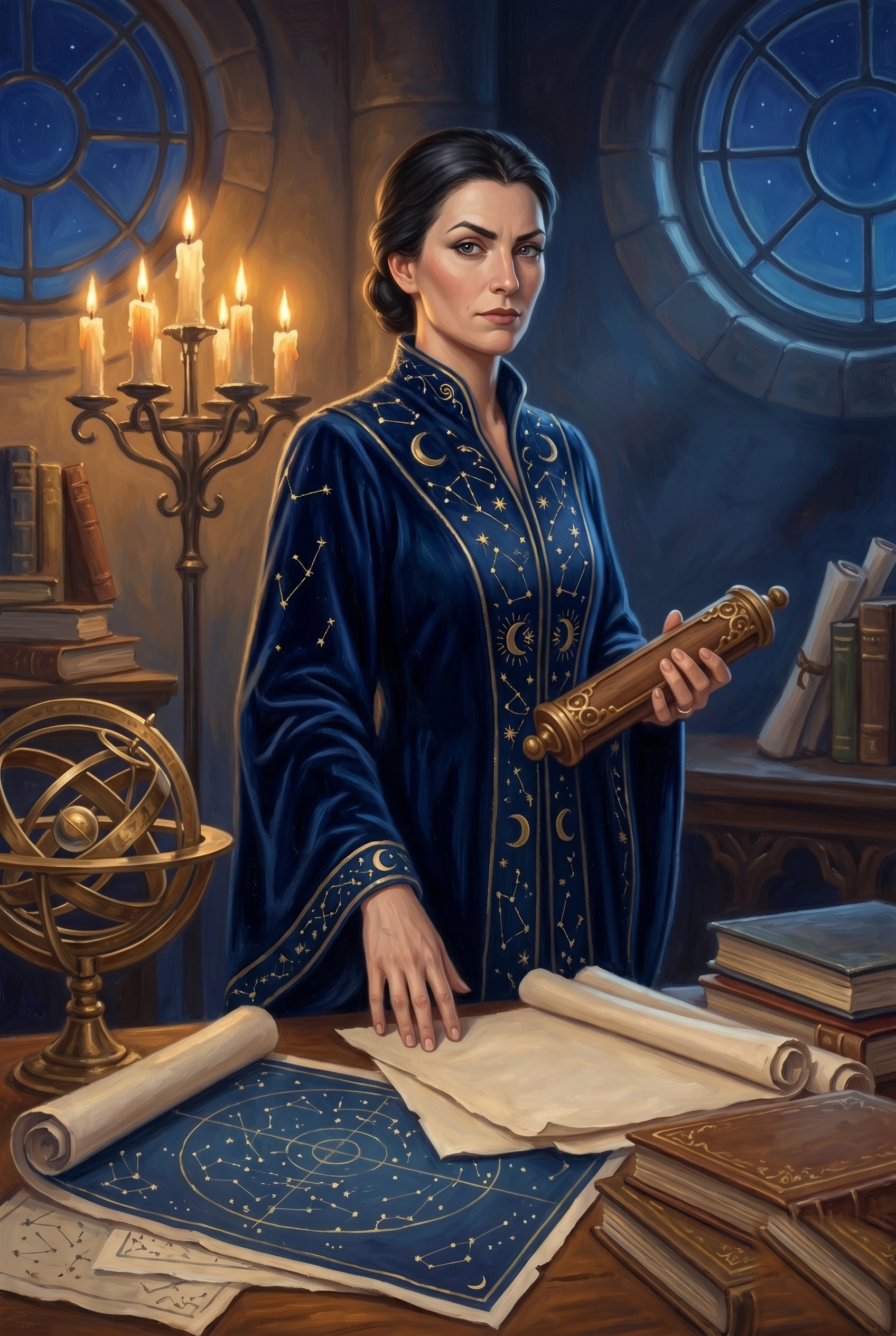
Iliana, the Court MageIn service to The Crown
Keeper of the kingdom's prophecies, and skeptical of every one of them.
At a glance
Old enough to have read the oaths at more Moots than she's believed in. Not so old she's stopped keeping the count.
- Home The Wardmoot barrow-hall
- Kingdom XII (The Vowel Crossing)
- Faction The Crown
- Employer The Crown
Iliana will tell you — flatly, off a card, in the voice of a woman who read the same words at a Moot last spring and the spring before that — that a prophecy is simply a very old way of being confidently wrong, and that her job is to keep a great many of them tidy without ever making the mistake of acting on one. She is the crown's court mage, which most people hear as someone who does magic for the king. What she actually does is read. Star charts, land-charters, muster rolls, and two centuries of Wardmoot minutes written in hands nobody alive can claim — she keeps them all, dates them all, and doubts them all in roughly that order.
It is a strange calling, keeping prophecies you don't believe, and she's the first to say so. But the crown didn't hire her to believe. It hired her to be the one person in the realm who won't march an army off a cliff because a scroll said a raven would fall. A believer in her chair would be a catastrophe waiting for the right omen. Iliana is the opposite: a filing cabinet that argues back. Hand her a marvelous prediction and she'll find the sentence in it that was only ever describing a thing that was going to happen anyway, and she'll circle that sentence, and she'll go back to her charts.
Which is what makes the wardship business sit so oddly on her. Once a season the crown sends her out past the crown court to the Wardmoot — a barrow-hall of a place, cold and old and honest — to administer the pledge, the oath by which a traveler swears to one of the three wardships: Bell, who sings what survives; Knot, who keeps what the water wants; Key, who finds what was locked away. She reads the three oaths off a card in a voice with all the ceremony pressed out of it, and she does not tell you which to choose, because a verb you'd want carved on your own door is a matter of taste, and she has firm and long-standing views about nudging anyone's taste but her own. She'll say only: pick one, and mean it. The banners, she notes, take offense.
She calls the ceremony sixty percent theater. She also calls it one hundred percent necessary, and if you can make those two numbers agree you're a better arithmetician than she is — she's simply decided both are true and gone on with her day. It is very like her. She is unbothered by a great many things that ought to bother a person, and it took me a while to understand that the un-botheredness is the work, not a flaw in it. A woman who can hold two contradictions in one sentence without flinching is exactly the woman you want minding the realm's most dangerous stories.
There is, in the barrow-hall, a thing she says without seeming to notice she's said it. Behind her stand five pegs. There have only ever been four banners. The spring you may remember, House Aldren got its name back and the Lantern folk — a fourth wardship, hung there since the hall was raised — read the muster roll twice, furled their banner, and quietly went home, leaving one peg warm with a recent goodbye. But the fifth peg has stood bare, she'll tell you, for longer than the Moot has kept minutes, and the minutes go back further than the question. She offers this as a complete answer. It isn't. She knows it isn't. And she has decided, with the serene stubbornness of a woman who has read too much to be startled by anything, not to be curious about it — which is, all by itself, the most curious thing about her.
You'll meet her again, farther on, at colder Moots than this one. She'll be reading off a card, marking a ledger without looking up, believing about two words in ten and keeping all of them anyway. If you ever want the plain truth about a thing everyone else has dressed in prophecy, she is the one to ask. Just don't ask her to be impressed. She retired that expression years ago, and the crown, on balance, is glad she did.
Tales & Rumors
She administers the wardship pledge because someone competent has to, and she is the only one at court who can read three oaths off a card without smirking at the second. She'll tell you, if you catch her after and never during, that she considers the whole ceremony sixty percent theater — and one hundred percent necessary, which is a harder ratio to argue with than it sounds.
Ask her about the peg in the barrow-hall that has never held a banner in living memory and she'll say, evenly, that there were five pegs when the hall was raised and only ever four banners as long as the Moot has kept minutes, and that the minutes go back further than the question. She considers this a complete answer. It is visibly not one, and she is visibly untroubled by that — which is, if you're paying attention, the most interesting thing she says all day.
She is a mage who casts almost nothing. Her craft is reading — star charts, muster rolls, two centuries of Moot minutes in a hand nobody living wrote — and her one reliable trick is telling you, precisely, which of the marvelous things you were promised were never actually promised at all. It has made her unpopular at exactly the sort of party she'd never attend anyway.
How They Measure Up
A court mage keeps a ledger on herself too, mostly in the margins she leaves blank on purpose.
Carries a scroll-case and a grudge against ceremony. The case is heavier.
Marks a ledger without looking up while a bell rings behind her. She's had the practice.
Reads three oaths off a card in a flat voice at Moot after Moot without once cracking. Call it patience; it's really stamina.
Keeps the kingdom's prophecies the way other people keep receipts — knows every one, trusts not a single figure on it.
Gives an answer that plainly doesn't cover the question, and is entirely unbothered that it doesn't. Knowing the difference is the whole trick.
Doesn't warm a room. Runs it — the way a clerk runs a queue, and about as fondly.
Disbelief — her professional discipline. She has read every prophecy in the crown's keeping and believes, on a generous day, roughly two of them — which is exactly why the crown trusts her to keep the rest. A prophecy in Iliana's hands is filed, dated, and doubted, in that order, and never once acted on before she's checked whether it's simply describing a thing that was always going to happen anyway.
Where you'll meet her
You'll find Iliana at the Wardmoot, in the barrow-hall beyond Four-Arch Ford in Kingdom XII (The Vowel Crossing) — standing in front of five pegs and three banners, reading the oaths off a card in the flat voice of a woman who has done this many times and meant it twice. One peg shines, recently bare; one has stood empty so long the dust hasn't bothered to settle on it. She won't tell you which verb to pledge — Bell, Knot, or Key — because she thinks that's a matter of taste and taste isn't hers to nudge. She'll tell you only to pick the one you'd want carved on your door, and to try to mean it, because the banners, she says without a flicker of a smile, take offense.