
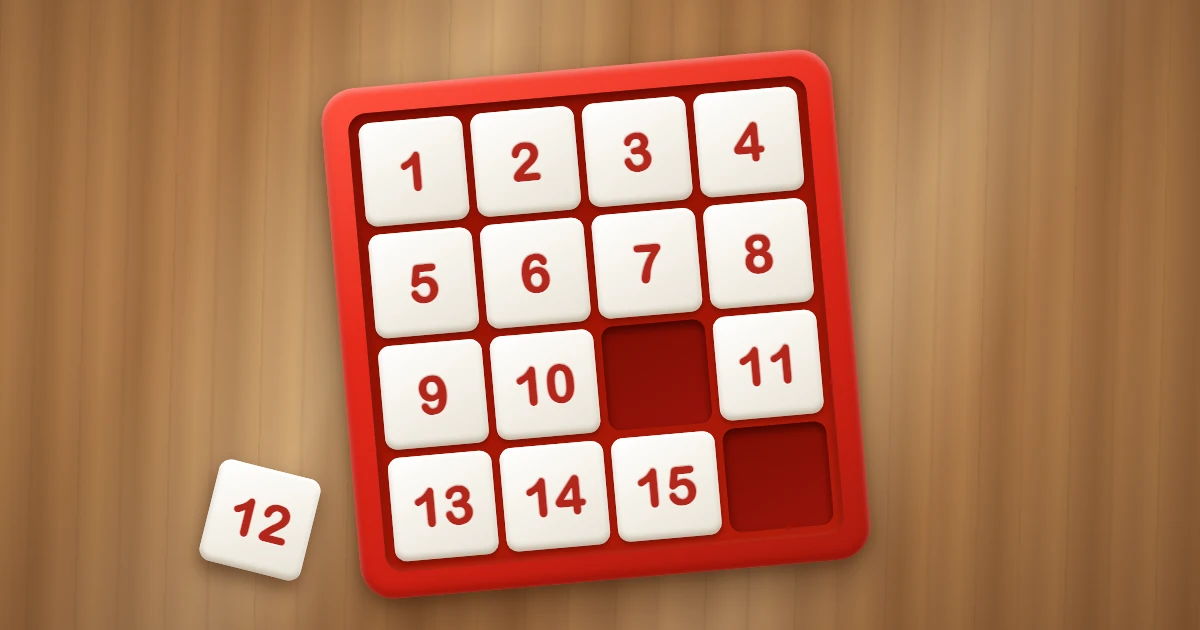
If you grew up any time in the last sixty years, you owned this toy. Maybe it came out of a birthday party goody bag. Maybe it was a stocking stuffer, or the prize bin at the dentist. A little square of red plastic, about four inches across, with fifteen numbered tiles and one empty hole. You slid the tiles around, one at a time, trying to put them back in order.
And at some point — be honest — it made you want to throw it across the room.
This is the story of that puzzle: where it came from, why it was so much harder than it looked, the confession about what I did to mine, and the small design change that removes the frustration entirely. Further down the page there are two puzzles you can play right in your browser, so you can feel the difference yourself.
The toy that was everywhere
The sliding puzzle belonged to a very specific club of childhood toys: the ones that were cheap, simple, and somehow in every single house. The Slinky that walked down the stairs exactly once before tangling forever. The can of Play-Doh that started as four bright colors and ended as one grayish-brown lump. The yo-yo you could almost, but never quite, get to "sleep." And the little red sliding puzzle, rattling around the junk drawer with dead batteries and rubber bands.
None of these toys needed batteries or screens. Most cost less than a dollar for decades. And each one had a built-in lesson in patience. The sliding puzzle's lesson was the cruelest, because it looked so easy. Fifteen tiles. One hole. Put the numbers in order. A five-year-old understands the goal in three seconds — and a determined adult can still be stuck twenty minutes later, watching tile 14 and tile 15 orbit each other in the bottom corner, refusing to trade places.
A craze older than the plastic it was made of
The plastic version we all grew up with is a mid-century, mass-produced descendant of a much older puzzle. The "15 puzzle" dates back to the 1870s — its invention is generally credited to Noyes Palmer Chapman, a postmaster in upstate New York — and by 1880 it had set off a genuine international craze. Newspapers wrote about it. Employers complained about it. People played it obsessively on trains and in parlors, a full century before anyone uttered the word "Wordle."
The puzzle's most famous story, though, is a con. Sam Loyd, the great American puzzle promoter, spent years falsely claiming he'd invented the 15 puzzle — and he offered a $1,000 prize for anyone who could solve a particular version of it: the board in perfect order except tiles 14 and 15 swapped. The prize was never at risk, because that arrangement is mathematically impossible to solve. Not hard. Impossible.
Here's the part that blew my mind when I finally learned it: of all the ways you can arrange fifteen tiles in that frame, exactly half can be solved by sliding, and half can never be solved at all. Mathematicians call it a parity constraint. Every legal slide preserves a hidden property of the arrangement, and no sequence of slides — short or long, clever or brute-force — can ever cross from the "wrong" half to the "right" half. If your board starts in the unsolvable half, you could slide tiles until the heat death of the universe and never finish it.
Keep that fact in mind, because it's about to become personally relevant.
The confession: I snapped a tile out
As a kid, I did not have the patience for the endgame. The first ten tiles were fine — satisfying, even. Then came that final corner, where the last few tiles do their endless little dance, and every move that fixes one thing breaks another.
So I figured out the other way to solve it. If you flexed the frame just right, you could pop a tile up and out of its track with a satisfying snap, and then press it back in wherever you wanted. Pop out a few tiles, reassemble the board in perfect order, place it innocently on the table. Puzzle solved. Genius.
Except — remember the parity math? When you pop tiles out and press them back in wherever you like, you're choosing an arrangement at random from all the possibilities, not just the reachable ones. Which means that when you scramble it back up and hand it to your little sister, there's a coin-flip chance the puzzle you've just handed her can no longer be solved by any human being on Earth.
I think about this a lot. All across the world, for decades, kids were quietly snapping tiles out of these puzzles and pressing them back in "fixed." Which means some meaningful fraction of the sliding puzzles in junk drawers everywhere aren't just annoying — they're broken in a way you cannot see, handed down like tiny cursed heirlooms. If you ever spent an afternoon on one of these and swore it was impossible: you may have been right.
Try it yourself
We host playable sliding puzzles in our Playground — real paintings from our game, playable right in your browser, no install, nothing to sign up for. Click the picture below to play it: sixteen squares, one open hole, exactly the same rules as the toy from your childhood (and scrambled honestly, by real slides from a solved board — no cursed heirloom here).
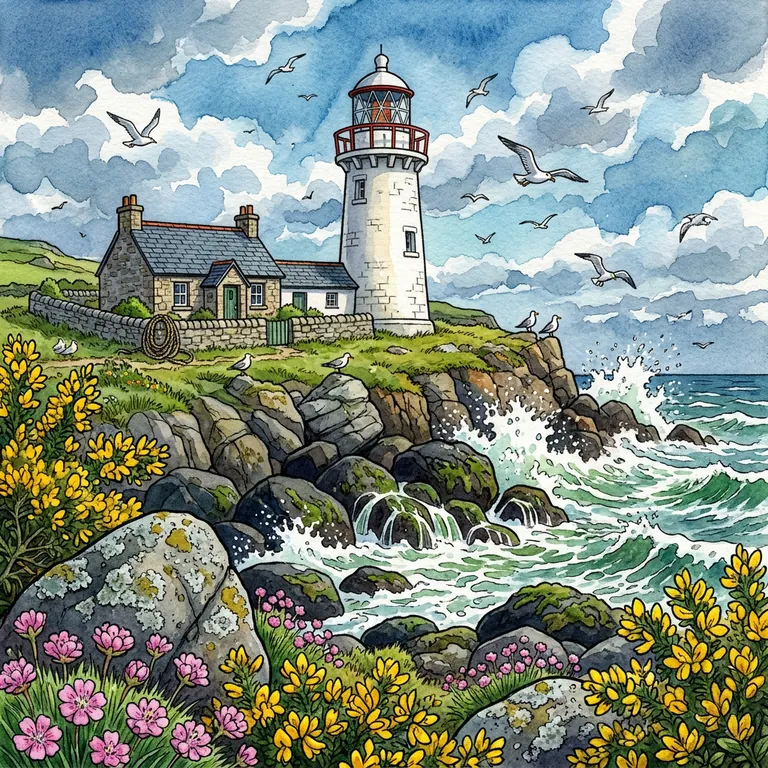
Feel that last corner, where the final few pieces chase each other around the hole? That's the feeling that made me snap the tile out.
The fix: a second hole
Years later, building word games at Logic Loft, we came back to the sliding puzzle — and to that childhood frustration. The question we asked was simple: what's the smallest change that keeps everything satisfying about sliding tiles, but removes the part that makes people want to cheat?
The answer turns out to be one tile. Remove a second tile, and the puzzle transforms.
With two holes, the cruel math changes completely. That parity wall — the invisible line dividing solvable arrangements from impossible ones — only exists when there's exactly one blank space. Give the board a second hole and the wall comes down: every arrangement becomes reachable from every other. Nothing you can do to the board makes it unsolvable. The endgame stops being a logic exam, because you always have somewhere to breathe; there's always a second escape route for that one stubborn tile doing laps in the corner.
You can feel this one for yourself too. Click the painting below to play another Playground puzzle — and if it senses you're struggling, it will offer to open up a second square for you. Accept, and notice how the whole board loosens:
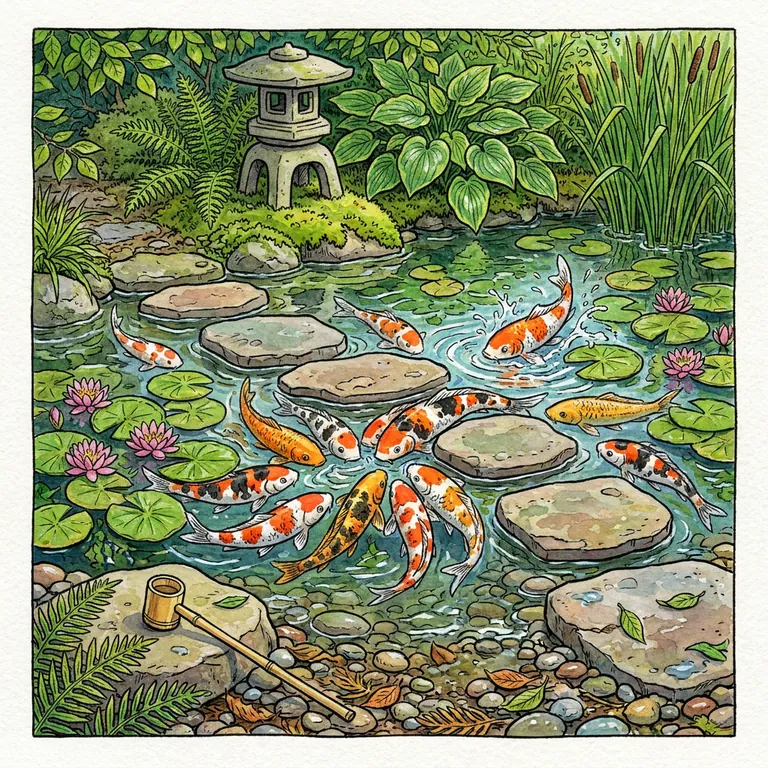
Noticeably friendlier with the second square open, right? Still a real puzzle — you can't just wish the pieces into place — but the "trapped in the corner" feeling is gone. It's the difference between a puzzle that fights you and a puzzle that plays with you.
From numbered tiles to letter pairs
That two-hole design became the heart of Pairdle Slide, our daily sliding word game. Instead of a 4×4 grid of numbers, Slide gives you a 6×6 board of tiles, each carrying a pair of letters, with two open squares to slide through. Instead of putting numbers in order, you're sliding pairs together to spell six-letter words.
The two open squares aren't a gimmick — they're the same fix you just played with. Because of them, every Slide board is fully navigable: no parity traps, no cursed configurations, no need to snap anything out of the frame. All of the childhood satisfaction of sliding tiles into place, none of the part that made you want to throw the thing across the room.
We make a new puzzle every day, the same way Pairdle gets a new letter-pair puzzle every day. If the little red square from your childhood ever beat you unfairly — and now you know it may genuinely have been unfair — consider this the rematch, on friendlier terms.
By Tim Nye, founder of Logic Loft Games. Tim has been writing code since getting his hands on a Vic-20 in 1980, and has been popping tiles out of sliding puzzles since not long after that. Pairdle Slide is his apology to every kid who got handed an unsolvable board.
Related articles
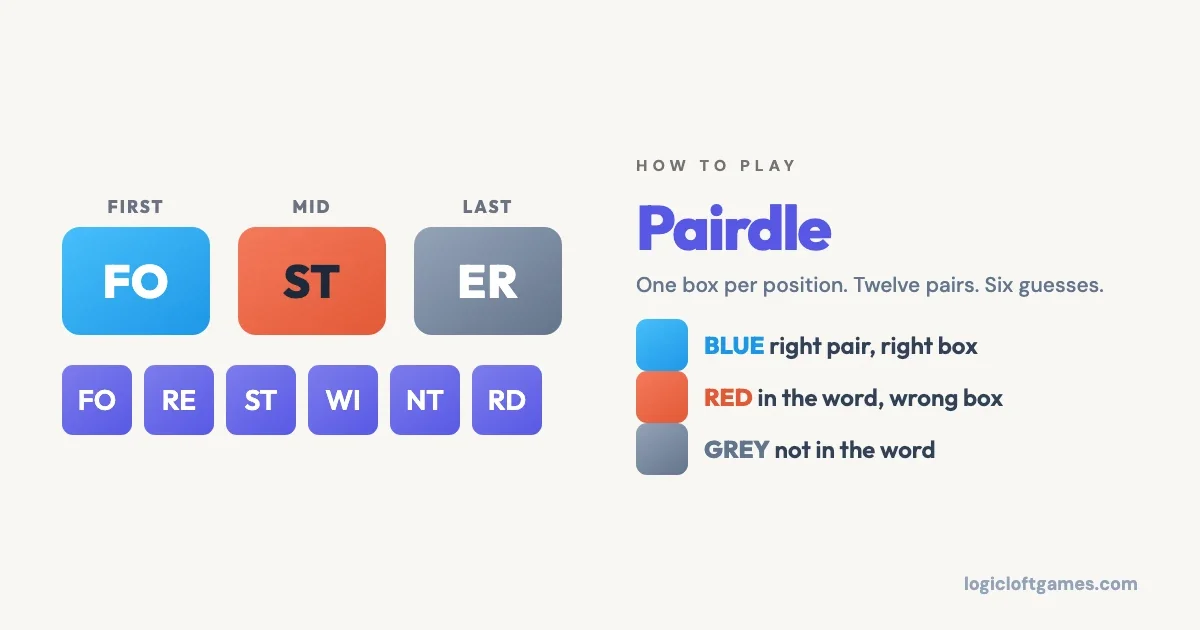
Pairdle 1.5: What's New, What's the Same, and an Exciting New Level
Pairdle 1.5 puts every level on one row, unlocks Pro, adds Expert and endless Practice, and introduces Olly the owl. Plus what a 12-tile board really holds.
How I Came to Build Pairdle and Accidentally Made It EPIC
I loved Wordle but refused to clone it, so I built a puzzle out of letter pairs instead. Then, fact-checking this very article, I found the generator had been quietly throwing away seven of every eight words since December.
The Complete List of 2-Letter Scrabble Words
Every valid 2-letter Scrabble word, grouped to actually memorize — plus why these tiny words are the highest-leverage thing a Scrabble player can learn.