
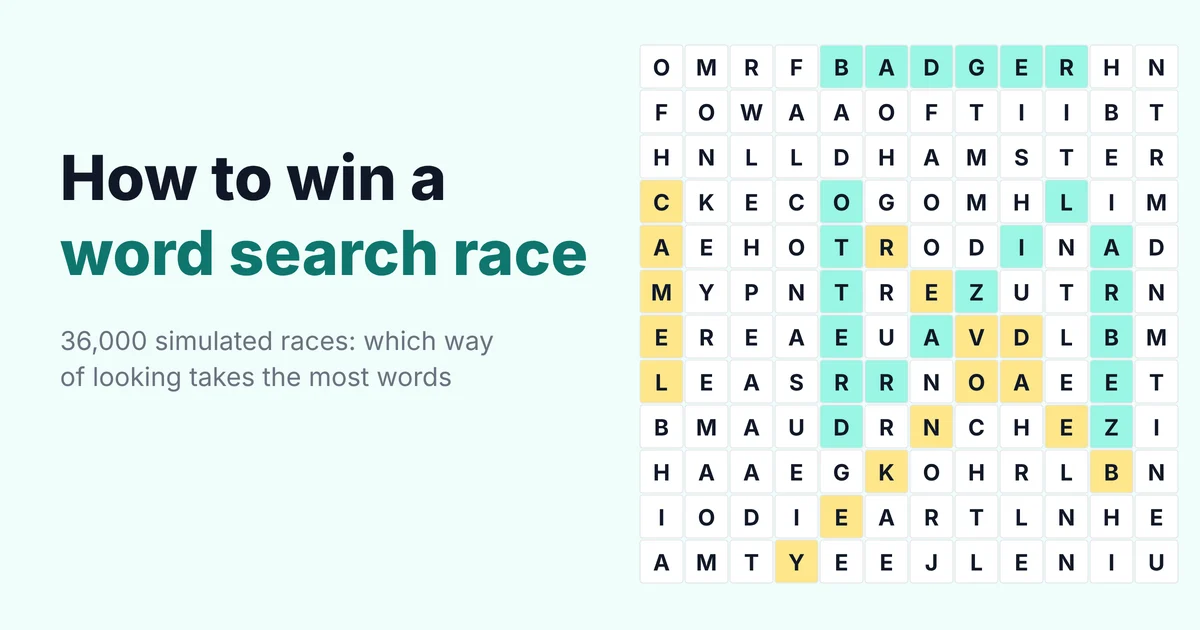
A word search race is two people on the same grid at the same time. Both see the same word list. When one of you marks a word, it is yours, and it drops off the other player's list. Whoever ends with more words wins. Word Search Battle is a free site built around this kind of match: you send a friend a game code, you both get the same grid at the same moment, and every word goes to whoever finds it first.
Racing changes what "good at word search" means. On your own, the only thing that counts is how long the whole grid takes you. In a race, the time you spend hunting for a word the other player then grabs is lost. So the question is not only how fast you look, but how you look.
To test this, we wrote a small simulation. Two searchers race on the same 12 by 12 grid with 12 hidden words. They look at the grid at exactly the same speed, so only their method differs. We ran 36,000 races across our own themed grids and counted who took more words. The results are below, and there is a race against our computer at the end of the page.
Where to play a real race: Word Search Battle (website, free). The rules of word search are the same as on paper: words run across, down and on the diagonals, and some run backwards.
The rules of a word search race
- Same grid, same start. Both players get the same puzzle at the same moment.
- First to mark it keeps it. When you mark a word, the other player sees it taken and cannot claim it.
- Most words wins. On Word Search Battle the site says each word also earns points, with a little more for diagonal, backward and short words. The winner of a battle is still the player who finds more words.
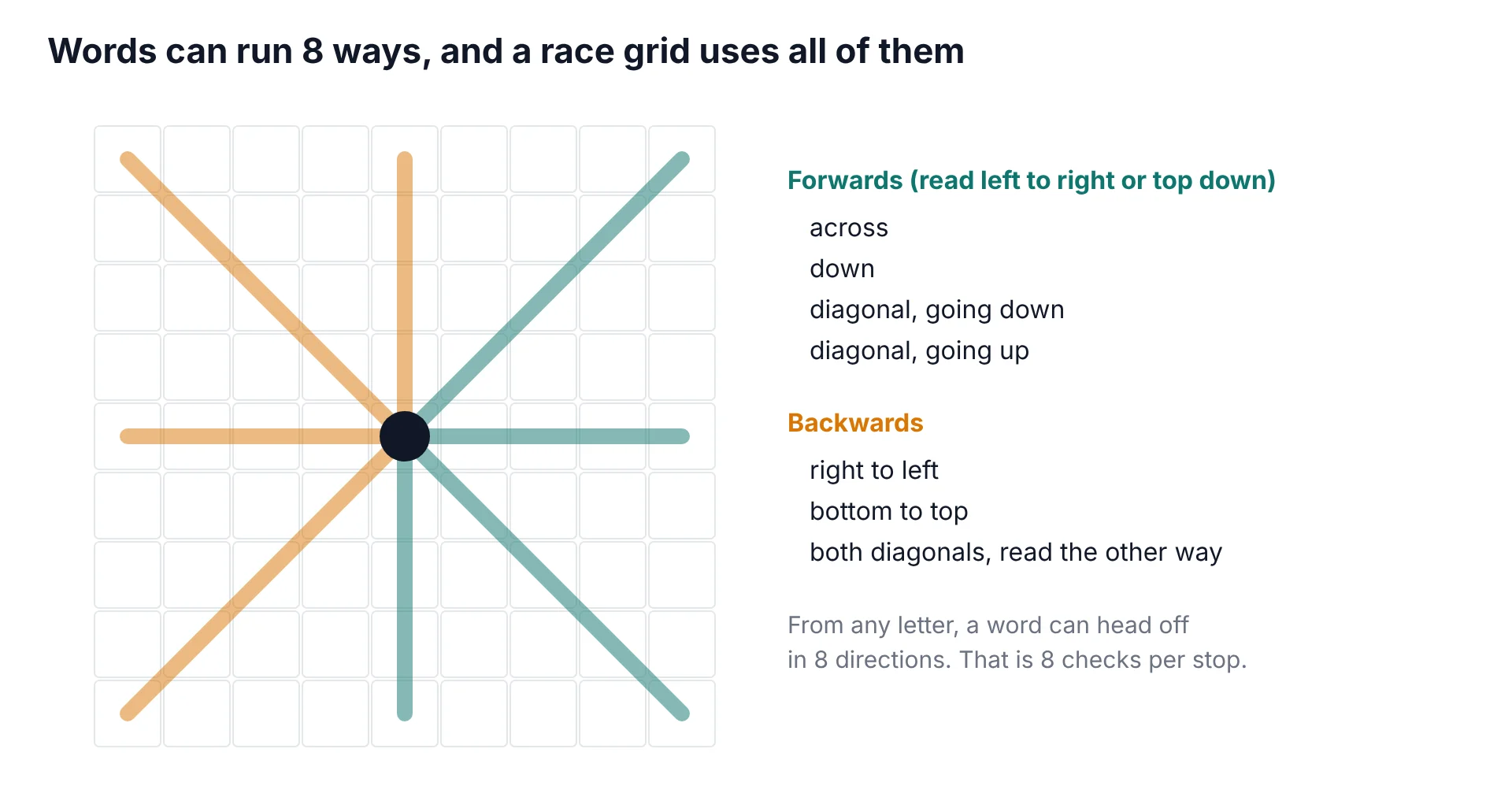
From any letter a word can head off in eight directions, so every time you stop at a possible first letter there are up to eight lines to check. That is why stopping at fewer letters matters so much later on.
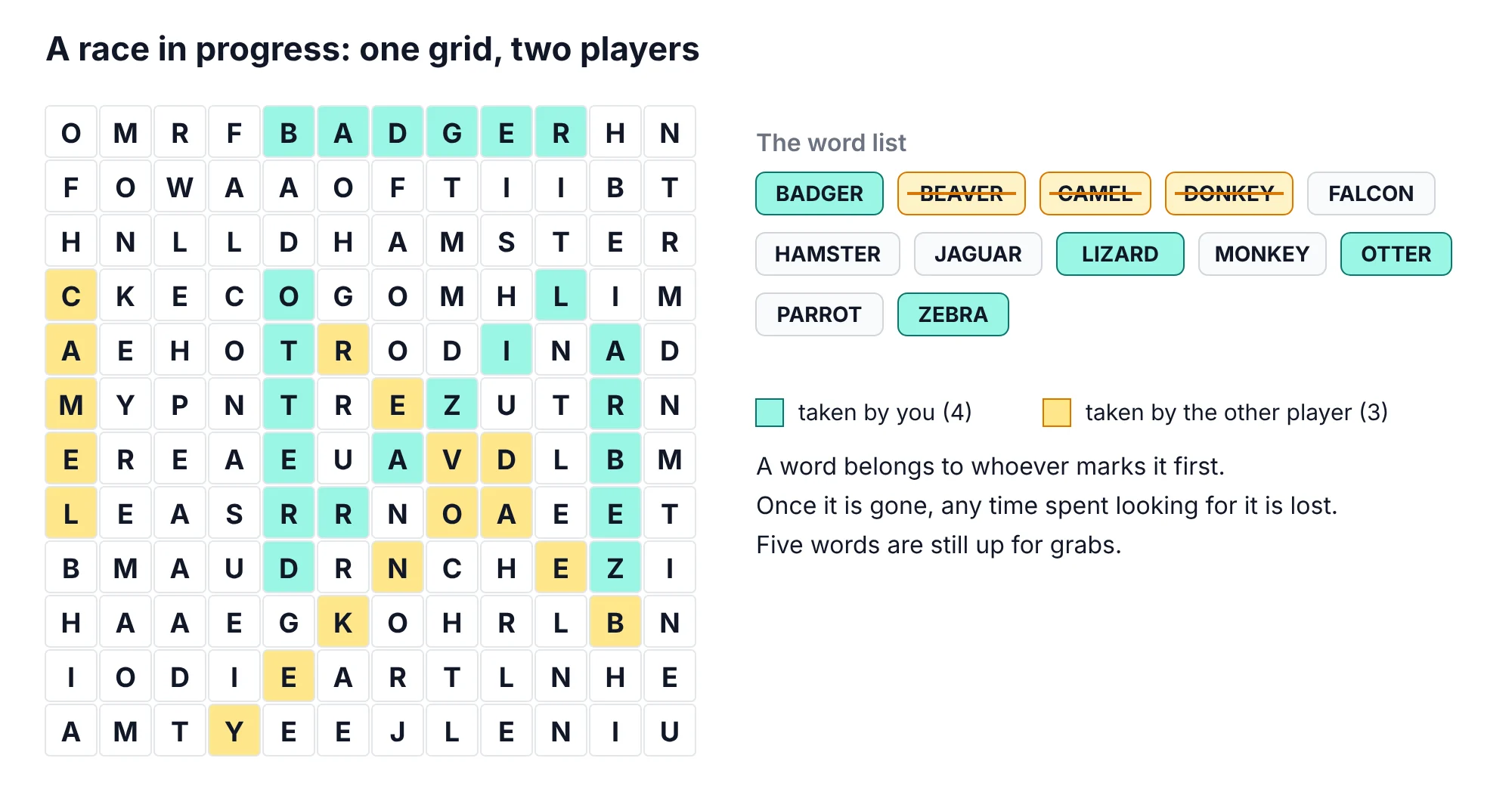
The picture is one of the grids from our simulation, part way through a race. Seven words are gone. The five left are the whole game now, and any looking either player did for BEAVER, CAMEL or DONKEY before they were taken bought nothing.
How we tested it
A person's eye is hard to measure, so we counted something simpler: letters looked at. Every letter a searcher reads costs one unit of time, for both players. A searcher can work in one of two ways.
- One word at a time. Pick a word from the list. Read the grid row by row until you hit a letter that could start it. At each such letter, check outward in all eight directions until the letters stop matching. Found it? Mark it and pick the next word.
- Several words at once. Keep a few words in your head and read the grid once, row by row. At each letter, check every word you are holding that could start there.
Holding several words in mind is not free. Nobody knows exactly what it costs, so we charged it at different rates: an extra quarter of a letter per glance for each extra word you hold, then half a letter, then a whole letter. If a word you are hunting gets taken by the other player, you drop it at once.
Each method also has an anchor. You can scan for a word's first letter, or for its rarest letter. For LIZARD, that means looking for the L or looking for the Z.
Looking for one word at a time is slow
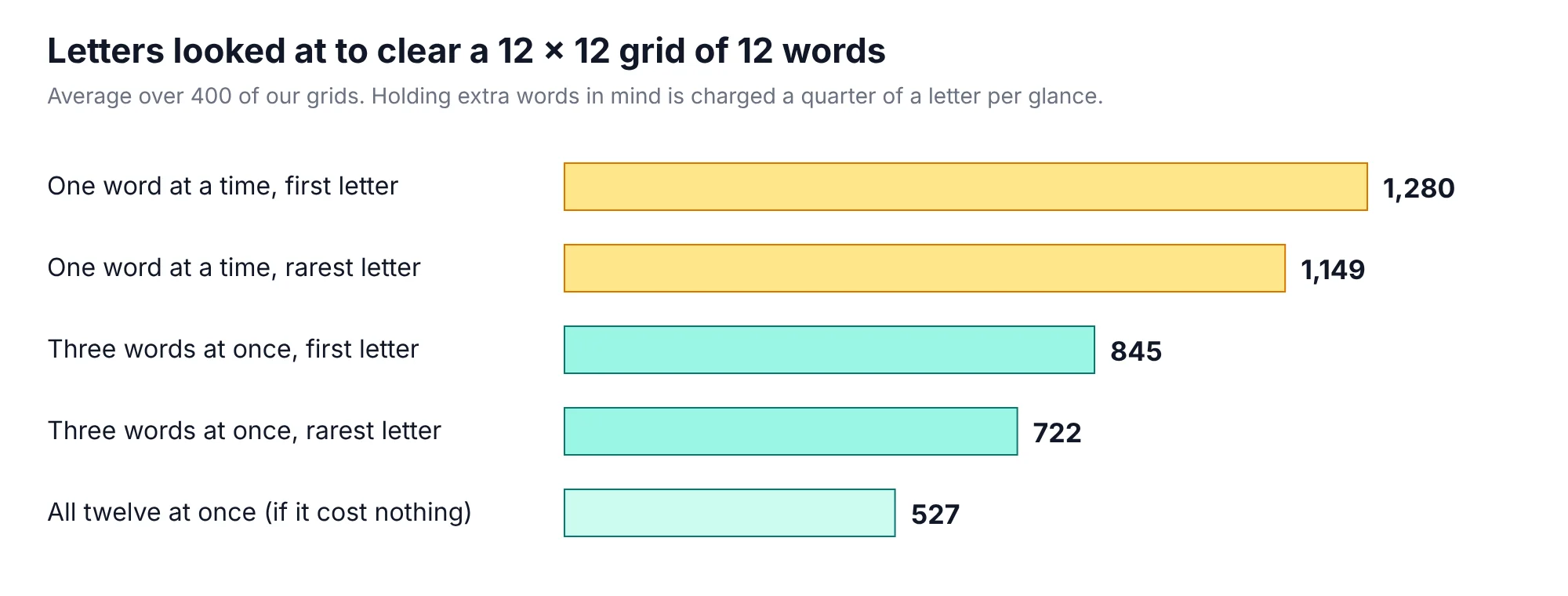
On your own, clearing a grid one word at a time took 1,280 letters on average. Most of that is reading the same rows again and again, once for every word. Holding three words at once, even with the quarter letter charge for remembering them, cut it to 845. That is a third less looking for the same 12 words.
The reason is plain once you see it. When you hunt for BADGER, your eyes pass over the start of OTTER and CAMEL and do nothing with them. Then you go back to the top and read the same rows for OTTER. A player holding three words gets three chances from every pass over the grid.
The race results
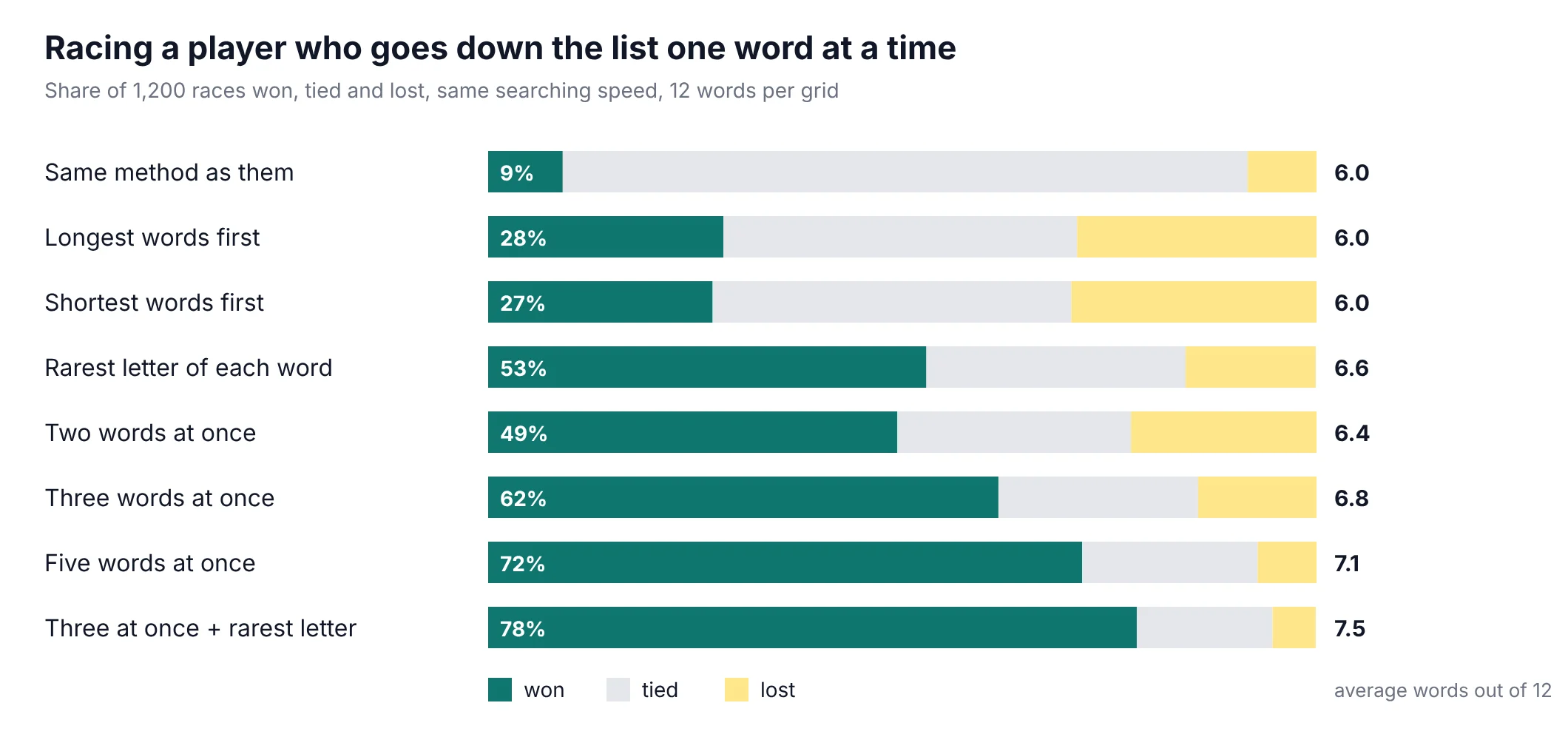
Our standard opponent is the way most people start: go down the list from the top and find each word in turn by its first letter. We raced it 1,200 times against each other method.
- Copying its method gets you nowhere. Two identical searchers tie 83% of the time. You both chase the same word, one of you gets it, and the other's effort is gone.
- Changing the order of the list barely matters. Taking the longest words first or the shortest words first won about as often as it lost. The average stayed at 6 words out of 12.
- Scanning for the rarest letter helps a lot. Same one-word-at-a-time method, but anchored on each word's least common letter: 53% wins, 16% losses, 6.6 words on average.
- Holding more words wins more races. Two words at once won 49%, three won 62% and five won 72%, all with the quarter letter charge.
- Both together are best. Three words at once, each anchored on its rarest letter, won 78% of races and lost only 5%. It took 7.5 of the 12 words on average.
Why the rarest letter is the one to look for
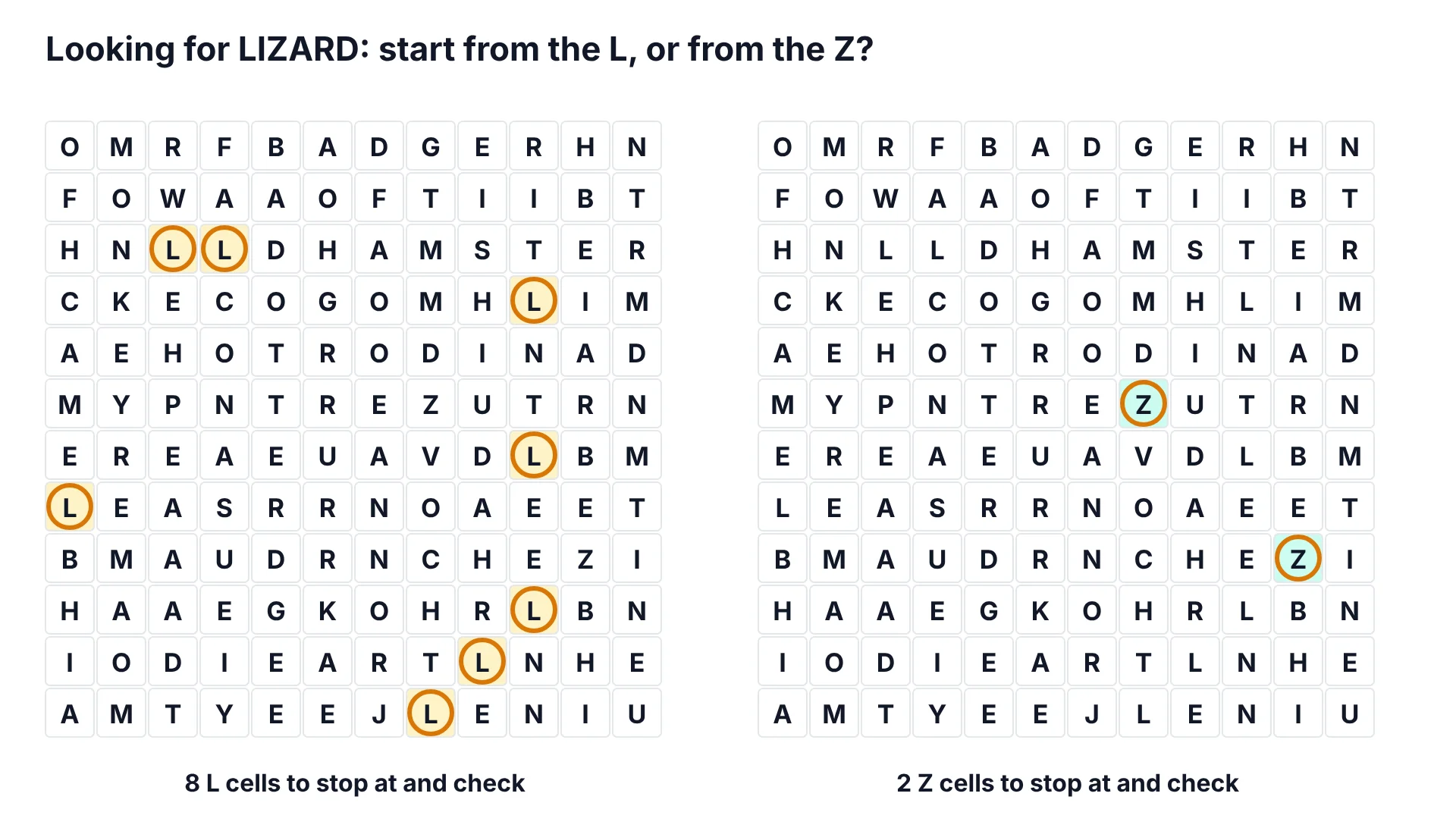
To find LIZARD by its first letter, you have to stop at every L in the grid and look around it. This grid has 8 of them. Search for the Z instead and there are only 2 places to stop, and one of them is the right one.
English uses E, T, A, O, I, N and S far more than K, X, Q, J and Z. Most word search makers fill the empty squares with letters in roughly that mix, so common letters are everywhere and rare ones stand out. A word's rarest letter is usually its fastest way in. For ZEBRA, JAGUAR and KOALA it is the first letter anyway. For LIZARD it is the Z in the middle, for HAMSTER the M, and for OTTER, oddly, the R, because O, T and E are all more common than R.
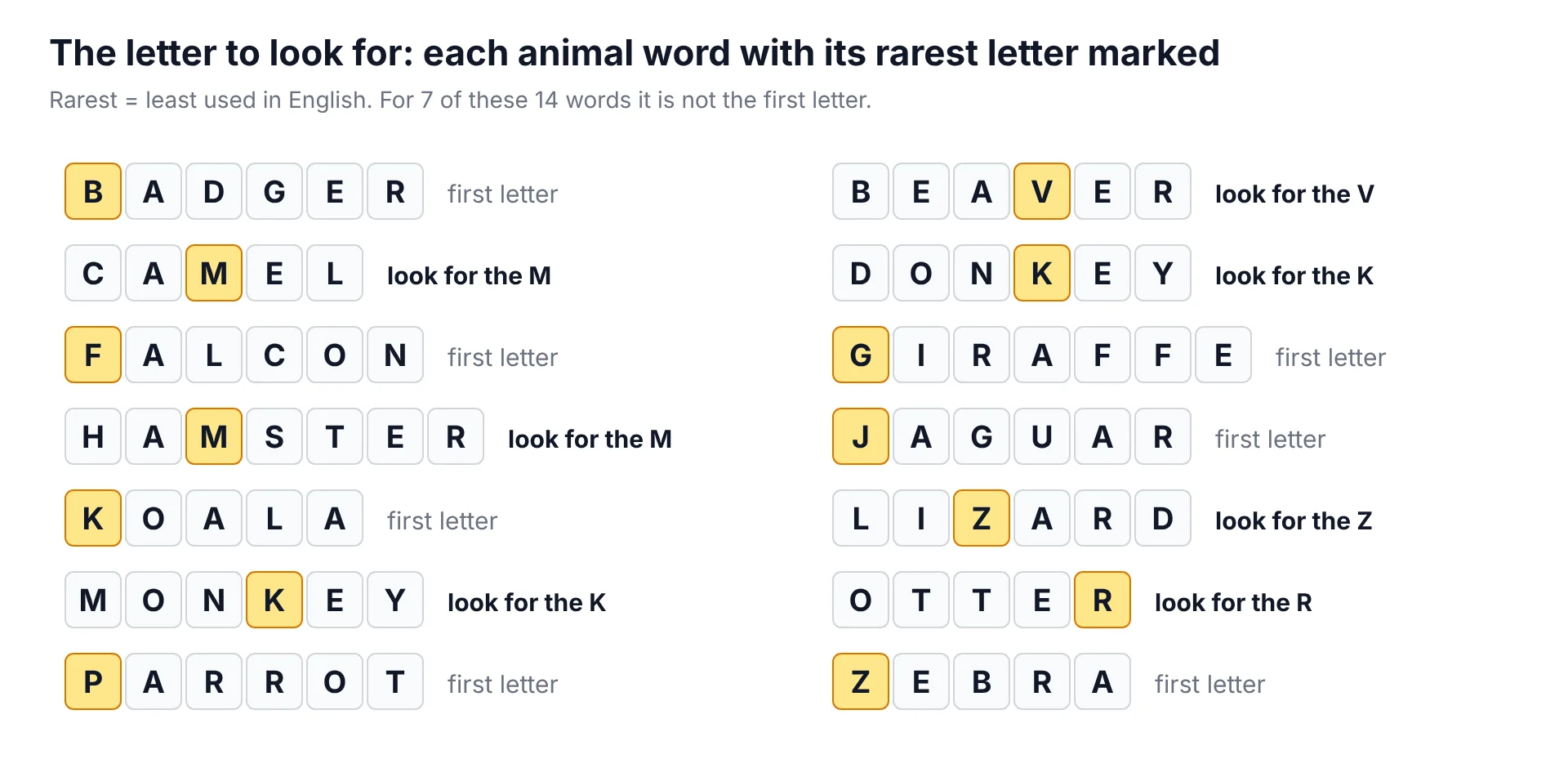
For half the words on our animal list, the rarest letter is not the first one. Those are the words where looking for the right letter saves the most stops.
In our grids, anchoring on the rarest letter cut the looking by about a tenth (1,280 letters down to 1,149). That sounds small, but in a race every word is decided by a few seconds, and a tenth is often enough to get there first.
How many words should you hold at once?
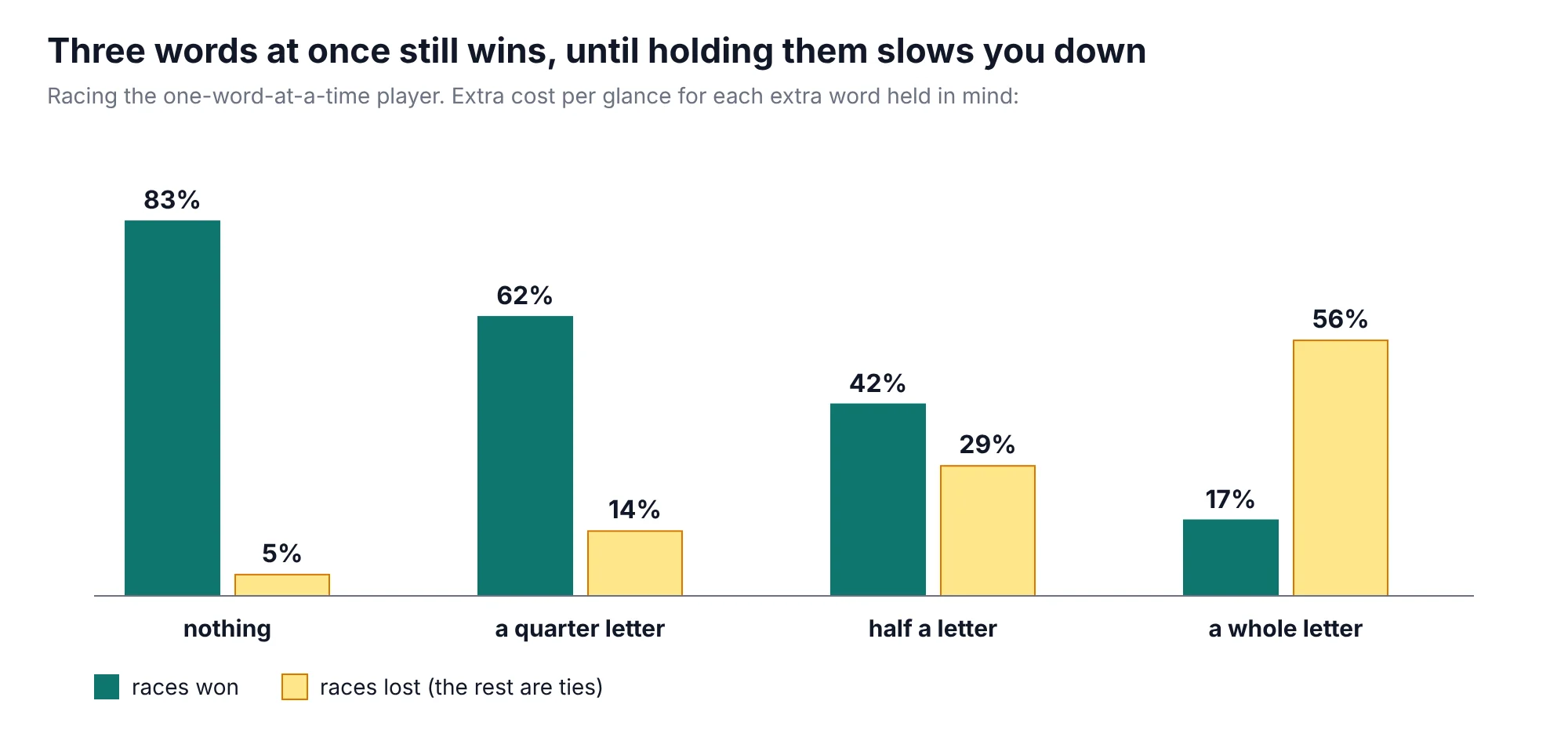
This is where the simulation stops being able to answer for you. Holding more words only pays while it does not slow your eyes down much. If each extra word you hold costs you a quarter of a letter on every glance, holding three wins 62% of races. At half a letter it is about even. If it slows you by a whole letter per glance, you lose more than half your races, and you would do better going one word at a time.
So the honest advice is: hold as many words as you can without slowing down. For most people that is two or three short words, or one long word and one short one. Try it in the game below. If holding three words makes you lose your place, drop to two.
Tips to win a word search race
- Read the whole list first. Spend two seconds on it before you touch the grid, and note each word's rarest letter: the J in JAGUAR, the Z in LIZARD, the K in WHISK.
- Hold two or three words, not one. Scan the grid once for all of them. You will pass over every word on the board anyway, so give your eyes more than one thing to catch.
- Look for the rare letter, not the first letter. For OCTOPUS look for the P, for WHISK the K, for JELLYFISH the J.
- Do not copy the other player. Two players using the same method tied 83% of our races, because they chased the same word at the same time. A different way of looking is what breaks the tie.
- Drop a word the moment it is taken. Watch the list, not just the grid. Every second spent on a word that is already gone is a second lost.
- Sweep the leftovers last. When three or four words remain, hold all of them and read the grid once more from the top. With so few words left, you can carry them all.
Our main word search guide has more on spotting words by their letter chunks (ING, ION, ENT), which works in a race too. If you like racing for words, Boggle is the same race against a clock, and Strands is a daily word search with a twist. For apps and sites to play on, see our list of the best word search games.
How we checked
The simulation is a Python script we wrote for this page. It builds grids the way most word search makers do: 12 words from one of our own 12 themed lists (Animals, Food, Ocean, Space and so on) go into a 12 by 12 grid in any of the 8 directions, words may cross on a shared letter, and the empty squares are filled with letters in the mix English uses. We threw away any grid where a list word could be read twice. Then two searchers race on 1,200 grids for each match-up, about 36,000 races in all.
Time is counted as letters looked at, the same for both players. That is a model, not a person, and real eyes skip and jump in ways it does not. The cost of holding several words in mind is a guess, which is why we show four different guesses. What the model is good at is comparing methods fairly: same grid, same speed, only the way of looking changes.
Common questions
What is a word search race? Two or more people search the same grid at the same time. A word belongs to whoever marks it first, and the player with the most words wins.
What is the fastest way to find words in a word search? Hold two or three words in mind and read the grid once for all of them, and look for each word's rarest letter rather than its first letter. In our simulation that cut the looking to about 720 letters from 1,280 for one word at a time.
Should I find the long words or the short words first? In our races it made almost no difference. Longest first and shortest first both averaged 6 words out of 12 against a player going down the list. How you look matters far more than the order.
Is Word Search Battle free? Yes. Its site says every puzzle is free, plays online on your own or against a friend, and prints in three levels with an answer key.
How do I play a word search against a friend online? On Word Search Battle one player starts a game and sends the other its game code or invite link. The race starts when both are ready.
Race the computer now
Our computer plays the way most people start: it goes down the list from the top and looks for each word by its first letter, one word at a time. It never makes a mistake, but it never holds more than one word either. Pick Easy, Normal or Hard to set how fast it reads.
Drag across a word to mark it, or tap its first letter and then its last. Words you take turn green. Words the computer takes turn yellow and are crossed off your list. Solo mode has no opponent, a clock, and a hint that rings the first letter of a word you have not found.
The grids are our own, built fresh each game from 12 themed lists of 14 words, so no two games are the same.
By Tim Nye, Logic Loft Games
Related articles
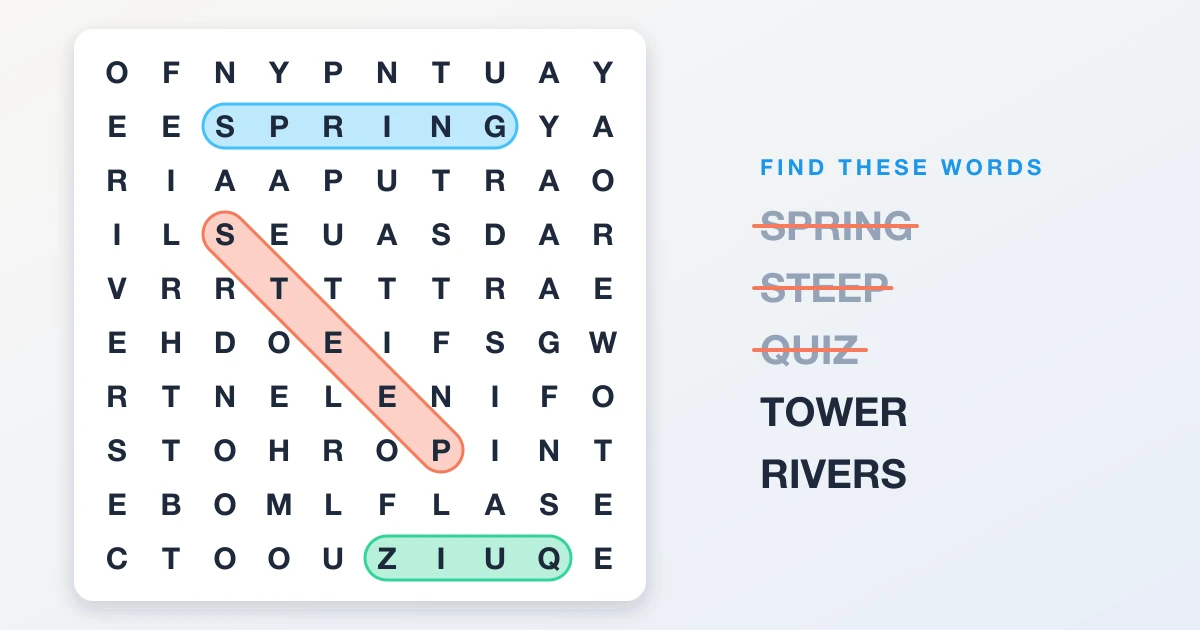
How to Play Word Search and Find Every Word Faster
The rules of word search, the scan order that clears a grid fastest, the extend-until-blocked trick, and a chart of the letter chunks that give words away.
The 10 Best Word Search Games and Apps in 2026
From classic grid hunts to modern twists, these are the 10 best word search games and apps for relaxing, sharpening your eye or keeping kids busy.
How to Master Pairdle, Column by Column
I counted the letter pairs in every answer on the Pairdle 1.5 schedule. The three boxes are nothing alike, and the last one is by far the easiest to call.