Editor's note: I am a Lord of the Rings fan, so I love riddles, and I was quite confident when I opened Riddlok for the first time. I played several rounds expecting it to be super easy, but I needed to use some clues. It's a simple concept but very enjoyable. I recommend it to anyone who likes riddles or puzzles. Great job, Justin!
Riddlok is a free daily word puzzle built around three different paths to the same answer: a riddle, a set of clues, and a hidden theme connecting those clue answers together.
The goal is to crack the KEY.
You can try to solve the riddle directly, use clues to reveal letters in the KEY, or figure out what the clue answers have in common. Usually the solution comes from bouncing between all three until the pieces suddenly fit together.
That "aha" moment is what Riddlok is built around, and it's the reason a puzzle that looks like a two-minute lark can hold you for a lot longer than that.
How to Play Riddlok
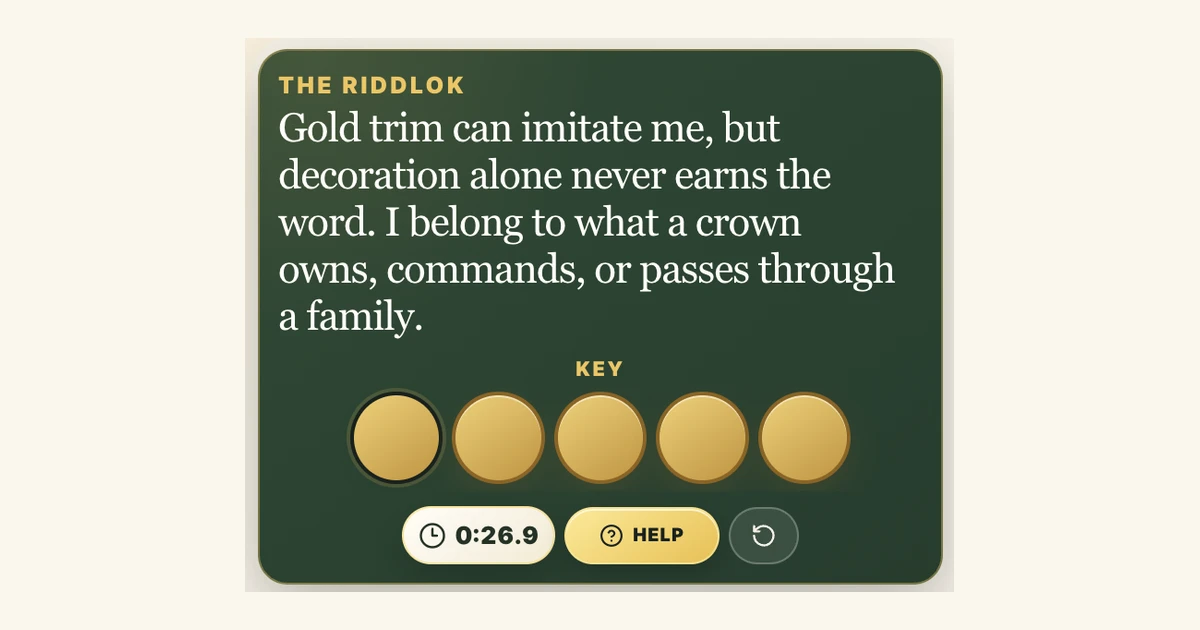
Every Riddlok starts with a riddle and an empty KEY. The KEY is the answer to the puzzle: the single word everything else on the board is pointing at.
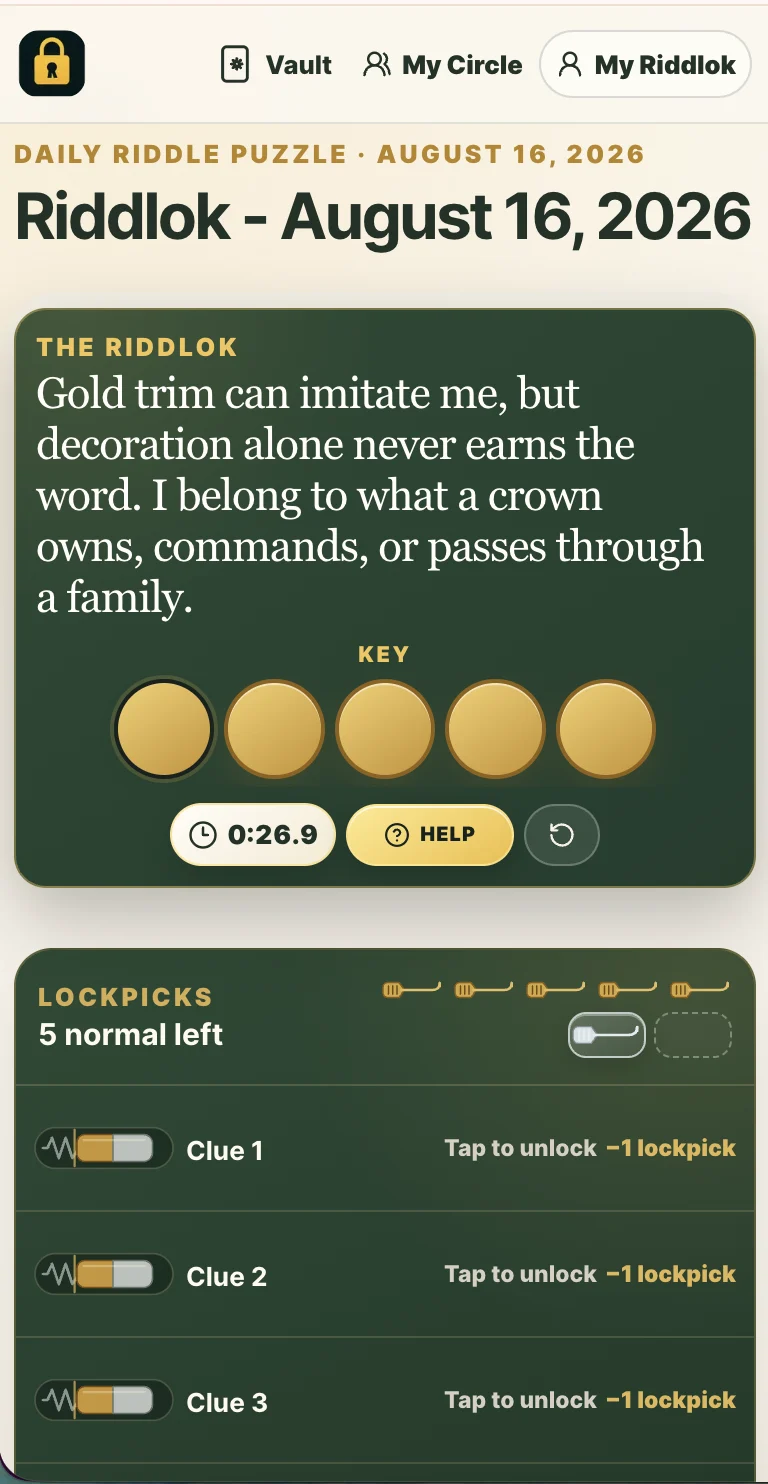
The first step is simply to read the riddle. If the answer immediately comes to mind, you can try entering it without opening a single clue. That's the purist's route, and on some days it works. If it doesn't, that's where lockpicks come in.
Using a lockpick opens one of the clues below the KEY. Solve that clue correctly and an important letter from the answer is revealed in the KEY. As more clues are solved, the KEY gradually begins to take shape.
A completely hidden answer might eventually look something like:
_ I _ E
That extra information can make the original riddle much easier to interpret. A riddle that read as hopelessly abstract a minute ago suddenly has a shape to fit into, and your brain stops free-associating and starts pattern-matching.
But there is another layer. The clue answers do more than reveal letters: they also share a relationship with the KEY itself.
For example, imagine two of the clue answers are:
FIGHTER
and
TRUCK
Both have an obvious connection to FIRE: firefighter and fire truck. If FIRE also fits the revealed letters and answers the riddle, the KEY has been cracked.
That gives you three different ways to work toward the same solution, and it's why two people can solve the same Riddlok by completely different routes.
Three Ways to Find the KEY
When a Riddlok starts to feel difficult, there are three useful questions to ask.
What answers the riddle? Sometimes the wording alone is enough to make a strong guess. Riddles reward reading them twice: the phrasing is usually doing more work than it first appears.
What do the revealed letters suggest? Every clue you solve narrows the possibilities for the KEY. Even one or two letters in the right positions can eliminate most of what you were considering.
What connects the clue answers? The answers share a theme or familiar relationship with the KEY, which gives you a third route to the solution: one that has nothing to do with spelling or wordplay and everything to do with association.
You might solve one clue, then another, suddenly notice what those answers have in common, and go back to the riddle with a completely different perspective. When the riddle, the revealed letters, and the theme all begin pointing at the same word, that is the core Riddlok experience.
It's a nice bit of design, because none of the three routes is the "correct" one. They're redundant on purpose, which means you rarely get truly stuck. You just switch lanes.
Lockpicks, Hard Mode, and the Clock
You don't need to solve every clue to finish a Riddlok. Lockpicks let you decide how much help you need before attempting the KEY, which turns clue selection into part of the strategy. Which clue looks most solvable? Which one is most likely to hand you a useful letter position? Those are real decisions.
One person may crack the puzzle from the riddle alone. Another may need several clues before the connection becomes clear. Both reach the same answer, just at different costs.
For anyone wanting a tougher challenge, Riddlok also includes a Hard Mode and Master Lockpicks earned through continued play. A running timer adds another layer for people who enjoy comparing results and trying to beat their own solve time.
None of that is necessary to understand before playing your first puzzle, though. Read the riddle, open a clue when you need one, and start looking for the connection.
Compete With Friends Using My Circle
Riddlok also includes a social feature called My Circle, designed for smaller groups of people who actually know one another rather than an anonymous global ladder.
You can invite friends, family members, coworkers, or other Riddlok players into your Circle and compare results on a personal leaderboard alongside the Global leaderboard.
There's built-in spoiler protection too. Before you complete the Daily Riddlok, the exact solve times of other Circle members stay hidden. Finish the puzzle first, then find out who had the better day.
The idea is to make Riddlok more than a solitary daily puzzle. It can become a small morning competition between coworkers, something shared in a family group chat, or an ongoing rivalry between friends. That's a pattern we believe in at Logic Loft too: it's why Pairdle has a shared daily board and a leaderboard rather than an endless stream of puzzles. A daily puzzle gets a lot stickier the moment somebody else is doing it at the same time.
An account isn't required just to start playing, which keeps the barrier to trying the game intentionally low.
How Riddlok Started
The idea behind Riddlok began with a crossword puzzle.
Its creator, Justin, built a crossword and submitted it to The New York Times. The puzzle wasn't accepted, but the experience of constructing it led him to start thinking about other ways crossword-style clues could be used.
At the same time, he had always enjoyed riddles. Eventually those two ideas began to overlap.
The goal became to combine the satisfaction of solving individual clues with the larger deductive payoff of a riddle, while adding a third layer that connected all of the clue answers together.
That became the basic structure of Riddlok: the riddle points toward the KEY, the clues reveal pieces of the KEY, and the relationship between the clue answers provides another way to discover it.
Three mechanics, one answer.
Where Riddlok Is Going Next
There's another idea behind Riddlok that could become an important part of the game as its community grows: letting players create puzzles themselves.
Building a traditional crossword can be intimidating. Constructing a full grid, managing crossings, filling it cleanly, and learning to write good clues creates a fairly high barrier for someone who simply has a clever puzzle idea.
Riddlok has the potential to lower that barrier.
The long-term vision is for players to create their own Riddloks by choosing a KEY, building connected clue answers around it, and writing the riddle and the clues. A Riddlok editor could then review the submission, help refine the puzzle where necessary, and potentially place it into the Daily queue.
For someone who has never constructed a published word puzzle, there'd be something uniquely satisfying about opening Riddlok one morning and seeing a puzzle they created as the Daily Riddlok everyone else is trying to solve.
That creation system is still in the future, but building Riddlok around both competition and community participation is a big part of where the game is intended to go.
Try Today's Riddlok
Riddlok is free to play in a browser on desktop or mobile, with a fresh puzzle every day. There's nothing to download, and an account isn't required to give it a try.
Read the riddle, unlock a clue if you need one, and see if the connections start to appear.
Can you crack the KEY?
Play today's puzzle at riddlok.com/today.
About the Creator
Justin is the creator of Riddlok, a free daily word game built around riddles, clues, themes, and the satisfaction of cracking a hidden KEY. He is developing Riddlok as a community-driven daily puzzle where friends can compete through My Circle and, eventually, players can create and submit Riddloks of their own.
P.S. For anyone who likes riddles: Epic Words is out now from Logic Loft Games, and its Chronicles system hands you a new encounter to puzzle through as you travel between kingdoms.
Related articles
The Mobile Gaming Landscape: Every Major Genre, Explained
From puzzle to shooter, slots to strategy, a founder's field guide to the 14 genres that make up mobile gaming today, with the games worth trying in each.
The Most Common Letter Pairs in English (And What They Reveal About How We Read)
Which two-letter combinations appear most often in English? We analyzed thousands of six-letter words to find out, and the results explain why some Pairdle puzzles feel easier than others.
How to Play Scrabble: Rules, Scoring & Board Bonuses
A clear, complete guide to Scrabble: setup, the 100-tile bag, how scoring and premium squares work, and the rules most people get wrong.