The Chronicle of Epic Words
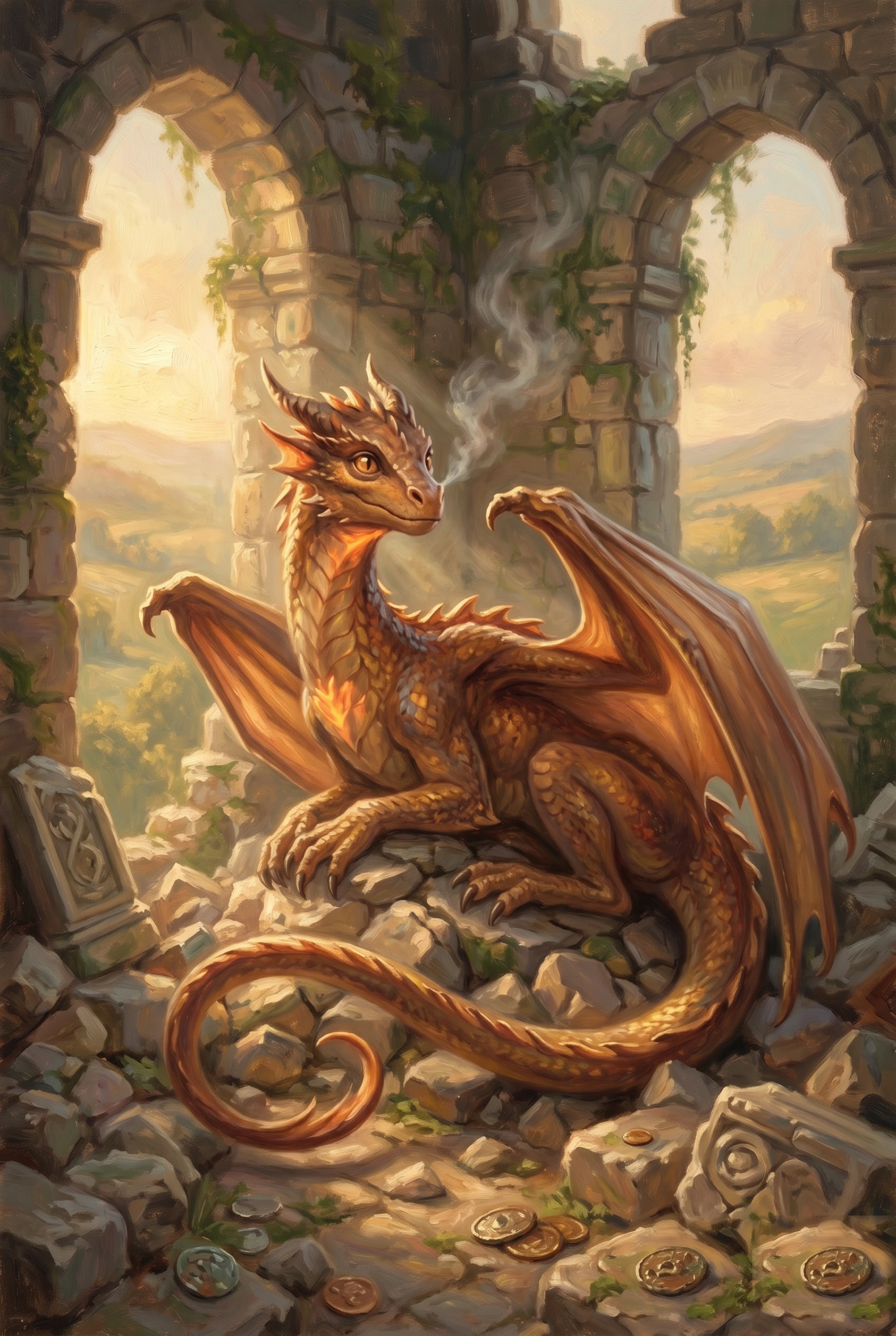
Ember, the Young Dragon
The realm's oldest rumour — glimpsed over ridgelines for a generation, never landing, and the only one who ever went below and came back.
At a glance
Young, for a dragon — which still makes her older than most of the kingdoms that tell stories about her, and old enough to have watched more history go by than any of them bothered to keep.
- Home The ridgelines at dusk — she has never been seen to land, save once
- Kingdom VII (The Hidden Syllable)
- Faction Neutral · Dragon
Ember will not tell you she is dangerous, because she does not need to, and because — young as she is — she has already worked out that the creatures who say it are usually the ones who aren't. She is a dragon the colour of banked coals, amber shading to copper along the spine, and the river country will tell you she lives in the tumbled remains of a tower at the quiet edge of the Hidden Syllable, out where travelers still call the land half-said, near the low green mound of Half-Said Barrow. Nobody has been up to check. She was not born there, by any account; she simply arrived, at some point too far back for anyone to have written down, and the story has had so long to settle that the tower and the dragon have become, in the local telling, a single thing: the place on the ridge where the stone breathes. What the ridge road actually offers a traveler is smoke on a cold morning, and a shape over the skyline at dusk, and no way at all to tell which of the two stories is the true one.
She is young for what she is, which is a strange sentence to write about something already older than the reigns of half-remembered kings. But dragons keep their own clocks, and by that reckoning Ember is barely more than a girl — impulsive, curious, quick to a decision and slow to a second thought. She has the size to be a legend and the temperament of a creature who has spent her whole life listening to a world that has never once addressed her directly. There is a loneliness in that, though she would set the whole ridge alight before she admitted to it.
What she is best at — better than the fire, better than the folding of walls — is waiting. She has waited through weather and war and a great deal of forgetting, out at the edges where nobody looks twice, and in all that stillness she has become an unnervingly good reader of people. She reads them the way you read a room from the doorway — at distance, unhurried, and without ever once being asked in. Fifty kingdoms have gone by beneath her without knowing they were being taken in. She is rarely wrong about any of them. She has had the practice.
This is where the barrow-tales go wrong about her, and they go wrong in a way that flatters the teller. They cast her as a thing to be come at — slain by the brave, spared by the merciful, befriended by the clever — because a dragon you can decide about is a far more comfortable dragon than one who has been deciding about you. Nobody has drawn a blade on Ember. Nobody has offered her an open hand. She is not the docile treasure of a nursery tale and she is not the ogre of one either; she is simply a creature the whole realm has fled from or sung about without once addressing directly, which is the loneliest arrangement available to anything that can hear.
She is not, whatever the barrow-tales say, a horde-and-cinders sort of dragon. She keeps a few coins in the rubble, more magpie than miser, and pays closer attention to the small business of the kingdom than anyone would credit — the miller's SILENCE worn from the gate-sign down at Hush Mill, the hum a traveler feels in their boots along Undertone Reach, the lute-note that hangs an instant too long over the barrow when a certain grey-haired bard finally remembers his word. She has opinions about all of it. She simply has never had anyone to give them to.
So do not go looking for her tower. Go the whole way instead — fifty kingdoms, to the square of The Eternal Sentence on the night the realm's Word is spoken whole — and somewhere over the last of it, with a sound like a ship settling, the rumour will land on the roof of the inn and fold its wings and stay. That is the meeting: a whole realm looking up at once at something every one of them recognises and none of them knows. She takes the roofline like a sentry who expected exactly this and has, in any case, nowhere better to be for the next age or so. The Hidden Syllable leaves everything unfinished, and it left her unfinished too — a question nobody has yet walked up to and asked. She will keep. Things that have waited that long generally do.
Tales & Rumors
Nobody in the half-said kingdom can quite tell you when the dragon came to the tower, only that the tower was already a ruin when she folded herself into it, and that the two have kept each other's company so long the local children think of them as one thing: the place where the stone breathes. She sleeps the way old rivers run — slow, deep, and with the occasional startling current — and the smoke that curls from the ruin on cold mornings is the only sign anything up there is alive at all.
Every telling of her ends the same way, with a traveler at her tower and a choice. Come with a drawn blade and she meets you as a drawn blade — she is young, not slow, and she has been waiting. Come warily and leave her be, and she lets you go with one amber eye half-open, filing you away for later. Come with an open hand and something worth saying, and you find the fiercest thing in the kingdom is also the most curious. It is a fine tale, and it has never once been tested: no blade has been drawn on Ember and no hand has been offered her, and the choice the songs hand out so freely is one nobody has yet gone up the ridge to make. What the tale gets right is the ending it never reaches — a creature who has listened to the world go by beneath her for years and would dearly like, just once, to be spoken to instead of fled from.
For all her size, Ember has the manners of someone raised entirely by eavesdropping. She has heard Hawthorn's lute carry up from Half-Said Barrow on still evenings for so long that she knows the very refrain he keeps forgetting — hums it, in fact, low enough to be mistaken for the hum that runs under the whole kingdom — and is quietly, enormously offended that in all these years no one has thought to ask the dragon how the song ends.
How They Measure Up
Every figure below is the realm's estimate of her, arrived at from a long way off — which is the only distance anyone has ever had on Ember.
Young, and still she could fold the tower's last standing wall with one unhurried stretch. She hasn't. That's the interesting part.
Coiled into a ruin built for men, she moves like a cat in a cupboard — surprisingly little knocked over, all things considered.
Slept through an age of weather, war, and forgetting without so much as a cough. Waking was the strenuous part.
Understands far more of the realm's speech than anyone has thought to wonder about — and has had a very long time, listening from a distance, to think about what she would say back.
Young enough to act first and reflect somewhere over the next valley. The reflecting, when it comes, is thorough. It just comes late.
Fills a skyline the way weather fills it — the light changes before you find the shape. A whole realm has spent a generation talking about her, and not one word of it to her.
The One Who Came Back — The only thing about her the old songs will not budge on. Something patient and very old lies under the realm, and everything that ever went down to it stayed down. Once, before living memory, Ember went down — and came back up, the only one who ever has. Nobody knows what she carries from it. She has had a generation of ridgelines, and one night on an inn roof, in which to decline to mention it.
Where you'll see her — once, at the end
Ember is a sight, not an acquaintance. There is no tower you climb and no dragon who wakes to take your measure: for nine and forty kingdoms she is the realm's oldest rumour — glimpsed at dusk over ridgelines for a generation, never landing, never hunting, present at the edges of things the way weather is. She comes down exactly once, at the very end, in the square of The Eternal Sentence on the night the realm's Word is finally spoken whole: a sound like a ship settling, and a young dragon on the roof of the inn, wings folded, head tucked, staying. Nobody in that square has met her. Everybody recognises her. The barrow-tales that put her asleep in a ruin somewhere out past Half-Said Barrow are tales, and she has never troubled to correct them. What the old songs are firm about is only this: that dragons remember the Word from before the First King, and that this one, once, before living memory, went below — and came back, the only one who ever did.