The Chronicle of Epic Words
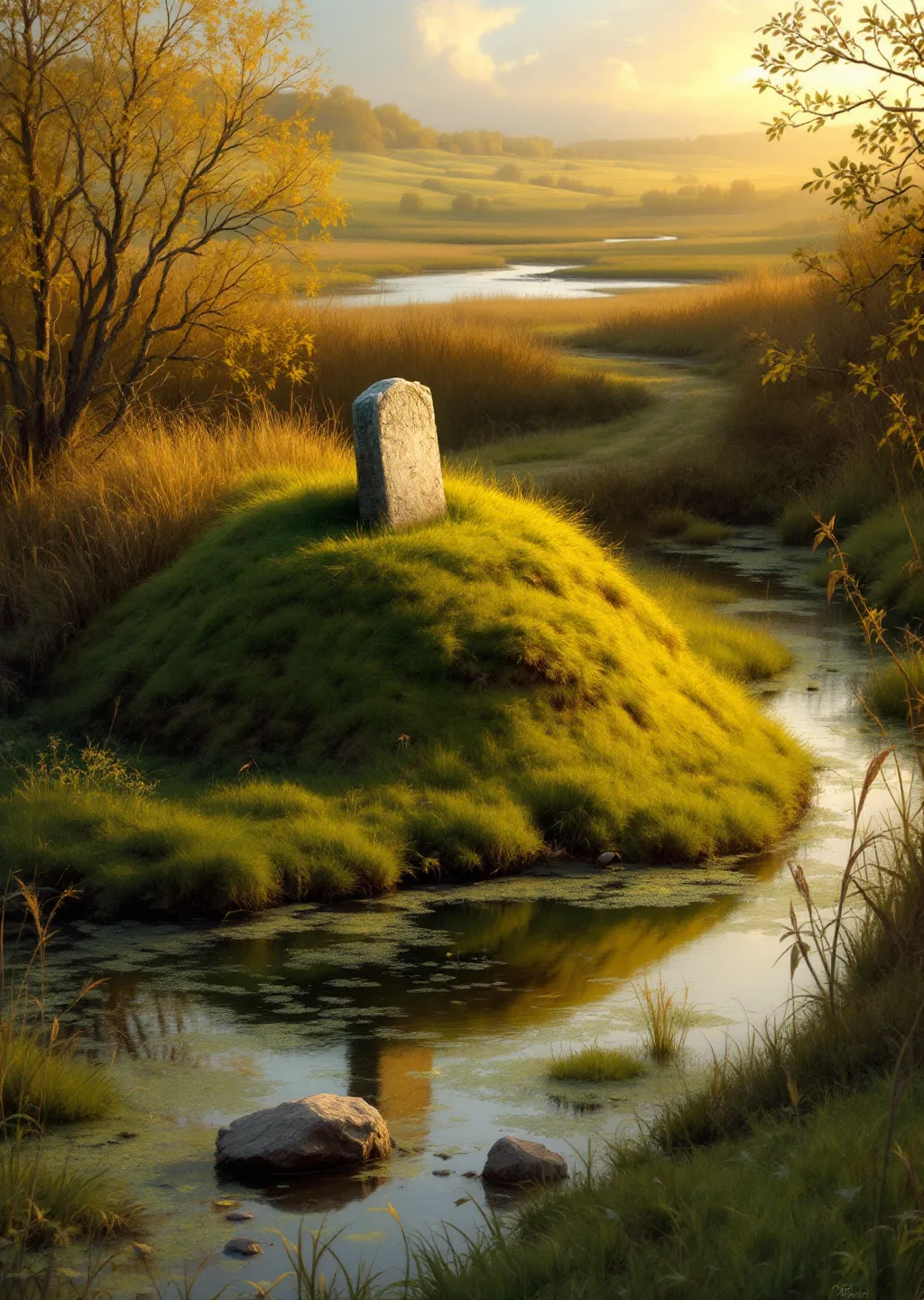
Half-Said Barrow
A low green mound whose oldest verse is missing its last word — smoothed away on purpose, waiting for someone to say it aloud.
At a glance
- Kingdom VII (The Hidden Syllable)
Half-Said Barrow is not much to look at, which is the whole point. A low green mound at the fringe of a marshy, osier-screened hollow, a single weathered stone face still upright where the rest have long since lain down in the turf — you'd walk past it without a second glance if it weren't for the lute. It belongs to the oldest kind of place in the vale: the sort that has been standing quietly for far longer than it has been doing anything, and has made its peace with that.
Everything about the barrow comes down to the stone. Carved into that one standing face are six lines of verse — five of them worn smooth but legible, the sixth half-eaten by lichen. And where the last line's final word ought to be, the stone is simply blank. Not broken. Not crumbled. Smoothed away, deliberately, as though the mason set his chisel down and decided the word should be left out — so that someday, someone passing through would have to kneel, tilt their head, and say it aloud to make the barrow whole. It is a lock that has been waiting a very long time for the right key, and the key is a word.
That waiting is what has snared Hawthorn, the grey-haired minstrel who has taken up residence on the barrow's grass-berm. The song he plays is older than the mound itself — he'll tell you so the way you'd mention a road being longer than it looks — and its oldest verse ends on the same missing word that finishes the barrow's inscription. Song and stone share the gap. Supply the word, and both complete at once: the lute-note hangs over the hollow longer than any note should, the osiers go dead still for three heartbeats as though the breeze had been asked to wait, and then the world quietly goes back to being itself. The word, for the record, is one every singer knows: the part of a song that keeps coming back.
The barrow rewards lingering. Stay past the point where the applause would normally happen and Hawthorn will turn the verse the bards keep for late listeners — a song about a road that forgets the names that built it, best not sung too loudly, because it "tends to find the right ears." Ask for the full account and the verse gives up a name: The Unwritten King, and a first court where the scribes were ordered to use only four vowels, and a royal seal kept in a box of salt to stop the names from rotting. It is one oblique thread among many in these kingdoms, and the barrow offers it the way it offers everything — sideways, unfinished, for you to carry off and worry at later.
Even the turf keeps secrets. Hawthorn once turned up a small bent brass badge here — a lute with a cracked neck, emblem of the old Royal Minstrels' Guild, disbanded generations back for reasons nobody quite agrees on. Some say the archives just thinned out from under them. He shrugs when he says it, the shrug of a man who has learned not to chase that particular thread too far. The barrow does not encourage chasing. It encourages sitting, and listening, and noticing that the silence here is far less empty than it sounds.
By the time you leave, the sixth line reads true again — if you know where to look. Most who pass this way won't; the word was left out on purpose, and only someone paying the right kind of attention will ever see it filled. Hawthorn will already be halfway down the road toward Hush Mill, lute across his back, whistling the very refrain that fixed the stone — a song one word fuller than it was that morning, walking away from a barrow that is, at last, entirely said.
Where you'll find it
Half-Said Barrow sits at the edge of an osier-screened hollow in Kingdom VII (The Hidden Syllable) — the river country travelers still call half-said, where every conversation seems to trail off a beat before it's finished. You'll hear the place before you reach it: a lute, played carefully and knowingly, stopping mid-phrase. Follow the road on and it runs toward Hush Mill and the low water of Undertone Reach; you'll know you've arrived at the barrow itself by the one weathered stone face still standing on the mound, and the grey-haired man on the grass-berm who has been trying to finish the same song all week.