The Chronicle of Epic Words · Founder’s Deck
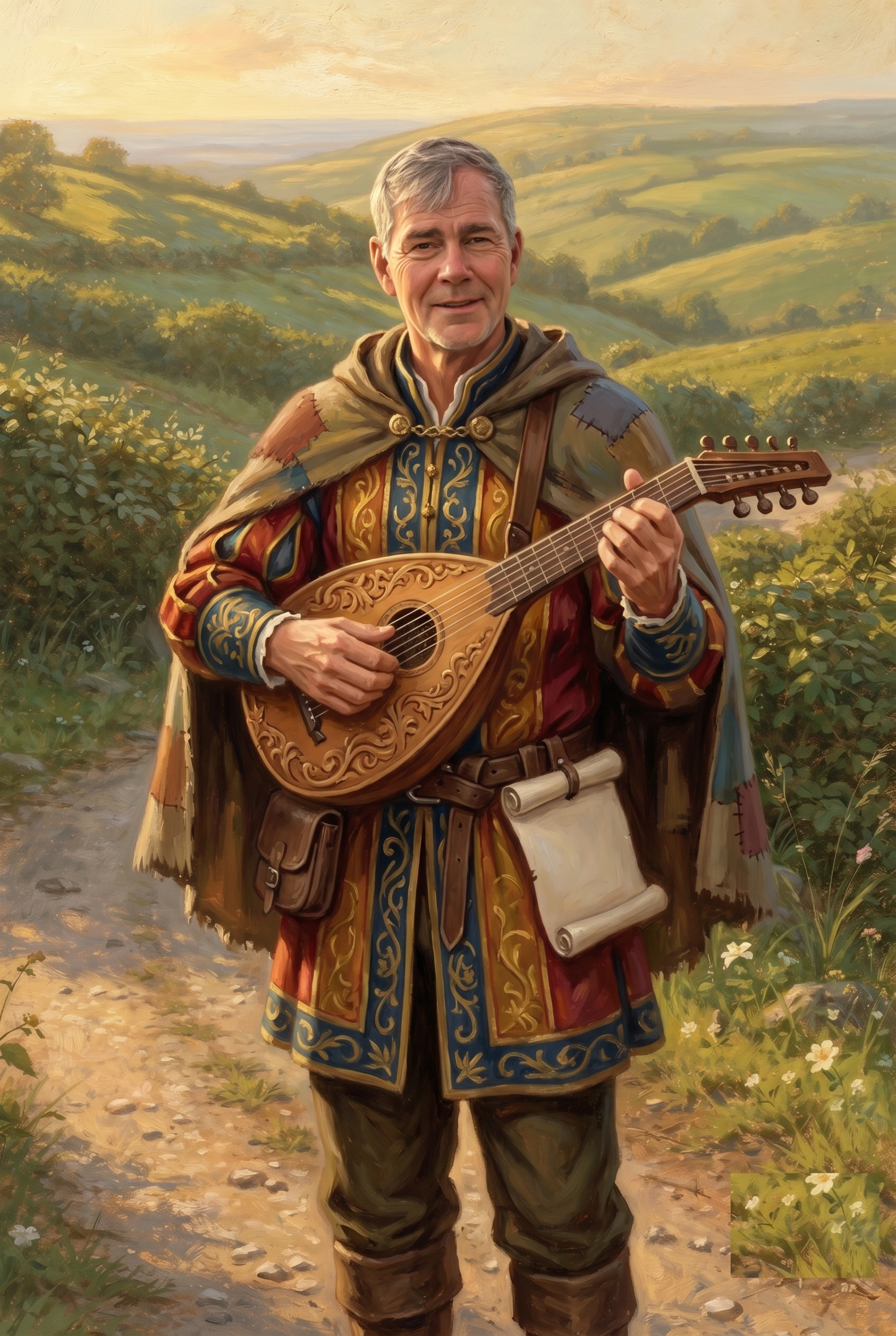
Hawthorn, the Bard
A grey-haired minstrel who has outlived several wars, two sets of patrons, and his own best verse — and is still, against all odds, in a fine mood about it.
At a glance
Grey enough to have outlived two sets of patrons and his own finest verse. Spry enough to still be whistling on the walk to the next town.
- Home The open road
- Kingdom VII (The Hidden Syllable)
- Faction Lexicographers · Wandering Minstrel
- Founder’s card Seven of Hearts
Hawthorn will tell you, if you give him the smallest excuse, that he is not lost and not finished — merely between verses, which is a different thing and a more dignified one. He has the grey hair of a man who has been at this a long time and the good boots of one who intends to keep at it, and a lute so worn at the edges that the carving has gone soft under decades of the same two thumbs. He has outlived several wars, two sets of patrons, and by his own cheerful accounting his own best verse, and he considers this less a tragedy than a long and interesting joke that the world is still telling at his expense. He does not mind. Minding, he'd tell you, is bad for the voice.
What ails him when you find him is very specific and very old. At Half-Said Barrow, the oldest song he knows has developed a hole — one word gone missing from its final line, the same line, as it happens, that finishes the barrow's weathered inscription. He has reached that gap three times this week and gone blank each time, and it troubles him the way a splinter troubles a hand: not badly, but constantly. The word, when it comes, is refrain — the part of a song that keeps returning, the line the singer circles back to however far the verse wanders — and it is entirely like Hawthorn that the word he cannot remember should be the word for the thing he cannot stop doing.
Because that is his whole character, if you watch him long enough. He cannot leave a thing half-said. Where another traveller would shrug at a smoothed-out stone and walk on to Hush Mill, Hawthorn will sit at the barrow for days, playing up to the gap and stopping, playing up to it and stopping, waiting for the world to hand him the missing piece. Say the word aloud and something quiet happens: the lute-note hangs a beat too long, the osiers by the water go still for three heartbeats as though the breeze has been politely asked to wait, and then the world goes back to being ordinary, one word fuller than it was that morning.
He is generous in the offhand way of people who own almost nothing. Stay for the long version of a song and he'll press a travelling apple into your hand, the spare he always carries; sit with him in silence instead and he's as likely to tuck a moon coin into your coat "for the next toll-keeper — they always want something." He carries an old, odd tune about a king who filed his own vowels away and kept the royal seal in a box of salt to stop the names from rotting, and he sings it the way you'd tell a ghost story you half-believe: for the pleasure of the chill, not the moral. If you tell him you've met others whose words go strange — couriers who say technically too often, a barmaid who remembers everything she overhears — he listens with his whole body, the way bards do, and files it all away for a verse he hasn't written yet.
Ask him about the disbanded Royal Minstrels' Guild whose broken badge he carries, and he'll shrug and hand you the badge. Ask him about the woman he loved thirty years ago and he'll change the subject with a musician's grace, so smoothly you won't notice for a mile. There is, you sense, a great deal he has decided not to chase — old guilds that thinned out from under themselves, songs that stopped using a name until he stopped asking why, verses he plays only when he thinks the stones aren't listening. He is not a man without questions. He is a man who has learned that some of them will wait, and that the road is long, and that a good refrain is worth more than a good answer, because a refrain, at least, always comes back.
You'll find him where the water hums under the boots at Undertone Reach and where the fey leave their marks at Willow Writ, always headed toward the next town, always one word short of finished and perfectly content to be. When your business at the barrow is done he'll already be halfway down the road to Hush Mill, lute across his back, whistling the refrain — the part that returns — and looking, for a man who has lost so much of his own best work, remarkably like someone who expects the good parts to come around again.
Tales & Rumors
He always carries one apple more than he means to eat — the habit of a man who has spent enough nights on the road to know that a spare apple is worth more than a spare coin, and easier to give away. Sit through the whole of a song with him, beginning to old gap to end, and the spare tends to find its way into your hand as payment for staying.
Tucked in the velvet lining of his battered lute-case is a small bent brass badge shaped like a lute with a cracked neck — the emblem of the old Royal Minstrels' Guild, disbanded generations back for reasons nobody quite agrees on. 'Some say the archives just thinned out from under them,' he'll say, with the shrug of a man who has learned not to chase that particular thread too far, and then he'll offer you the badge as though glad to be rid of it.
Thirty-odd years ago there was a woman named Elowen he'd have followed anywhere, and for a while did. Then her studies asked more of her than the road could spare, and she chose the studies. He doesn't sound bitter about it — bards rarely waste a good sorrow on bitterness — but there's one verse he only ever plays when he thinks the barrow isn't listening, and he's never once told anyone its name.
How They Measure Up
A bard keeps his own tally too — mostly in verses, half of them about himself, all of them slightly improved in the retelling.
A lute, a pack, and a spare apple, carried three kingdoms without complaint. Ask him to lift anything heavier and he'll offer to sing about it instead.
Fingers that find the right string in the dark after forty years of practice. It's only words that go missing on him now, never notes.
Has walked through the tail end of several wars and out the far side of two patrons' fortunes, boots still good. That's not luck; that's mileage.
Carries whole verses no living scribe has bothered to copy — and knows exactly which ones not to sing too loudly.
Learned long ago which threads are worth chasing and which just want to pull you off the road. Chooses, most days, to keep walking.
Can make a stranger sit down on a grave-mound and stay for the long version of a song. Does this roughly once a week, apparently by accident.
The Returning Line — he cannot leave a song half-said. Hand him a verse with a word worn out of it and he will circle the gap for days, playing up to it and stopping, until somebody says the missing word aloud and lets the line come home.
Where you'll meet him
You'll hear Hawthorn before you see him, in Kingdom VII (The Hidden Syllable) — a careful, knowing lute-phrase that climbs toward its ending and then, mid-note, simply stops. He'll be sitting on the grass-berm of Half-Said Barrow, a low green mound crowned by a single weathered stone carved with six lines of verse: five worn smooth but legible, the sixth ending in a blank where the final word should be — not broken, not crumbled, but smoothed away, as if the mason left the gap on purpose. Hawthorn has reached that line three times this week and gone completely empty each time. 'You wouldn't happen to know,' he'll ask, hopeful in the cautious way of a man who has learned not to be, 'the word for the part of a song that keeps coming back? Six letters. Starts with R.'