The Chronicle of Epic Words
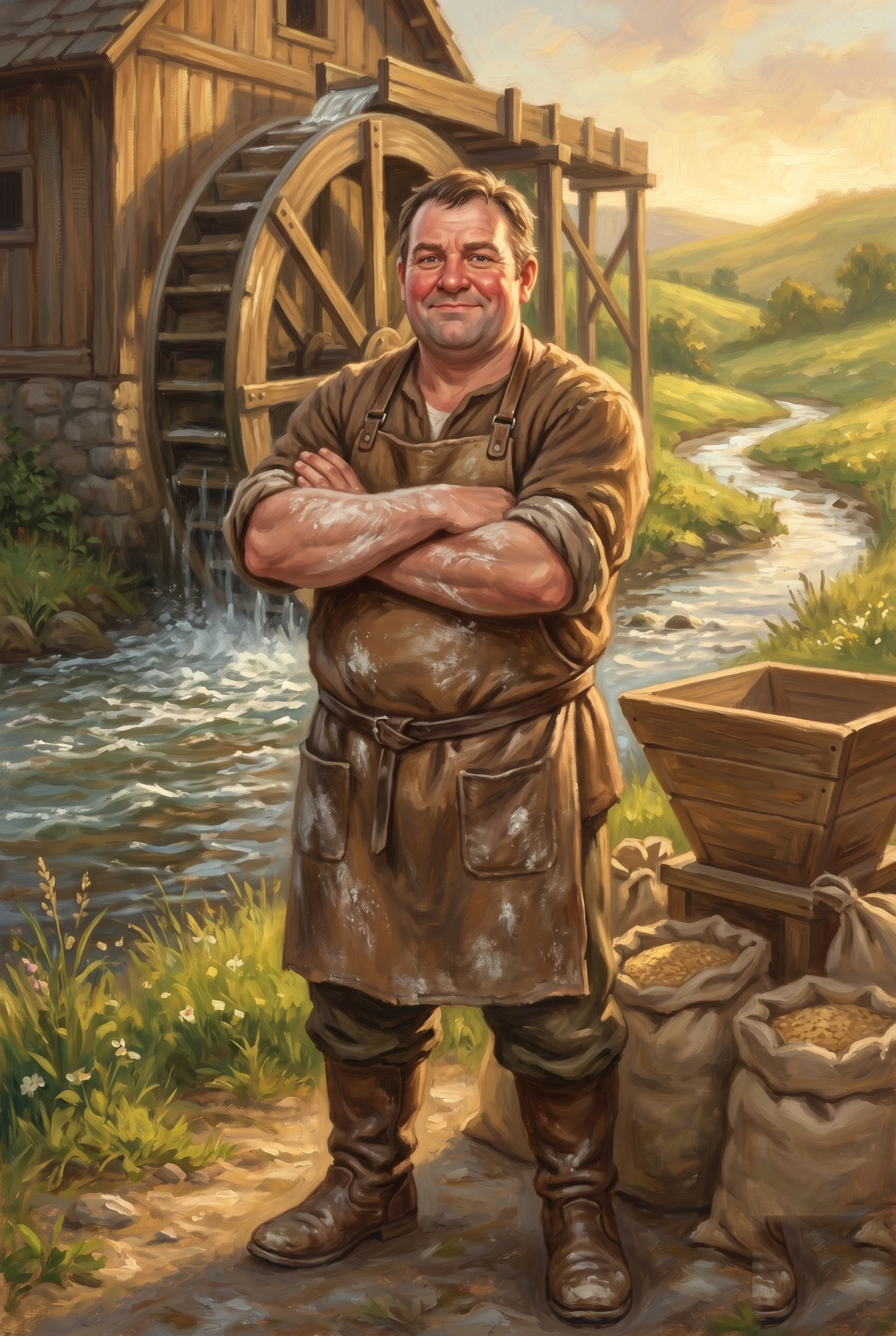
Brann, the Miller
A man who has lost the same mill to the same river four times, and is quietly certain the fifth spring will be the dry one.
At a glance
Old enough that the river has carried his mill off four times. Young enough to be sure it won't manage a fifth.
- Home The mill below Confluence Watch
- Kingdom V (The Babel Tower)
- Faction Common Folk · Miller
Brann will tell you, if the water is low enough that he has the leisure to say anything at all, that a mill is not a building. A mill is an argument with a river, and the river — being older than any miller, and a great deal more patient — tends to win that argument about once every third spring. He says this without bitterness. He says it the way other men remark on the weather, which, for Brann, it essentially is.
He grinds the grain of half the kingdom at the fork below Confluence Watch, in the one spot where the river gives up trying to be a single thing and becomes two of them instead, loudly and permanently. It is, by every sober measure, the worst place in the vale to put a mill — the exact low seam the high water fills when the high water comes. It is also, by the only measure Brann has ever cared about, the best: two currents' worth of push on a single wheel, and not a barge moving between Tongue's Landing and the silt-flats that doesn't pass his door. He has weighed those two facts against each other his whole life and declined, every time, to let the first one win. So the mill sits in the fork. And every third spring or so, the fork takes it back.
You would think a man could learn. Brann has learned everything except the lesson. He can read the river the way a scholar reads a page — he'll tell you to the hour when the water will come up, which meltwater is snow and which is storm, what a certain smell off the flats means for the week ahead — and he is right, reliably, about all of it. What he cannot do is act on being right. The knowledge that the flood is coming and the decision to build somewhere it can't reach live, in Brann, in two entirely separate rooms that have never been introduced. He saves the good millstone. He moves the flour up high. He does not, ever, move the mill. And when the water goes down he is back in the fork within the week, laying the same timber in the same doomed line, humming, certain past all argument that this is the year it holds.
The apprentices are the part that gives him away. He keeps more of them than the mill could pay in three good years running, and it has not had three good years running in living memory. None has drawn a full wage since a dry autumn nobody can place; all of them stay. They stay for the board, and the trade — there are worse things to know than milling — and for the standing, sincere, endlessly renewed promise that this season's flour will square last season's wages. It never quite does. The promise rolls forward like a stone down a mill-race, gathering interest it will never be asked to pay, and the apprentices, who are fond of him and no better at sums than he is, long ago stopped keeping the count. When the water comes, they haul his timber out of the current beside him without being asked. It is, whatever the ledger says, a kind of wealth.
He is not a man the great story of the kingdom has any particular use for, and he'd be the first and most comfortable to say so. Couriers know him — Pell has dried his socks at Brann's fire more than once, and the centaur Cody treats the mill as a fixed point in a landscape that otherwise keeps rearranging itself around bandits and closed roads. The flour he grinds turns up on tables from the flats to the Duke's own hall, though Brann has never met the Duke and would not know what to do with him if he did. When the pass above the river closes and the barges stop, it is Brann's wheel that stands idle and Brann's apprentices who go hungriest, three towns from anyone who decided it — the small, downstream cost of other people's larger quarrels, borne without much complaint by a man simply trying to get one wheel turning again before the next rise.
Between floods is where he lives — not in any of the four mills the river has taken, but in the good, dry, humming stretch of certainty between the last one and the one he is already, cheerfully, laying the timber for. Whoever finally comes down to the fork will find him there, because there is nowhere else he has ever intended to be.
Tales & Rumors
He runs the mill at the exact spot where the river below Confluence Watch can't decide whether to be one river or two and settles the matter by being both, loudly. It is the worst possible place to grind grain — precisely where the high water goes when the high water comes — and also the best, since two currents push one wheel and every barge between Tongue's Landing and the flats must pass his door. Brann has known both those facts his whole life and built there anyway, which is either the soundest business decision in the vale or the most stubborn, and he has never felt the need to decide which.
He keeps apprentices the way other men keep debts: more than he can afford, and with a great deal of private guilt. None of them has been paid in full since a dry autumn nobody can quite place, and every one of them stays — for the board, the trade, and the standing promise that this year's flour will finally settle last year's wages. The promise compounds. The apprentices, being fond of him and not much good at sums either, have mostly stopped counting.
When the flood comes he saves things in a fixed order that says everything about him: the good millstone first, the ledger never, the apprentices always, and the gate-sign — its lettering long since rubbed soft by weather and passing sleeves — not at all, on the grounds that everyone knows where the mill is anyway, and the ones who can't read it were never going to.
How They Measure Up
A miller keeps accounts too — of water, mostly. The other kind he keeps badly, and on purpose.
Carries a full grain-sack under each arm and complains only about the stairs. There are a great many stairs; the flood put them there.
Hands the size of a shovel-blade, and a millstone's tolerances measured in the width of a hair. He manages. Ask him to thread a needle and watch the whole thing come apart.
Has worked wet to the knee for thirty years and calls a head-cold 'the price of the trade.' The trade has never once presented a receipt.
Reads water better than any scholar in the vale and letters worse than any child. Knows to the hour when the fork will rise; couldn't tell you what his own gate-sign says anymore.
Every instinct he has about the river is correct, and every one about the river's effect on his finances he cheerfully ignores. That's not the same number twice — it only looks like it.
Nobody dislikes Brann. This is partly warmth and partly that he has never once managed to say no to a hungry apprentice, and word gets around.
Rebuilding — the one thing about Brann that has never washed away. Take his mill, his wheel, his winter's flour, and his front wall — the river has taken all four together, more than once — and by the next dry week he'll be up to his boots in the same doomed fork, laying the same timber, wholly certain that this is the year it holds.
Where he is, and why you haven't met him
Not on the road yet. Brann's mill stands in Kingdom V (The Babel Tower), down where the river forks below Confluence Watch, and the grain of half the kingdom passes through it on its way to Tongue's Landing — but no traveller has yet turned off the river road to knock, and this page is the record of a man rather than the promise of a meeting. When the road does go down to the fork, here is what will be standing in it: a mill between floods. The wheel stopped, the flour short, the barge-trade piling up behind a wheel that isn't turning, and Brann knee-deep in the aftermath of a spring rise, hauling a soaked timber out of the current with the resigned good cheer of a man doing a thing he has done before and fully expects to do again. He would not, he'd assure you, call it trouble. He is simply between floods.