The Chronicle of Epic Words
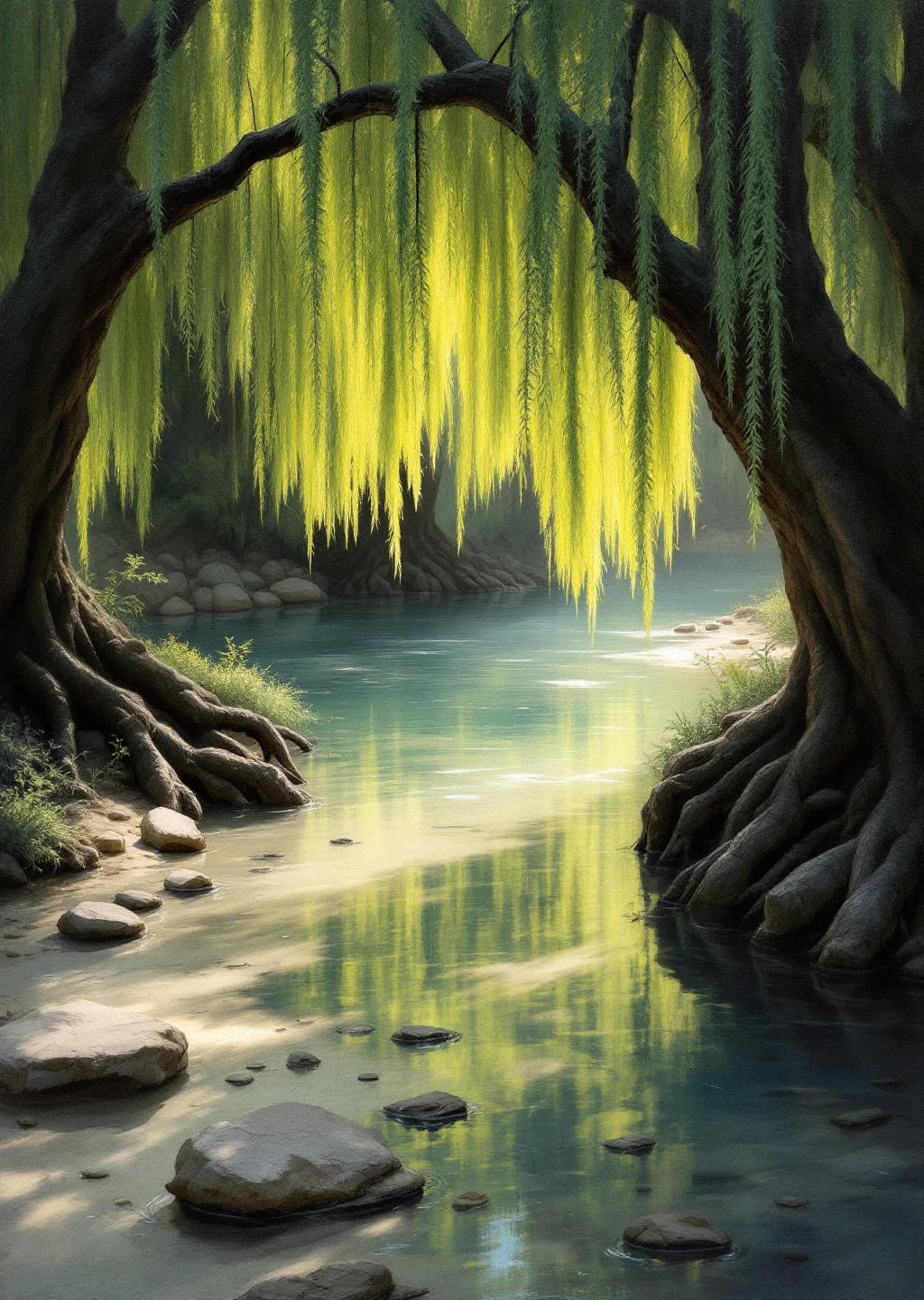
Willow Writ
The clear stretch where the willows write names into stone — and the water keeps the ones it's asked to forget.
At a glance
- Kingdom VI (The Letter Garden)
Every kingdom keeps its records somewhere. In Calligrapher's Green it's ink and hedge and the fourteen disputed inscriptions of the Runic Arbor. At Willow Writ, it's the streambed — and the streambed does not lose things the way paper does.
You come to it by following the river until the road forgets its manners. The willows have grown low over a clear stretch of water, ancient trees whose roots run thick as barrels and black as charcoal, anchoring the gravelly bed against every spring the vale has ever thrown at it. Their trailing branches have brushed the same pale stone for decades, and where they've brushed, they've worn — not idly, but with the patient, deliberate insistence of something taking dictation. The letters pressed into the rock are worn smooth and round, like pebbles that have spent ten thousand years in a millrace, and unmistakably intended. Not carved. Grown into the stone by steady wood-friction. Single letters, not words. A G. An I. An N that used to be a whole N.
The water is so clear it has no colour of its own — only the grey of the stone beneath it and the pale green of the leaves above. It is shallow enough to see the bottom, and strange enough that you'll look twice to be sure you're seeing it right. The locals say the letters are just the water's work. The locals are half telling the truth. The rest of it belongs to whoever's reading the bed when you arrive.
That, most likely, is Thistle — the lake fairy who doesn't so much appear as turn out to have been there the whole time, the way things are when you've stared at water too long. Wings the colour of dragonfly-green, bare feet two inches above the surface, and the absorbed frown of someone working through a difficult text. She reads the streambed the way an archivist reads a ledger: fluently, and with opinions. The letters worn in honestly by time she finds pleasant. The ones that aren't honest — the ones the water was made to move — she finds a great deal more interesting.
Because one of them was moved. Six years back, someone worked the bank above the marker-stone and redirected the current, and the pushed water took a stroke off a rune that had no business losing it — the half-N, a wound that has nothing to do with weather. And it is not the only scar here, only the newest. Underwater near the far bank sits a flat slab of white limestone, and on it a G whose cross-bar was split by a wedge-mark like a miniature lightning bolt — not water this time but a chisel, two centuries ago, in the hand of someone who wanted the stream to forget along with everything else. It didn't quite work. Stone remembers longer than parchment, and Willow Writ has been remembering, unbothered, while people upstream filed the same name out of a signet and assumed that would be the end of it. They forgot to check the water. Thistle has watched the half-worn letter for six years, waiting for someone to come and ask the right question — and she is far more interested in the names that were pushed than the ones that were kept.
She trades in a currency the ink-scribes of the Green don't stock: the fey-favour, a small warm river-token that stays faintly damp in your pocket long after you've left. Bring her a name and she'll weigh it like a jeweler weighs a stone. It's a quieter errand than the gossip and cider of the Pressed Petal, where Rowan hears everything and admits to noticing nothing — but the two places are asking after the same missing letter from opposite ends. One reads the room. The other reads the riverbed. Neither will tell you the whole word yet. Come back, Thistle says, when you know the whole name. She will want to hear it.
Where you'll find it
Willow Writ is a shallow bend of the river in the water-and-hedge country of Kingdom VI (The Letter Garden). From the center of Calligrapher's Green, follow the river out past the trimmed hedges until the road gives way to willow-shade and the current goes glass-clear. You'll know the place by its silence — the locals will point you to it in daylight and, without ever quite saying why, none of them will offer to walk you there after dark.