The Chronicle of Epic Words
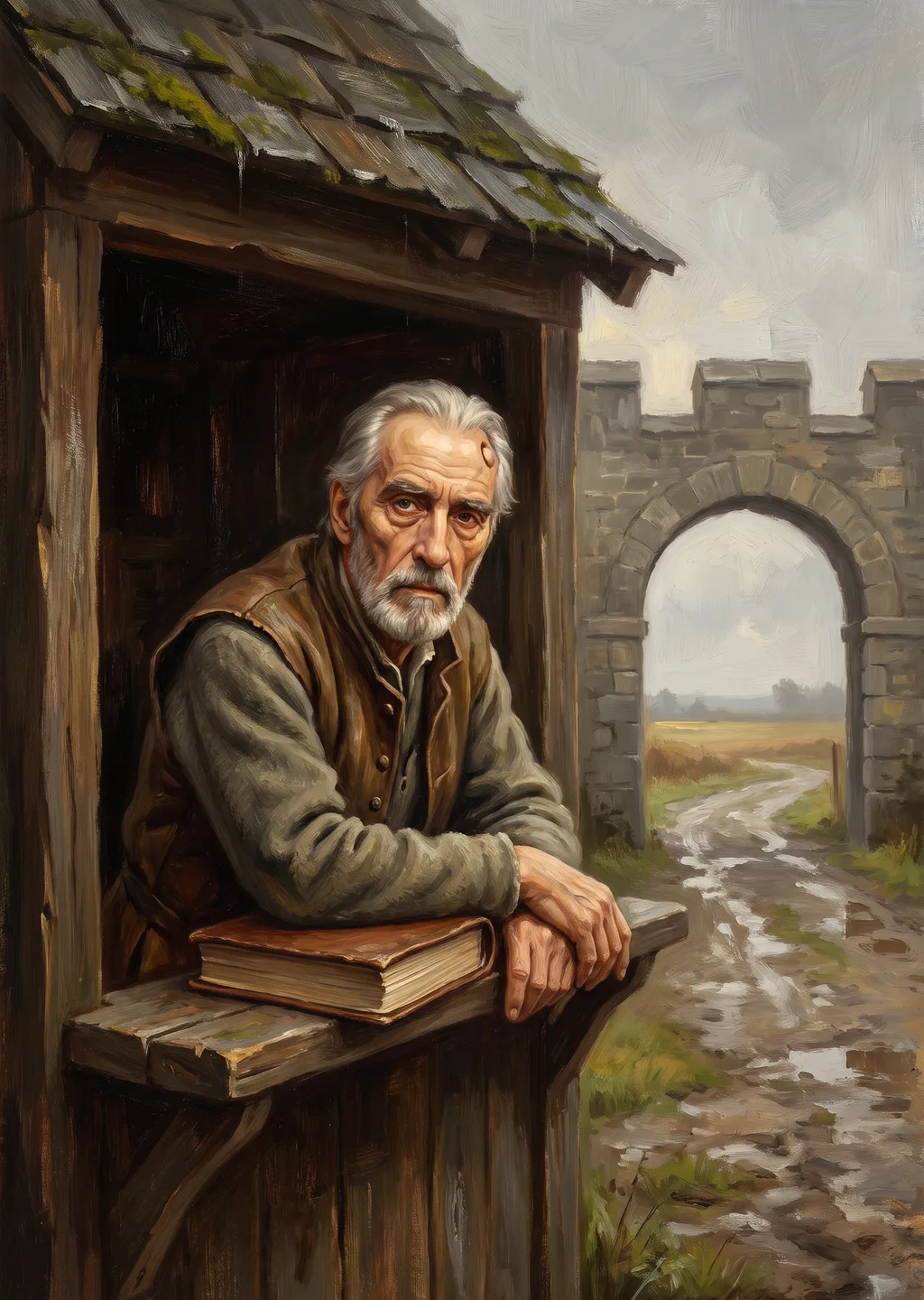
Orin, the Tollkeeper
The keeper of a crossing whose toll is paid in patience, and a ledger of the dead nobody else came back for.
At a glance
Old enough that the ledger was already thick when he inherited it. Not old enough, by his own reckoning, to have reached the bottom of it.
- Home Before-Gate
- Kingdom XXII (The Prefix Passage)
- Faction Common folk · Tollkeeper
Orin will not tell you his troubles, because in his own accounting he doesn't have any — he has a post, and a ledger, and a toll that most travelers misunderstand until the moment they're standing inside it. He keeps Before-Gate, the crossing at the edge of a country nobody living can name. It wasn't lost, that name. It was taken, cleanly, long enough ago that even the people who lost it have died and been replaced twice over. What's left is a gate, a booth, a fence-line of birds, and Orin, who keeps the one record the vanished country still has: a ledger, thick as a brick, of everyone who died out here that nobody came back for.
He did not set out to become that. He took the keeper's post the way people take the posts nobody else wants — the man before him stopped showing up one season, someone had to sit at the gate, and Orin was there. The ledger came with the chair. He opened it expecting a toll-schedule and found instead a column of the unclaimed dead: travelers caught by weather, shepherds who wandered too far, children whose people never came asking. He could have closed it. Instead he made himself, without ever quite deciding to, the last institution that remembers any of them at all.
The toll he charges is the strangest fare on any road you'll walk. It isn't coin — he'll say so before you've finished reaching for your purse. The toll is your presence. You stay, and stand still, while he finds a page and reads one name aloud into the open air. He reads them plainly, without ceremony, the way you'd read a delivery manifest, because ceremony is a thing he stopped being able to afford somewhere around the fortieth name. And he reads them in no order at all — never in order — because order would mean counting, and counting would mean knowing exactly how many are still left, and that is the one piece of arithmetic Orin has decided, deliberately and permanently, not to do. "I have to say them eventually," he'll tell you. "It's easier with a witness. It's unbearable alone." That is the whole of the transaction. You give him a few unhurried minutes of standing there, and in exchange he lets you cross into lands that no longer have a name to charge you in.
Above the booth, along the fence-line, there is always a grief-flock — the patient, circling kind of birds that keep following a shepherd's flock long after the shepherd has stopped coming to call it in. Nobody came back for the flock either. So Orin feeds them, quietly, out of his own stores, and denies it to anyone who asks. He would prefer the Foreword's innkeeper go on believing he's rationing properly. When he finishes reading the day's name, the flock goes silent for exactly as long as it takes him, and not a moment longer, and he closes the ledger with the specific care of a man handling something that feels unbearably light for what it's supposed to weigh.
There is a small shelf beside his booth, cluttered with things travelers have left behind for reasons he long ago stopped asking about — a whittled bird, a single glove, a coin from a country that may not use coins anymore. He doesn't offer it to you. It's just there, the way a shelf is, and whatever you choose to do about it he'll take in the same unremarking stride, going on filing his paper as though the world hadn't moved.
Once, years back, Mara sent a healer's tonic out this way — years too late for the fever it was meant to break. He kept the jar. If you happen to carry her name to his gate, something in his face eases at it, just slightly, and he looks at you a beat longer than the moment needs, as though recalculating who you might turn out to be. He has spent a very long time keeping the forgotten; being remembered himself, even secondhand, plainly costs him something to receive gracefully. He is not comfortable being on the other side of the ledger. But he doesn't tell you to stop, either — and from Orin, at a crossing this far from anywhere, that is close to warmth.
Tales & Rumors
He took the Before-Gate post the way people take posts nobody else wants — because someone had to, he was there, and the keeper before him had simply stopped coming one season without a word of explanation. He inherited a ledger already thick with the region's unclaimed dead: travelers, shepherds, a handful of children nobody ever came back for. He reads one name aloud most days he's at the booth, in no particular order, because reading them in order would mean admitting how many are still left to read.
A grief-flock works the fence-line above his booth — the loose, patient kind of birds that follow a shepherd's flock long after the shepherd has stopped coming to call it in. Orin feeds them out of his own stores and flatly denies it to anyone who asks. 'Don't tell the Foreword's innkeeper,' he'll say, filing the day's paper. 'He thinks I'm rationing properly.' He is not, in his own estimation, a sad man. He would simply rather be useful to the dead than comfortable about the living.
Years ago Mara sent a healer's tonic out to his crossing — for a fever that had already finished its work by the time the jar arrived. He kept the jar anyway. He'll tell you, if her name comes up, that he doesn't know why, in the tone of a man who knows precisely why and would rather not say it out loud at a toll-booth.
How They Measure Up
A man who keeps everyone else's accounts keeps a thin one on himself — thin on purpose.
Hauls his own stores out to a fence-line of birds that aren't his, most mornings, and never mentions the weight of it.
Files a day's paper with slow, deliberate hands. Speed was never the point of anything he does here.
Reads one name a day out of a ledger that only ever gets longer, and has not once let it finish him. That is a kind of endurance nobody hands out medals for.
Keeps a record cleaner than the crossing deserves, in no order at all — because order would mean counting, and he has decided, on purpose, not to count.
Knows exactly which kinds of watching don't require an explanation to keep happening, and includes his own work in that category without ever quite saying so.
Doesn't charm. Asks for your silence, gets it, and somehow leaves you feeling you were the one done a kindness.
The Witness — his whole trade, and his one refusal to look away. The toll he charges is presence: you stay while he reads a name aloud, because saying the dead out loud is bearable with a witness and unbearable alone, and he has decided the unbearable version is not an option he's willing to take.
Where you'll meet him
You'll find Orin at Before-Gate, the crossing into The Prefix Passage — Kingdom XXII, the edge of country that has been without a name so long that even the taking of it left no scar to point at. He'll be bent over a ledger thick as a brick, and he won't look up when he tells you there's a toll and it isn't coin. The toll is that you stay while he reads one name out loud, because he has to say them eventually and it is easier with a witness. Today it's a shepherd's, and he's been putting it off since sunrise. Bring nothing but your patience. That, exactly and only that, is the fare.