The Chronicle of Epic Words
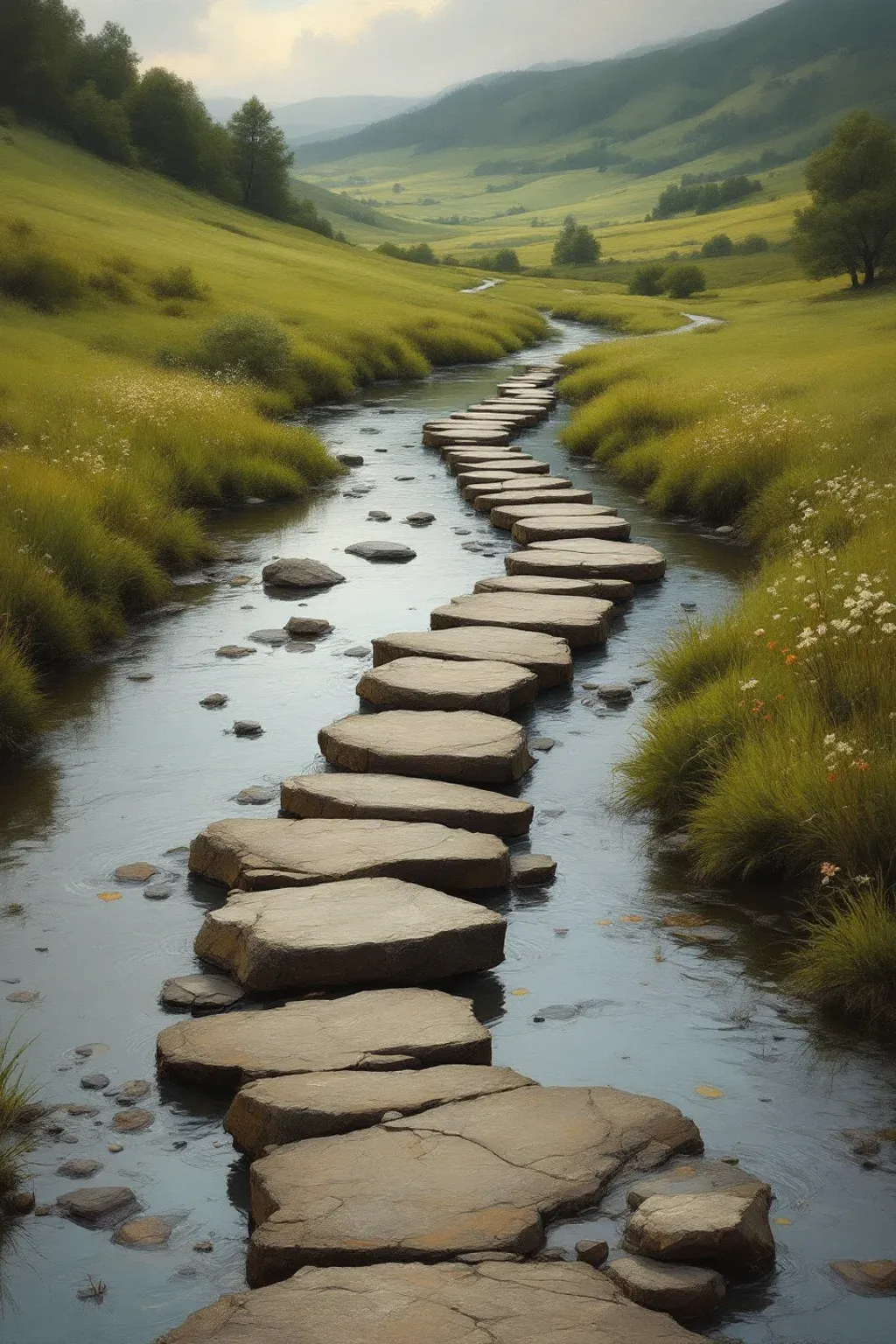
Lip Ford
The crossing where the water makes a mouth, caught mid-word.
At a glance
- Kingdom I (The First Word)
There is a place on the Greenway Road where the water can't help itself. It comes down out of the low country shallow and unhurried, and where it crosses the road it splits around two banks that mirror each other so cleanly they might have been cut to match — one curving up, one curving down, the near lip and the far lip closing toward a middle that never quite touches. Stand on the road and look at it head-on and there's no unseeing what the locals see: a mouth. Open. Caught in the exact instant before it says a word it never gets around to saying.
That's Lip Ford. A crossing named for the shape of its own crossing, which is about as Uttermost Rest a thing as the vale has ever done — and Lip Ford sits close enough to that village to have caught the habit. Everything here means to finish a sentence and then doesn't.
The name is written down, more or less. Someone long ago set a stone marker at the water's edge and chiseled onto it the word for the shape the banks make, so travelers would know they'd arrived somewhere and not just at more river. The word is still there. Two of its letters are not — weather, or spray, or the slow sanding a river gives anything foolish enough to stand beside it for a few hundred years. What's left reads M · U · H, and the vale, characteristically, offers no help filling in the rest. The banks make the shape. The shape is the answer. If you can't read a mouth off a marker that's shaped like one, the vale figures, that's between you and your eyes.
It's a gentle crossing, for all its theatrics — shallow enough to wade without soaking a pack, the current more suggestion than threat. Which is more than can be said for some of what waits past it. Come across from the east and Lip Ford is the last easy thing before the village; leave the village heading east and it's the first, a soft goodbye before the road remembers it's a road.
On the eastern bank sits a milestone, low and worn and just the right height to rest a tired body on. It is not, strictly, furniture. But it's used as furniture often enough that the game will introduce you to someone using it exactly that way — an older traveler with the dust of Uttermost Rest still on her coat and boots mended in three colors of twine, watching the road with the patience of a person who has seen a great many people make a great many wrong choices at this very water. The Old Woman on the Path is the first real face the road gives you, and Lip Ford is where it gives her. What you decide to do at this milestone is, quietly, the first thing the game ever teaches you about itself.
You may also pass a surveyor here, a knot-rope-and-brass-pins sort of man counting his strides in a low chant, muttering darkly about "creeping miles" and "shifting milestones" as though the vale's very distances had gotten as loose and unreliable as its spelling. He does not stop. Men like that rarely do. But he's right about one thing without knowing it: nothing in this stretch of country stays fully fixed. The words slip their letters, the signs lose their nerve, the milestones — if you believe him — go for the occasional walk.
Half a mile on, Sounding Hill rises over the treeline and hands your own voice back to you, and warmer than either of them, back toward the village center, the fire at The Hearthmark is still lit. But you cross Lip Ford first. Everyone does. Stop at the mouth in the water, decide what kind of traveler you're going to be, and go on. The river isn't going to finish the thought for you.
Where you'll find it
Lip Ford is the river crossing on the eastern edge of the Greenway Road, in your very first hour with the game — the last shallow water before Uttermost Rest if you come in from the east, and the first thing you'll splash through leaving the village if you go the other way. You cross it early in Kingdom I (The First Word). Sit on the milestone at the eastern bank a moment before you wade in; someone tends to be waiting there.