The Chronicle of Epic Words
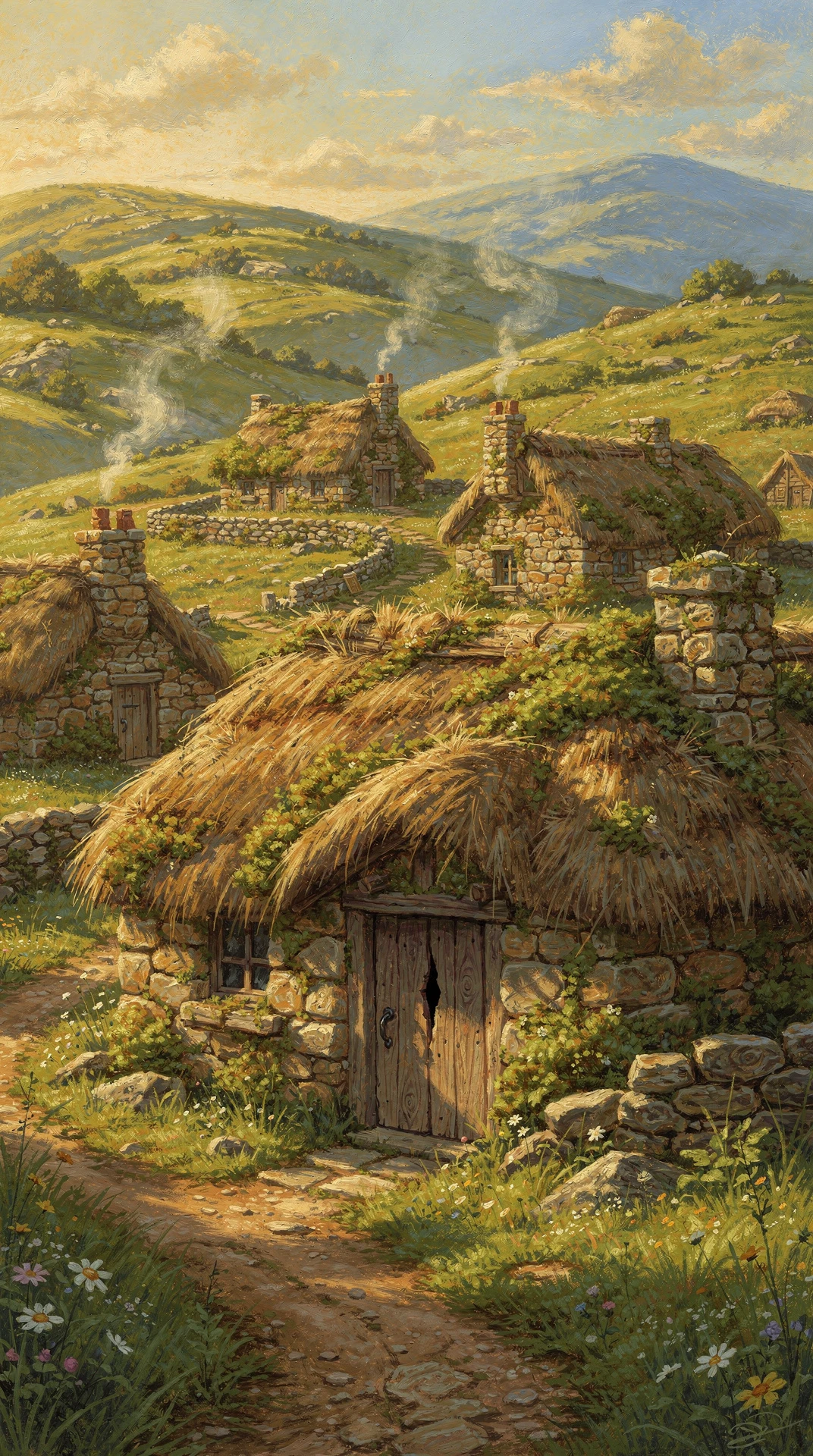
Uttermost Rest
The oldest word in the vale, and half of it worn away.
At a glance
- Kingdom I (The First Word)
Every village has an oldest building. Uttermost Rest is one — the oldest in the vale, by every account anyone still bothers to give — and it wears the fact the way an old dog wears a limp: openly, expecting you to make allowances. You'll feel it in the first ten minutes, in the hush of a place that's been standing quietly for longer than it's been doing anything else.
Start at the door, because everyone does. The oldest door in Uttermost Rest still wears one carved word above the lintel — or wore one, once. Two of its letters have weathered to nothing, sanded away by however many generations of rain the vale has managed since somebody first picked up a chisel. The house knows what it used to say. It isn't telling. Ask a local and you'll get three answers and a shrug — either the vale's idea of a joke or its idea of history, and here it's hard to tell the two apart.
The door isn't the only casualty. Walk the lanes and you'll find a hand-lettered sign near the fringe of the woods, warning passersby in a hand that ran out of something before it ran out of wall: BEWAR THE BOR — DO NOT ENTRE. Whoever painted it lost the daylight, or lost the alphabet, and never came back to finish the job. A village that can't keep hold of its own words probably shouldn't be trusted to spell boar correctly either — and at least it's upfront about that.
The warning isn't idle. Somewhere on the track between Sounding Hill and the western fringe, in a woodcutter's lean-to nobody's bothered to tear down, something large and bristled has taken up residence with strong opinions about visitors. Most travelers give it a wide berth on the strength of the sign alone — more credit than the sign's spelling probably deserves.
Follow the road the other way and you'll cross Lip Ford, where the water splits around two mirrored banks that curve together like a mouth caught mid-word — the vale's small, unbothered joke at its own expense, repeated in stone and current since long before anyone was around to appreciate it. It's shallow enough to cross without much fuss, which is more than can be said for what waits on the far side.
That would be The Last Silence — a ruined speaking-circle a short walk out of the village, where a low tone hums from no visible source and sets travelers' teeth on edge without ever quite explaining why. Nearby stands a crossroads signpost of remarkably little help, its arms pointing with total confidence in directions that never resolve into an actual decision. Visit once, out of curiosity. Don't linger.
Warmer company waits back toward the center, at The Hearthmark — an inn that still knows how to hold a fire and pour a drink, one of the few businesses here that hasn't quietly given up the ghost. The lane from its door toward The Last Silence starts confidently enough, then loses its nerve a hundred yards out — narrowing, wandering, becoming less a road than a suggestion of where one used to be.
Closer in sits Aldren's Rest, a stable that was, within living memory, a proper coaching inn — fresh horses, a full larder, a sign that said so. The sign still says so, mostly: the final letter has flaked clean off, and it now reads, with unintended honesty, ALDREN'S RES. A man can still get a bed there. He can also, on a bad night, get locked out of it, which tells you most of what you need to know about how carefully the place is run.
Once, this was a village that mattered. The Vale Road carried the Crown's daily patrols through here, back when the kingdom checked in on its far edge. Calligrapher's Green, on the outskirts, cut keys and bound books for half the vale — real trades, real guilds, real reasons for a stranger to ride in with coin. That was a long time ago, and the vale, by its own quiet admission, "used to matter more than it does now." What's left isn't ruin. It's just late — a village that missed its moment and kept living anyway, one weathered sign at a time.
It has produced, at least, one export worth mentioning: Pell the Courier grew up on these lanes before the Duke's service carried him further afield, and it's the dust of Uttermost Rest that Mara the Healer still carries on her coat, long roads later. The village doesn't ask for credit. It rarely finishes asking for anything.
Where you'll find it
Uttermost Rest is the first proper village on the Greenway Road, in your very first hour with the game — the place you'll pass through, and likely pass back through, before the road opens up into the rest of Kingdom I (The First Word). Come in from the east and you'll cross Lip Ford first; come in from the west and you'll walk past the old lean-to below Sounding Hill. Either way, you'll know you've arrived by the signage. Nothing in this village finishes its own sentence.