The Chronicle of Epic Words
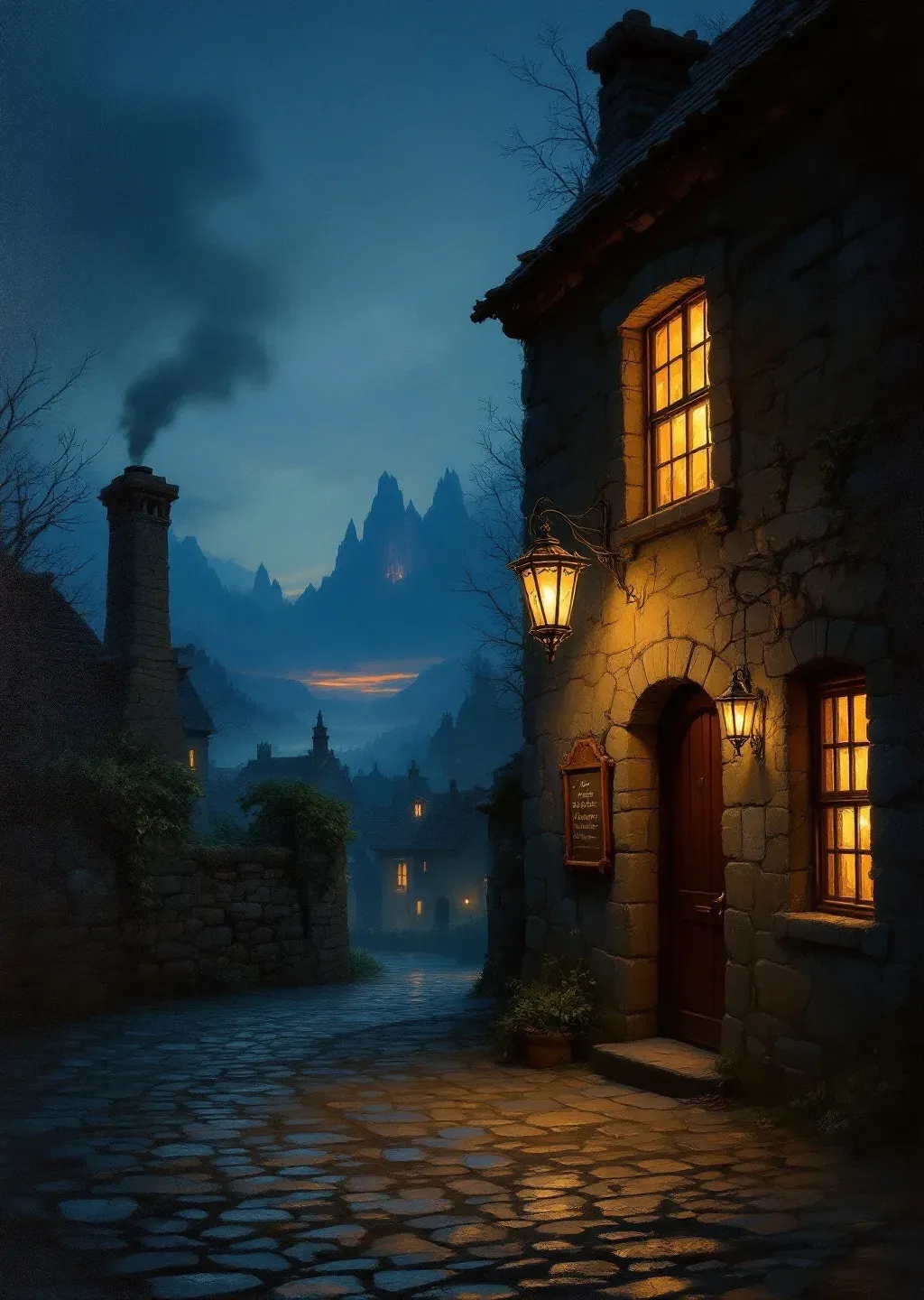
The Standing Ink
A tavern where nothing written ever quite fades — and one thing, against every local law, has faded anyway.
At a glance
- Kingdom XVI (The Quill Chamber)
Every town has a building that has stopped bothering to pretend it is anything but what it is. In Nib's Point that building is the Standing Ink, and what it is — under the taps, under the smell of spilled beer and cellar damp — is a place where nothing written ever quite fades. Ink outlasts the paper it's set on here. Occasionally, and to the visible irritation of the man who has to wipe it, it outlasts the table the paper was set on too. The whole town shares the trait, but the Standing Ink is where you'll feel it hardest, because the Standing Ink is where the town keeps its record of itself.
It is, on the face of it, a tavern. You can get a room, a stiff drink, and a meal you didn't ask about the provenance of. But the front room is not the point of the place, and everyone who comes twice knows it. The point is the back room, and the back room is not a pawnshop, whatever it looks like — Holt will walk you through the whole moral distinction if you give him the opening, and he will find the opening. A pawnbroker sells things back. The Standing Ink holds them. Nothing here is quite bought and nothing quite sold. Things are taken in, noted, and waited on, until the day a stranger walks through the door carrying the matching half of an old grief and the trade squares itself.
What waits back there is less inventory than museum: a lute strung with nothing, a wedding ring in a jar labeled only RECONSIDER, a stack of letters no one ever came back for. It is a catalogue of other people's worst weeks, and it is organized by no system anyone has managed to name — not date, not value, not kind. Things simply sit near other things, the way old grief sits near old grief. Holt could explain the arrangement if you asked. It would take all night, and he would enjoy every minute of the telling.
Trade runs on the town's one iron principle. Bring the Standing Ink a foreign thing — a piece that isn't yours, picked up somewhere down the road — and if Holt holds its twin, he'll make an even swap and call it sentimental value, then admit the sentiment was get it out of my cellar. If you've nothing of his to trade, he shrugs and wraps the piece back up — and, if the night's slow and he's taken to you, may pour you a drink you didn't order and forget to charge for it, either plain generosity or an opening move, and with this house it is genuinely hard to say.
Gossip and unclaimed goods loop quietly between the Standing Ink and the Pressed Petal, the bar Rowan keeps some kingdoms off in the Letter Garden. One flow of talk, one flow of objects, carried the long way between them by whoever's travelling — a favor never fully settled, and neither party willing to admit who started it. Ask either of them and you'll get two shrugs so identical you'd think they'd been rehearsed. They have not. They've simply been at it long enough that the question no longer has an answer, only a habit.
And then there is the ledger, open on the bar, which is the real reason a stranger should ever cross this threshold. Everything is in it — every trade, every debtor, every home village, every scrupulously fair valuation — set down in one steady hand across three decades. One man did write the whole thing, and he trusts the book further than his own excellent memory, precisely because a memory can be talked round on a slow night and a book cannot. Save that on one line, dated to the year Holt's father handed him the taps, where a pawner's name should sit there is nothing. Not a blot. Not a tear. A clean, deliberate absence the exact width a name would take — an erasure, in the one house on the map where ink is famous for refusing to leave. Holt doesn't know what he's looking at. You might. And it is the first such wrongness in this whole long business that anyone can put a year to.
Where you'll find it
The Standing Ink is the taverner's house at the heart of Nib's Point, in Kingdom XVI (The Quill Chamber), deep in the crystal zone. You'll come to it, more often than not, by way of a note passed rather than spoken — telling you a keeper here holds a back room full of foreign, unclaimed things, waiting on someone with the matching emblem. Follow the chalked well-post at the village center and you'll find the door: low, dark, and smelling of old iron and older beer. Behind the bar, Holt will already be weighing whatever you're carrying like produce he hasn't decided to trust.