The Chronicle of Epic Words
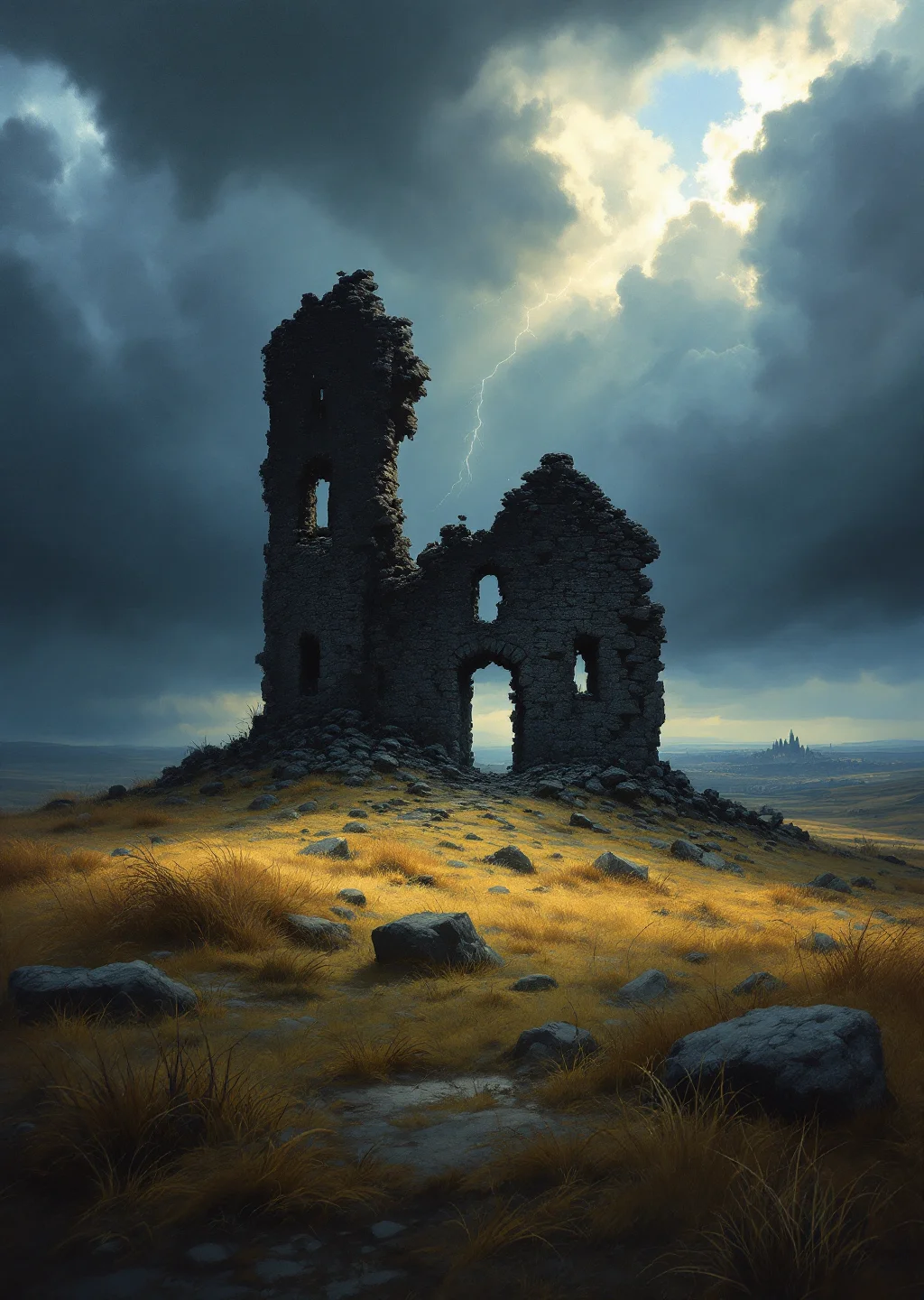
Squall Barrow
A ruin struck too often to rebuild, kept as an archive of what the storms took.
At a glance
- Kingdom XXV (The Storm of Syllables)
Squall Barrow has been struck by lightning so many times that the people who once lived near it gave up on the ordinary sequence of loss and repair. There is a point past which you stop rebuilding a thing and start keeping track of it instead, and Squall Barrow crossed that point long enough ago that nobody remembers it as anything but a ruin. What stands now is low, blackened, and honest about its condition — half-walls, broken windows, a doorway that frames weather rather than keeping it out. The barrow does not pretend to be a building. It has settled comfortably into being a record.
The record has a keeper. Serafine the Recordkeeper has made herself the entire archive of Squall Barrow, and her subject is not the storms but their leavings — the specific, catalogued absences the weather takes and never returns. Walk the shelves and you'll read her small, exact hand on labels attached to things that have outlived their purpose: a hinge with no door, a bell with no clapper, a name-plate scoured past reading. She catalogues absences the way other people catalogue possessions, with the same care and none of the sentiment. If something was lost near here, Serafine has a place for the shape of it.
She meets visitors in the doorway, usually holding an iron-banded box she keeps sealed and carries a little too carefully. What's in it is not, in the ordinary sense, hers to say. Squall Barrow is one of those places in the vale where the important thing is the thing that stays shut — a sealed door, a box that won't be named, a sentence that gets started and then, deliberately, doesn't get finished. Travelers who arrive expecting the barrow to explain itself tend to leave disappointed. Travelers who can sit in a half-roofed ruin with an unfinished sentence and not demand it be finished tend to leave having passed a test they didn't know they were taking.
For all its gravity, the barrow is not a solemn place to everyone. Children treat its charcoal walls as the only paper large enough for the drawings they have in mind, and they've named its worst habit affectionately — the squalling, that thin keening the wind pulls out of the broken glass, which they rank as the ruin's second-favorite pastime, right after being struck by lightning. It is the kind of joke a place earns only by having survived the thing it's joking about.
Squall Barrow belongs to a kingdom that is honest about being loud. Down the road, Gale Landing has replaced its welcome sign so many times — it's on the fourth one now — that the town has made its open peace with repetition, the way the barrow has made its peace with ruin. Even wanderers who belong to gentler kingdoms find their way here when the weather turns interesting; Thistle has been spotted at the flooded stair-foot of the local spire, cheerfully wetter than the storm strictly required, declaring that she likes a kingdom where everything is honest about being loud.
You will not leave Squall Barrow with the box open. That is the point of it. You'll leave with it still sealed and Serafine still sorting the storm's unclaimed things — a door that stayed shut, on purpose, for reasons that are hers to keep a while longer.
Where you'll find it
Squall Barrow sits out past the storm-battered streets of Kingdom XXV (The Storm of Syllables), a ruin the weather kept and the town gave up on. You'll come to it the way most travelers do — following the noise. When the wind finds the ruin's broken windows it makes a sound the local children call squalling, and you can hear it long before you can see the low charcoal walls. Step in through what used to be a doorway and you'll likely find Serafine the Recordkeeper already there, holding a box she does not immediately explain.