The Chronicle of Epic Words
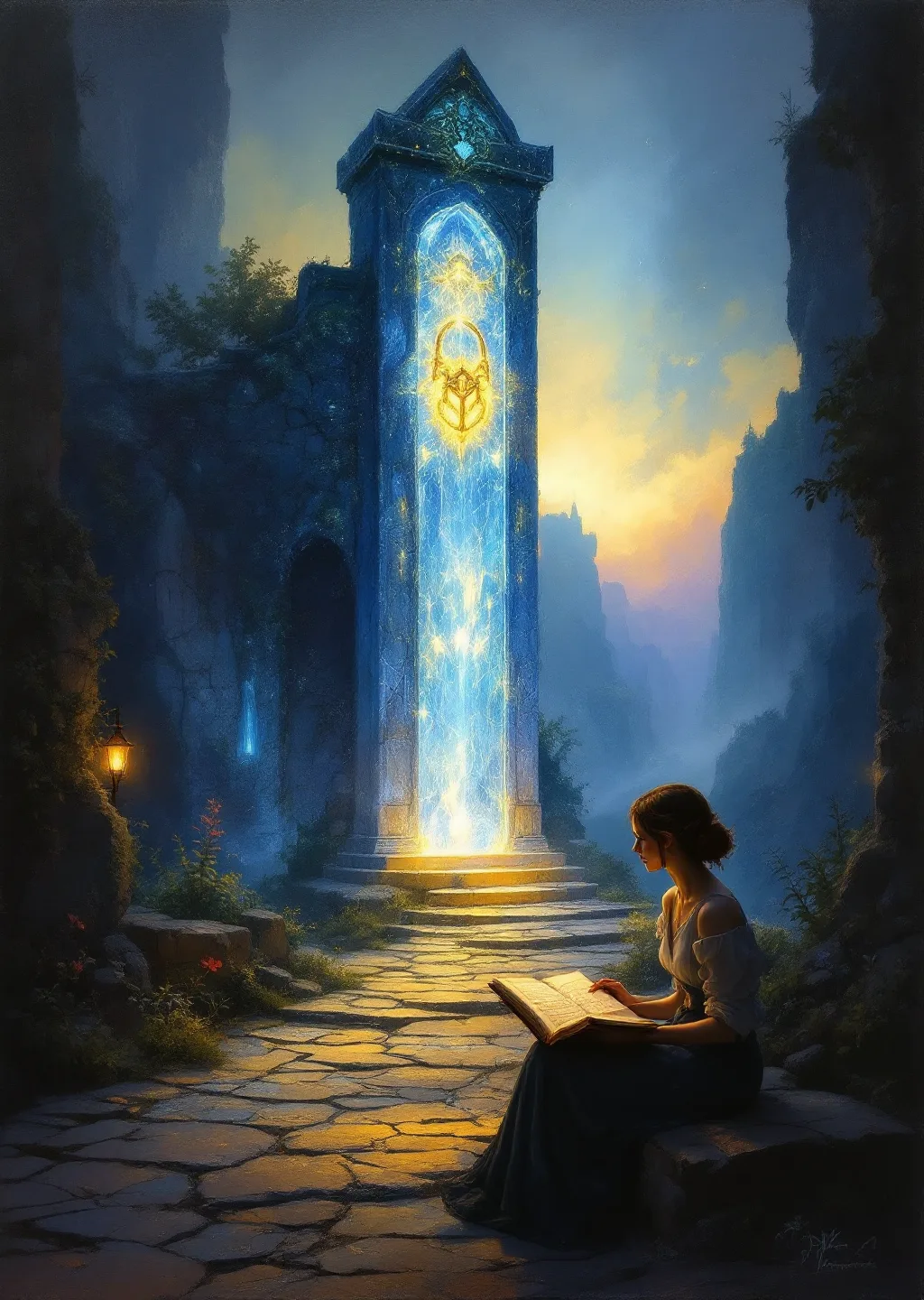
Clasp Gate
The gate that takes no coin — only one true thing about yourself.
At a glance
- Kingdom XIV (The Binding Thread)
Every kingdom has its toll. Most of them want coin. Clasp Gate wants something harder to counterfeit.
It stands at the end of the road through Kingdom XIV, a single crystal gate that opens on a mechanism nobody living installed and nobody living fully trusts. The locals will tell you — flatly, the way you tell a thing that's stopped frightening you — that it has shut mid-crossing three times, and that two of the three travelers caught inside it were fine. They say the second part quickly, and they never quite specify the first. The gate keeps its own counsel. Worked into the mechanism, in letters only legible when it's shut, is a riddle it apparently poses to itself: I close without asking, and open the same way. A latch, in other words, with a shockingly consistent success rate and no interest at all in explaining the exceptions.
You do not cross Clasp Gate by paying it. You cross it by satisfying Vesla, who keeps it, and who has kept it longer than most of the surrounding villages have kept accurate records. Precise, unhurried, underestimated for a lifetime by people who mistake precision for smallness, she sits with a ledger open on the stone sill — not a toll-book, you'll realize later, but something closer to a confession-book that nobody's told is one. "Passage costs one true thing," she says. "About yourself. I'll know if you're lying, and so, I suspect, will the gate." Give her the version you'd tell a stranger at an inn and you'll wait. Give her the other one — the real reason you're on this road — and the gate exhales, once, and stands open. That'll do, she'll say, and mean it.
Past the gate is the reason to come at all. Vesla's archive holds a muster-song two centuries old, sung so long that nobody remembers why — its refrain naming an old house, worn soft at the edges by handling voices until two of its sounds went missing entirely, like pegs left behind at a Wardmoot. Fill the gap and the word settles itself the way a held breath finally lets go, and somewhere in the stacks a much older piece of paper agrees with you. The house is Morvaine, Vesla's grandmother's house — one that, she'll tell you without much weight, once paid a bell-founder's guild to keep it remembered, back when it had a name worth the fee. "Two centuries," she says, closing the muster-book gently, the way people close books they intend to reopen. "And the tune outlasted the paperwork."
Clasp Gate is not the kind of place you conquer. It's the kind you're briefly, uncomfortably honest at, and then allowed through. That reputation travels: when institutions elsewhere in the realm fall to quarreling over things with real teeth — the way Coll later brokers a paper-truce among the feuding lexicographers and surveyors of the Morpheme Depths, with Tessaly tracing family-names through the argument — it is Vesla they summon from Clasp Gate to witness it, as the region's most trusted neutral hand. She goes, watches the ink dry on a jointly signed appendix that concedes nothing, and offers the only benediction such things earn: Institutions rarely apologize. They just eventually agree on the wording. It's not nothing.
She keeps her private grievances the same way she keeps her archive — precisely, and off the page. Ask about the sharp-eyed boy who once kept her ledger three winters — the best hand she ever had for finding what a page was missing, until a better offer took him elsewhere — and you'll get a professional grievance where a personal one plainly lives. The gate, at least, never pretends. It closes without asking, and opens the same way, and asks only that you do it the courtesy of meaning what you say.
Where you'll find it
Clasp Gate is the last crossing on the road through Kingdom XIV (The Binding Thread), out past Threadneedle, the Loomed Word, the six pillars of the Binding Posts, and the glittering wreck of Caught Hollow. You'll reach it late in the kingdom, when the path narrows to a single crystal gate and a woman with a ledger who does not want your gold. Come with something true to say — the gate opens for those, and only sometimes for those.