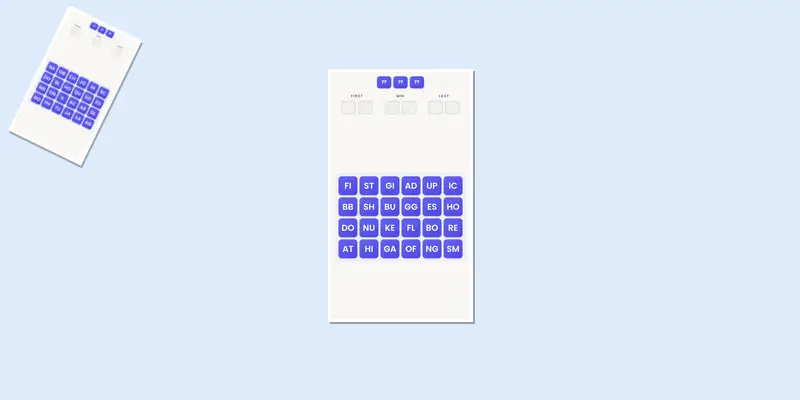
Pairdle is a daily word puzzle where you place letter pairs — two letters at a time — to decode a hidden word. If you've been playing for a few days, you've probably solved the Standard puzzle once or twice. Maybe you've hit a wall and want to understand the patterns behind it.
As one App Store reviewer put it: "It was more challenging than expected (in a good way), so that was a great surprise." — KLead4D
That challenge is the point. And the good news is that Pairdle is a logic game, not a vocabulary test. Getting better is about sharpening your thinking, not memorizing more words.
Good news: Pairdle is a logic game, not a vocabulary test. That means getting better is about sharpening your thinking, not memorizing more words. Here are five strategies we use internally — yes, even the people who built the game need strategies.
1. Stop Trying to Spell Words on Your First Guess
This is the most common mistake new players make, and it comes from Wordle habits.
In Wordle, your first guess should be a real word with common letters — something like CRANE or SLATE. In Pairdle, your first guess should be an experiment, not an answer.
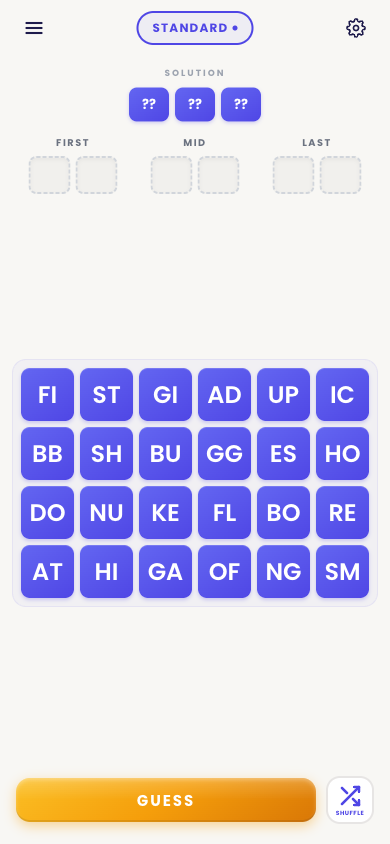
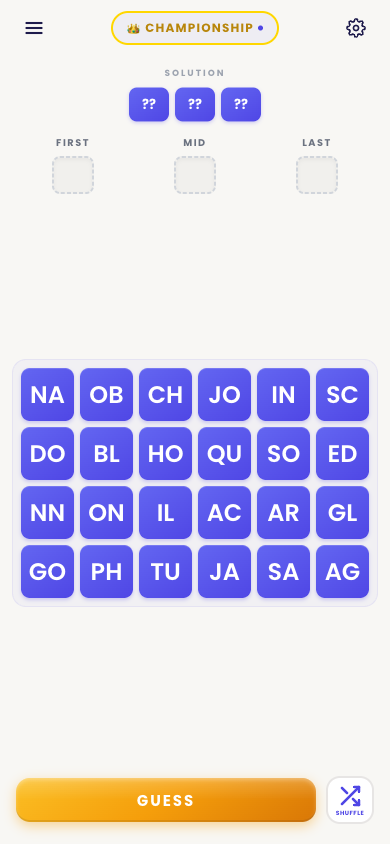
You have 24 letter pairs in the grid. Only 3 of them form the secret word. Your first guess should test which pairs are in the word and which aren't. Pick three pairs that look plausible, place them anywhere, and hit submit.
You're not trying to solve the puzzle on guess one. You're trying to gather information.
Think of it this way: A scientist doesn't walk into the lab expecting to discover the answer on experiment one. They design an experiment to narrow down the possibilities. Your first Pairdle guess is experiment one.
If you've been playing Wordle for two years, some of these instincts will actually work against you — and that's completely normal. Wordle rewards vocabulary recall. Pairdle rewards deduction.
2. Learn to Read Position Patterns
This is where Pairdle starts feeling like Sudoku.
Certain letter pairs almost always appear in specific positions in English words:
Common START pairs: CH, BE, CO, RE, DE, MA, BA, PR, ST, TR
Common END pairs: EN, ER, ED, LE, AL, NG, LY, ES, NT, TH
Common MID pairs: RR, LL, MM, AT, AN, AR, OR, IT
You don't need to memorize these lists. After a week of playing, your brain starts recognizing the patterns automatically. But being aware that position patterns exist gives you a head start.
For example: if RR shows up as yellow in the START column, you know immediately it belongs in MID or END — and since RR almost never ends a word, it's probably MID. That's one pair placed with pure logic, no guessing required.
3. Use Gray Pairs as Your Best Weapon
New players focus on greens and yellows. Experienced players focus on grays.
Every gray pair eliminates one option from the grid permanently. After your first guess, you've typically eliminated 3 pairs. After your second guess, you might have eliminated 5-6. That means the 24-pair grid has shrunk to 18 or fewer options.
Here's the key insight: you don't need to identify which pairs ARE in the word. You need to eliminate which pairs AREN'T. Once enough pairs are grayed out, the remaining options become obvious.
This is the same logic that makes Sudoku work. You don't guess numbers — you eliminate impossibilities until only one answer remains.
4. Work Backwards from Locked Pairs
Once you get a green pair — correct pair, correct column — everything changes.
Say you know EN is locked in the END position (green). Now scan the remaining pairs in the grid and ask: "Which two pairs could sit in START and MID to form a real word ending in EN?"
BA + RR + EN = BARREN?
GA + RD + EN = GARDEN?
HI + DD + EN = HIDDEN?
You're no longer searching blindly. You've reduced the problem from 24 pairs to a handful of candidates that fit with your locked pair. This is especially powerful in Championship mode, where one locked pair can crack the entire puzzle.
5. Play Championship Mode (Yes, Even If It's Hard)
Standard mode teaches you the basics. Challenge mode tests your speed. But Championship mode is where your Pairdle brain actually develops.
Championship puzzles are harder because the letter pairs are less obvious and the decoys are more convincing. You'll fail more. You'll use all six guesses. Sometimes you won't solve it at all.
But here's what happens: after a week of Championship attempts, Standard mode starts feeling easy. The patterns you struggled to see in Championship become automatic in Standard. You're training your pattern recognition at a higher difficulty, and it pays off everywhere.
Tim Nye, the founder of Logic Loft Games, plays Championship mode every morning. He doesn't always solve it. He says that's the point.
"If I can always solve it, the puzzle isn't hard enough. Championship mode is supposed to humble you sometimes."
6. Track Your Two-Guess Hypothesis
This is how you measure real improvement. Track how often you have a strong hypothesis after just two guesses.
After guess one, you have raw data — some greens, yellows, and grays. After guess two, you should have a theory about the word. If you find yourself guessing randomly on guess three, you're not using the information from your first two guesses effectively.
The best Pairdle players can often state the answer confidently after two guesses. They might not submit it until guess three (to confirm), but the deduction is already done.
That's the goal: not fewer guesses, but faster understanding.
Ready to Practice?
Today's puzzle is waiting for you at logicloftgames.com/pairdle. Try applying just one of these strategies and see if it changes how you think about the grid.
And if you solve Championship in three guesses or fewer, come find us on X @LogicLoftGames — we want to hear about it.
New to Pairdle? Start with our How to Play guide to learn the basics.