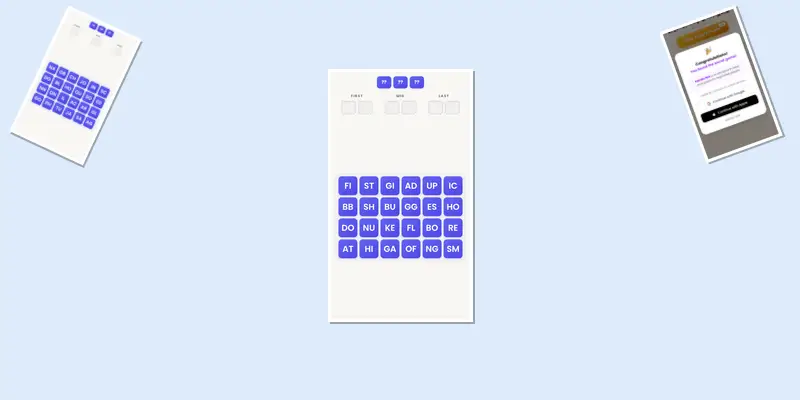
If you've ever felt like Wordle was more luck than logic — guessing words and hoping for greens — you're not alone. That frustration is exactly where Pairdle started.
Every game has an origin story. Most of them start with "I was bored" or "I had an idea in the shower." Ours starts in a Harvard lecture hall.
The Spark: CS50 and a Final Project Called Pairagrams
Tim Nye, the founder of Logic Loft Games, didn't follow a straight line into game development. He earned a biology degree at Harvard Extension School, spent a year at Oxford researching longevity and drug discovery, and built a career as a serial entrepreneur. But programming was always in the background — literally since 1980, when he got his hands on a Vic-20.
Decades later, Tim enrolled in Harvard's legendary CS50 course. If you've taken it, you know the final project is a big deal. You're expected to build something real. Tim's project was a word game prototype called Pairagrams — and it planted a seed that would eventually grow into everything Logic Loft Games builds today.
"The idea was simple: what if a word game tested your logic instead of your vocabulary?"
The Core Insight: Words as Pairs, Not Letters
Most word games ask you to think about individual letters. Wordle gives you five blanks and says "guess a word." Scrabble dumps tiles in your lap. These games reward knowing obscure words.
Pairdle flips that on its head.
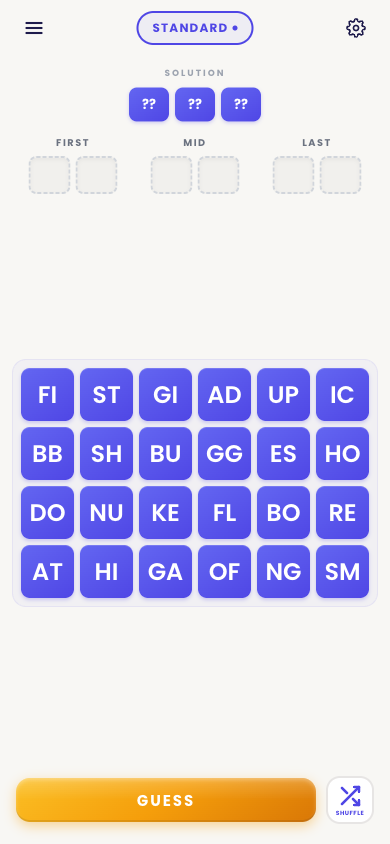
Instead of guessing one letter at a time, Pairdle splits a six-letter word into three pairs of two letters. You're given 24 letter pairs — only three of which form the secret word — and your job is to figure out which pairs go where: START, MID, or END.
Tim calls it "Word Sudoku." The answer is always on the screen in front of you. You don't need a massive vocabulary. You need pattern recognition, position logic, and the ability to eliminate possibilities through deduction.
Why Pairs Change Everything
When you read normally, your brain processes words in chunks — you don't actually see individual letters. Pairdle forces you to think about those chunks consciously.
Consider the word BARREN. In Pairdle, it becomes three pairs: BA, RR, and EN. You know that EN almost never starts a word. RR doesn't either. BA is a natural starter. That's not vocabulary knowledge — that's pattern logic.
The color feedback works like Wordle but for pairs:
-
Green means the pair is correct and in the right column
-
Yellow means the pair is in the word but in the wrong column
-
Gray means the pair isn't in the word at all
By your second or third guess, gray pairs have been eliminated from the grid, yellow pairs narrow the possibilities, and the answer often clicks into place through pure deduction. That "click" — the moment your brain sees the pattern — is what makes Pairdle different from every other word game.
From Prototype to Daily Habit
Pairagrams was a final project. Pairdle is what happened when we asked: "What if we made this into something people played every day?"
We launched Pairdle in February 2026 with a simple premise: one new puzzle every day, three difficulty levels, and a clean interface that works on your phone, tablet, or desktop.
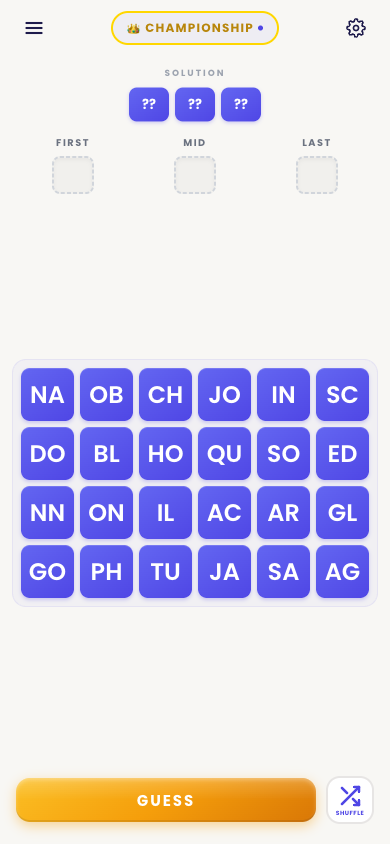
Standard mode gives you a six-letter word — accessible, solvable by almost anyone in four guesses or fewer. Challenge mode tightens the constraints. And Championship mode is what Tim calls the "black diamond" — puzzles so tricky that even the person who designed the game gets stumped.
Then we added Pairdle Pro: eight-letter words, more pairs, deeper deduction. It's for the players who solved Standard in two guesses and needed something harder.
The "Aha!" Moment We're Chasing
Every puzzle game lives or dies by one thing: the moment of discovery.
In Wordle, that moment is when you guess the right word. In Sudoku, it's when you place the last number. In Pairdle, it's something slightly different — it's the moment when the fog clears and you realize you've cornered the solution through logic alone.
You didn't guess. You didn't get lucky. You deduced the answer. That feeling is what gets people coming back.
"The best 'Aha!' moment isn't remembering a word. It's realizing you cornered the solution through pure deduction."
Don't just take our word for it. Here's what players are saying:
"I like this fresh new take on word games. Easy to place and a good brain challenge!" — Sdreader12, App Store
"This is my new favorite! It was more challenging than expected (in a good way), so that was a great surprise. Bravo to the dev team." — KLead4D, App Store
What's Next
Pairdle is live on the web at logicloftgames.com/pairdle, and available on the App Store and Google Play. We release a new puzzle every day at midnight Pacific.
We're also building more games at Logic Loft — all rooted in the same philosophy: pattern recognition over memorization, logic over luck. Our next game, Epic Words, takes fragment-based word building in a completely different direction.
But Pairdle will always be the one that started it all. A CS50 final project that refused to stay finished.
By Tim Nye, founder of Logic Loft Games. Tim earned a biology degree at Harvard Extension School, spent a year researching at Oxford, and has been writing code since getting his hands on a Vic-20 in 1980. Pairdle is his answer to the question: what if word games tested logic instead of vocabulary?
Pairdle is free to play. No paywalls. Just a daily puzzle and your brain.