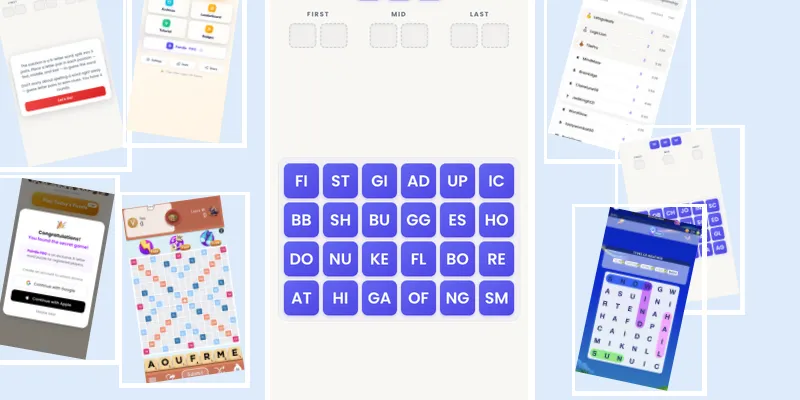
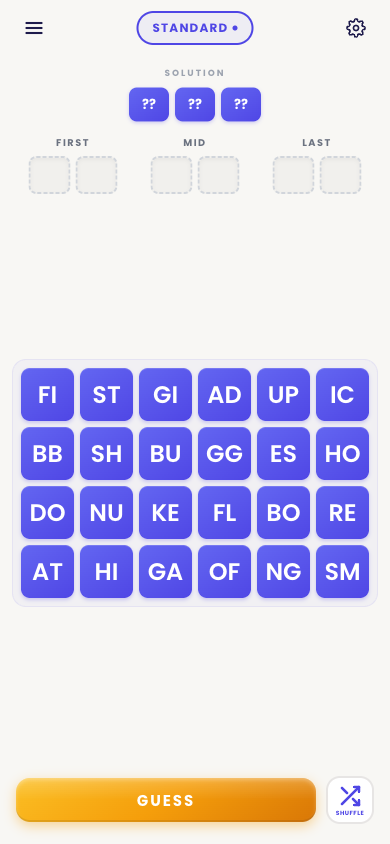
If you've ever played Pairdle, you've stared at a grid of two-letter pairs and tried to spot which ones form a word. Some combinations jump out immediately — TH, ER, IN — while others look completely foreign. Why?
It turns out that English has strong preferences for certain letter pairings, and understanding those preferences makes you better at word games, crosswords, Scrabble, and yes, Pairdle.
We analyzed our word database of six-letter English words to find the most (and least) common letter pairs. Here's what we found.
The 20 Most Common Two-Letter Pairs in Six-Letter Words
These pairs show up again and again across thousands of English words:
| Rank | Pair | Example Words | Position Tendency |
|---|---|---|---|
| 1 | TH | THIRST, MOTHER, GROWTH | Start or Mid |
| 2 | ER | BETTER, ERASER, FINGER | End (most common) |
| 3 | IN | INSIDE, BITING, REMAIN | Start or Mid |
| 4 | AN | ANSWER, CANDLE, BANANA | Mid (most common) |
| 5 | RE | RETURN, DIRECT, FIGURE | Start (most common) |
| 6 | ON | ONDERS, BEYOND, PRISON | Mid or End |
| 7 | EN | ENTERS, HIDDEN, BARREN | End (most common) |
| 8 | AT | ATTACK, MATTER, COMBAT | Mid (most common) |
| 9 | LE | LETTER, MIDDLE, BUNDLE | End (most common) |
| 10 | TE | TEMPLE, BITTER, REMOTE | Mid or End |
| 11 | AL | ALMOST, GLOBAL, SIGNAL | End (most common) |
| 12 | ST | STRONG, MISTER, ALMOST | Start or End |
| 13 | OR | ORIGIN, DOCTOR, MIRROR | Mid (most common) |
| 14 | NG | CHANGE, HUNGER, STRONG | End (almost always) |
| 15 | AR | GARDEN, MARKET, GUITAR | Mid (most common) |
| 16 | IT | ITSELF, BITTER, SPIRIT | Mid (most common) |
| 17 | ED | EDITED, WICKED, FISHED | End (almost always) |
| 18 | OU | DOUBLE, COURSE, MOUNTS | Mid (most common) |
| 19 | ES | ESCAPE, HORSES, DISHES | Start or End |
| 20 | RI | RISING, STRIKE, FABRIC | Start or Mid |
What This Tells Us About English
Endings are predictable
Look at the "Position Tendency" column. An enormous number of the most common pairs land at the END of words: ER, EN, LE, AL, NG, ED, ES. English loves its suffixes. If you're playing any word game and you see one of these pairs, your first instinct should be to test it in the final position.
This isn't a coincidence — it reflects how English builds words. We take root words and add endings: PLAY becomes PLAYER, HIDE becomes HIDDEN, SIGN becomes SIGNAL. Those suffixes create extremely common letter pairs at the end of words.
Starts are distinctive
Start pairs are less common overall but more distinctive. When you see TH, RE, ST, or CH at the beginning of a word, they're almost always starters. Very few English words end with TH in a six-letter context (GROWTH is an exception, not the rule).
This means your START column is often the easiest to fill — starter pairs tend to "look" like starters.
The middle is the wild card
MID pairs are the hardest to predict because English word roots are incredibly varied. AN, AT, AR, OR, IT — these pairs can appear almost anywhere depending on the root word. This is why the middle column in Pairdle is usually the last one you solve.
The Rarest Pairs (And Why They Trip You Up)
Not all letter combinations are created equal. Some pairs are so rare that when they show up in Pairdle, they're almost certainly decoys:
-
XY, ZZ, QU — Extremely rare in the pair grid context
-
JK, WX, ZH — Almost never appear in English words
-
YZ, VX, JQ — You can safely ignore these if they show up
On the flip side, some uncommon-looking pairs appear more often than you'd expect:
-
RR — Shows up in BARREN, MIRROR, BARREL, PARROT
-
LL — Common in FOLLOW, MELLOW, PILLOW, BALLET
-
SS — Found in LESSON, MISSED, FOSSIL,АССIGN
Double-letter pairs are almost always MID pairs. If you see RR, LL, or SS in the grid, test them in the middle column first.
How This Applies to Other Word Games
This letter pair knowledge isn't just useful for Pairdle. It transfers directly to:
Scrabble and Words With Friends: Knowing that ER, EN, and ED are the most common ending pairs helps you spot word extensions on the board. If there's an E on a triple-letter score, think about what pairs could extend backward from it.
Crosswords: When you have two consecutive blank squares, the most common pairs give you a starting hypothesis. If the blanks are at the end of a word, try ER, ED, or LE first.
Wordle and its variants: Understanding which letters commonly appear together helps you choose better starting words. STERN covers ST, TE, ER, and RN — four of the most common pairs in a single guess.
Boggle: Adjacent letter pairs on the board that match common English pairs are much more likely to be part of valid words.
The Takeaway
English isn't random. The language has deep patterns in how letters combine, and those patterns are most visible when you look at two-letter pairs instead of individual letters.
Once you start seeing words as collections of pairs — TH-IN-GS instead of T-H-I-N-G-S — something shifts in how you approach word games. You stop guessing and start recognizing. That's the fundamental skill that Pairdle trains, and it makes every other word game a little easier too.
Want to put your pair knowledge to the test? Play today's Pairdle at logicloftgames.com/pairdle.
For more word game strategy, check out our guide: 5 Strategies to Get Better at Pairdle.